The present study attempts to explore the field of creative music workshops with the elderly. A growing amount of research has been carried out into running (creative) workshops, and besides we know a lot about the elderly and ageing. The aim of this research is to gather knowledge on the merging of both subjects, creative music workshops with the elderly in the so-called ‘fourth age’. In particular, this research project has been carried out as a study of a potential professional field for musicians and music educators. For this reason the research objective is focused on the position of the workshop leader and what is needed to run creative music workshops with elderly in residential homes for the elderly successfully. We therefore aim to explore aspects connected to this practice such as entrepreneurship, musicianship and leadership.
DOCUMENT

INTRODUCTION: Sufficient high quality dietary protein intake is required to prevent or treat sarcopenia in elderly people. Therefore, the intake of specific protein sources as well as their timing of intake are important to improve dietary protein intake in elderly people.OBJECTIVES: to assess the consumption of protein sources as well as the distribution of protein sources over the day in community-dwelling, frail and institutionalized elderly people.METHODS: Habitual dietary intake was evaluated using 2- and 3-day food records collected from various studies involving 739 community-dwelling, 321 frail and 219 institutionalized elderly people.RESULTS: Daily protein intake averaged 71 ± 18 g/day in community-dwelling, 71 ± 20 g/day in frail and 58 ± 16 g/day in institutionalized elderly people and accounted for 16% ± 3%, 16% ± 3% and 17% ± 3% of their energy intake, respectively. Dietary protein intake ranged from 10 to 12 g at breakfast, 15 to 23 g at lunch and 24 to 31 g at dinner contributing together over 80% of daily protein intake. The majority of dietary protein consumed originated from animal sources (≥60%) with meat and dairy as dominant sources. Thus, 40% of the protein intake in community-dwelling, 37% in frail and 29% in institutionalized elderly originated from plant based protein sources with bread as the principle source. Plant based proteins contributed for >50% of protein intake at breakfast and between 34% and 37% at lunch, with bread as the main source. During dinner, >70% of the protein intake originated from animal protein, with meat as the dominant source.CONCLUSION: Daily protein intake in these older populations is mainly (>80%) provided by the three main meals, with most protein consumed during dinner. More than 60% of daily protein intake consumed is of animal origin, with plant based protein sources representing nearly 40% of total protein consumed. During dinner, >70% of the protein intake originated from animal protein, while during breakfast and lunch a large proportion of protein is derived from plant based protein sources.
DOCUMENT

The continuing aging of the population sparked off a public discussion on the extent of state care of elderly people. A historical evaluation of the Dutch system of family care is an essential part in the above discussion, especially regarding options like self-aid and 'mantelzorg'. Using population registers, household stutters of elderly people in the periode 1920-1940 were reconstructed for two different regions in the Netherlands. The most important conclusion of this investigation is that the Dutch elderly were, in most cases, living independently, as head (or wife of the head) of the household in which they were residing.
DOCUMENT
This paper describes the approach used to identify elderly people’s needs and attitudes towards applying ambient sensor systems for monitoring daily activities in the home. As elderly are typically unfamiliar with such ambient technology, interactive tools for explicating sensor monitoring –an interactive dollhouse and iPad applications for displaying live monitored sensor activity data– were developed and used for this study. Furthermore, four studies conducted by occupational therapists with more than 60 elderly participants –including questionnaires (n=41), interviews (n=6), user sessions (n=14) and field studies (n=2)– were conducted. The experiences from these studies suggest that this approach helped to democratically engage the elderly as end-user and identify acceptance issues.
DOCUMENT

The aim of this systematic review was to examine the association between malnutrition and oral health in older people (≥ 60 years of age). A comprehensive systematic literature search was performed in four databases (PubMed, CINAHL, Dentistry and Oral Sciences Source, and Embase) for literature from January 2000 to May 2020. Both observational and intervention studies were screened for eligibility. Two reviewers independently screened the search results to identify potential eligible studies, and assessed the methodological quality of the full-text studies. A total of 3240 potential studies were identified. After judgement for relevance, 10 studies (cross-sectional (n = 9), prospective cohort (n = 1)) met the inclusion criteria. Three studies described malnourished participants as having fewer teeth, or functional (tooth) units (FTUs), compared to well-nourished participants. Four studies reported soft tissue problems in malnourished participants, including red tongue with blisters, and dry or cracked lips. Subjective oral health was the topic in six studies, with poorer oral health and negative self-perception of oral health in malnourished elderly participants. There are associations between (at risk of) malnutrition and oral health in older people, categorized in hard and soft tissue conditions of the mouth, and subjective oral health. Future research should be focused on longitudinal cohort studies with proper determination of malnutrition and oral health assessments, in order to evaluate the actual association between malnutrition and oral health in older people.
DOCUMENT

A Dutch healthcare organisation modernizes its real estate portfolio to meet today’s requirements and acquired an office building for conversion into a nursing home for elderly with dementia. The purpose of the research has been to study the design principles for elderly with dementia, for innovative and smart application in work processes and the acquired building.Methods – Using multiple-method qualitative research design, bachelor thesis students of a university of applied sciences explored the reconstruction of the acquired building and related healthcare processes. Results – Application of design principles for the elderly with dementia were studied, among which were interior design, catering process, and connection with the neighbourhood. Feasible interior ideas were elaborated, intentions for change in the catering process were confirmed by stakeholders, and an action plan for neighbourhood connections was delivered. Elements are being used for a final design. Implementation has to be checked with close scrutiny.Originality – The application of design principles for elderly with dementia (design, favourable state, beautiful moments) together with changes in work processes of health care employees aiming at patient-centred care is a new combination. Practical or social implications – When a healthcare organisation chooses a new care concept, not only the surroundings change. Also, the processes around people and the way we take care of them change. In many ways a new concept can only succeed when the employees and the way they work change as well.
MULTIFILE

In Leading to engage Karolien Dons explores the ways in which musicians and elderly participants of a collaborative music activity experience and contribute to the sense of inclusion. Through qualitative research strategies involving a theory-generating ethnographic exploration of existing practices and a theory-validating case study of one practice, it aims to provide a description and understanding of the phenomenon from the perspective of the diverse participants.
DOCUMENT

In leaving the more traditional territories of the concert performance for broader societal contexts, professional musicians increasingly devise music in closer collaboration with their audience rather than present it on a stage. Although the interest for such forms of devising co-creative musicking within the (elderly) health care sector is growing, the work can be considered relatively new. In terms of research, multiple studies have sought to understand the impact of such work on musicians and participants, however little is known about what underpins the musicians’ actions in these settings. With this study, I sought to address this gap by investigating professional musicians’ emerging practices when devising co-creative musicking with elderly people. Three broad concepts were used as a theoretical background to the study: Theory of Practice, co-creative musicking, and Praxialism. Firstly, I used Theory of Practice to help understand the nature of emerging practices in a wider context of change in the field of music and habitus of musicians and participants. Theory of Practice enabled me to consider a practice as “a routinized type of behaviour which consists of several elements, interconnected to one another: forms of bodily activities, forms of mental activities, ‘things’ and their use, a background knowledge in the form of understanding, know-how, states of emotion, and motivational knowledge” (Reckwitz, 2002, p. 249). Secondly, I drew the knowledge from co-creative musicking, which is a concept I gathered from two existing concepts: co-creation and musicking. Musicking (Small, 1998), which considers music as something we do (including any mode of engagement with music), provided a holistic and inclusive way of looking at participation in music-making. The co-creation paradigm encompasses a view on enterprise that consists of bringing together parties to jointly create an outcome that is meaningful to all (Prahalad & Ramaswamy, 2004; Ramaswamy & Ozcan, 2014). The concept served as a lens to specify the jointness of the musicking and challenge issues of power in the engagement of participants in the creative-productive process. Thirdly, Praxialism considers musicking as an activity that encompasses “musical doers, musical doing, something done and contexts in which the former take place” (Elliott, 1995). Praxialism sets out a vision on music that goes beyond the musical work and includes the meanings and values of those involved (Silverman, Davis & Elliott, 2014). The concept allowed me to examine the work and emerging relationships as a result of devising co-creative musicking from an ethical perspective. Given the subject’s relative newness and rather unexplored status, I examined existing work empirically through an ethnographic approach (Hammersley & Atkinson, 2007). Four cases were selected where data was gathered through episodic interviewing (Flick, 2009) and participant observation. Elements of a constructivist Grounded Theory (Charmaz, 2014) were used for performing an abductive analysis. The analysis included initial coding, focused coding, the use of sensitizing concepts (Blumer 1969 in Hammersley, 2013) and memoing. I wrote a thick description (Geertz, 1973) for each case portraying the work from my personal experience. The descriptions are included in the dissertation as one separate chapter and foreshadow the exposition of the analysis in a next chapter. In-depth study of the creative-productive processes of the cases showed the involvement of multiple co-creative elements, such as a dialogical interaction between musicians and audience. However, participants’ contributions were often adopted implicitly, through the musicians interpreting behaviour and situations. This created a particular power dynamic and challenges as to what extent the negotiation can be considered co-creative. The implicitness of ‘making use’ of another person’s behaviour with the other not (always) being aware of this also triggered an ethical perspective, especially because some of the cases involved participants that were vulnerable. The imbalance in power made me examine the relationship that emerges between musicians and participants. As a result of a closer contact in the co-creative negotiation, I witnessed a contact of a highly personal, sometimes intimate, nature. I recognized elements of two types of connections. One type could be called ‘humanistic’, as a friendship in which there is reciprocal care and interest for the other. The other could be seen as ‘functional’, which means that the relationship is used as a resource for providing input for the creative musicking process. From this angle, I have compared the relationship with that of a relationship of an artist with a muse. After having examined the co-creative and relational sides of the interaction in the four cases, I tuned in to the musicians’ contribution to these processes and relationships. I discovered that their devising in practice consisted of a continuous double balancing act on two axes: one axis considers the other and oneself as its two ends. Another axis concerns the preparedness and unpredictability at its ends. Situated at the intersection of the two axes are the musicians’ intentionality, which is fed by their intentions, values and ethics. The implicitness of the co-creation, the two-sided relationship, the potential vulnerability of participants, and the musicians’ freedom in navigating and negotiation, together, make the devising of co-creative musicking with elderly people an activity that involves ethical challenges that are centred around a tension between prioritizing doing good for the other, associated with a eudaimonic intention, and prioritizing values of the musical art form, resembling a musicianist intention. The results therefore call for a musicianship that involves acting reflectively from an ethical perspective.
DOCUMENT

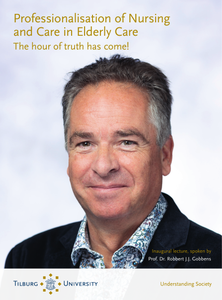
Inaugural lecture, delivered upon public acceptance of the endowed professorship in Professionalisation of Nursing and Care in Elderly Care by Prof. Dr. Robbert J.J. Gobbens at Tilburg University on 29 September 2023.
DOCUMENT
Objective: To predict mortality by disability in a sample of 479 Dutch community-dwelling people aged 75 years or older. Methods: A longitudinal study was carried out using a follow-up of seven years. The Groningen Activity Restriction Scale (GARS), a self-reported questionnaire with good psychometric properties, was used for data collection about total disability, disability in activities in daily living (ADL) and disability in instrumental activities in daily living (IADL). The mortality dates were provided by the municipality of Roosendaal (a city in the Netherlands). For analyses of survival, we used Kaplan–Meier analyses and Cox regression analyses to calculate hazard ratios (HR) with 95% confidence intervals (CI). Results: All three disability variables (total, ADL and IADL) predicted mortality, unadjusted and adjusted for age and gender. The unadjusted HRs for total, ADL and IADL disability were 1.054 (95%-CI: [1.039;1.069]), 1.091 (95%-CI: [1.062;1.121]) and 1.106 (95%-CI: [1.077;1.135]) with p-values <0.001, respectively. The AUCs were <0.7, ranging from 0.630 (ADL) to 0.668 (IADL). Multivariate analyses including all 18 disability items revealed that only “Do the shopping” predicted mortality. In addition, multivariate analyses focusing on 11 ADL items and 7 IADL items separately showed that only the ADL item “Get around in the house” and the IADL item “Do the shopping” significantly predicted mortality. Conclusion: Disability predicted mortality in a seven years follow-up among Dutch community-dwelling older people. It is important that healthcare professionals are aware of disability at early stages, so they can intervene swiftly, efficiently and effectively, to maintain or enhance the quality of life of older people.
MULTIFILE




