Visual research has historically been productive in foregrounding marginalised voices through photovoice as alternative to the written and oral forms of participation that dominate public participation. Photovoice projects have however been slow to leverage digital and spatial technologies for reworking the method in ways that enable geospatial analysis and collect structured metadata that can be used in workshops to bring different groups together around unpacking urban problems. The Urban Belonging project contributes to this by testing a new application, UB App, in an empirical study of how participants from seven marginalised communities in Copenhagen experience the city, including ethnic minorities, deaf, homeless, physically disabled, mentally vulnerable, LGBTQ+, and expats in Denmark. From a dataset of 1459 geolocated photos, co-interpreted by participants, the project first unpacks community-specific patterns in how the city creates experiences of belonging for different groups. Second, it examines how participants experience places differently, producing multilayered representations of conflicting viewpoints on belonging. The project hereby brings GIS and digital methods capabilities into photovoice and opens new epistemological flexibilities in the method, making it possible to move between; qualitative and quantitative analysis; bottom-up and top-down lenses on data; and demographic and post-demographic ways or organising participation.
DOCUMENT
Getting students to reflect critically is considered hard to achieve. This should be addressed because critical reflection is crucial for students to prepare for their professional lives in a complex world. We examined the research method Photovoice to raise critical reflection in students. Traditionally, this is achieved in a social, reflective process of discussing self-made photos. However, the process of taking photos is performed individually, therefore not fully contributing to critical reflection. In the research presented here, mobile technologies were used in Photovoice assignments to turn photo taking into a social, reflective process of taking and sharing. Students’ general attitude towards this approach was examined, as well as towards specific aspects related to anonymity and influence of and on peers.
DOCUMENT
Door te tuinieren kunnen leerlingen in de buitenlucht hun zintuigen laten prikkelen. Geen klassieke busopstelling in een klaslokaal, maar tussen de planten en insecten op ontdekking gaan. Eerder onderzoek met bewegingssensoren toonde aan dat de leerlingen gemiddeld 28% van de tijd behoorlijk tot zeer actief bewegen en 38% van de tijd licht actief bewegen. Dit illustreert dat de schooltuin kansen biedt voor leerlingen om actief te leren. Maar hoe ervaren leerlingen het leerproces in de schooltuin en wat is hen het meest bijgebleven? Die vraag stond centraal tijdens een photovoice onderzoek op de schooltuin, in het najaar van 2023.
DOCUMENT

Critical reflection, addressing students’ attitude, beliefs and values related to pressing topics in the world, plays a crucial role in developing ethical sensitiveness and critical design literacy in design education. Critical reflection is provoked by discussing self-made photos, as is demonstrated in the research method Photovoice. This paper considers Photovoice in design education for its ability to foster learning through self-guided critical reflective interactions with peers based on self-made photos. Research on how to support this is lacking. This paper addresses this gap by studying students engaging in self-guided Photovoice assignments. Results consist of adapted steps for Photovoice in education and illustrate potential as well as boundaries of self-guided Photovoice through students’ quotes and photomaps. Also, five frames of interpretation, suggested by students engaged in self-guided Photovoice, contribute to previous knowledge and may inspire the design education community to start experimenting with Photovoice in course work. The final aim is to support students in critical reflection, a crucial skill for responsible design professionals.
MULTIFILE

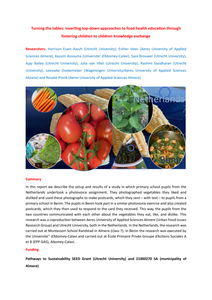
In this report we describe the setup and results of a study in which primary school pupils from the Netherlands undertook a photovoice assignment. They photographed vegetables they liked and disliked and used these photographs to make postcards, which they sent – with text – to pupils from a primary school in Benin. The pupils in Benin took part in a similar photovoice exercise and also created postcards, which they then used to respond to the card they received. This way, the pupils from the two countries communicated with each other about the vegetables they eat, like, and dislike.
DOCUMENT
The online lifeworld gives adolescents various opportunities to meet their developmental needs. Not all young people benefit from these opportunities. They encounter negative experiences, have difficulties fulfilling their needs and engage in risky and harmful behaviours in the online lifeworld. This poses challenges for Dutch youth work professionals, as little is known about the digital lives of Dutch adolescents and the challenges they encounter when meeting their developmental needs in the online lifeworld. In this qualitative study, a photovoice method was used to collect screenshots from adolescents (N = 175) concerning their experiences and needs in the online lifeworld. Six types of developmental needs in the online lifeworld were distinguished. The article concludes that understanding how adolescents use online affordances to fulfil their developmental needs is a starting point for all youth work professionals in providing adequate support to adolescents in the online lifeworld.
DOCUMENT
De nieuwe herindelingsgemeente Midden-Groningen wil leefbaarheids- en welzijnsproblemen binnen dorpen, buurten en wijken stevig aanpakken. Vergeleken met elders in Nederland heerst er onder de inwoners van de gemeente gemiddeld meer armoede en werkloosheid en is er sprake van een lagere levensverwachting en minder kansen. Ook valt er aan de woonomgeving vaak veel te verbeteren (1, 2). Vanuit het Strategisch kader voor het lokaal programma van het Nationaal Programma Groningen (1) heeft de gemeente zich onder andere als doel gesteld om in de verschillende dorpen en wijken gebiedsgericht aan de slag te gaan. Dit geldt zo ook voor Noorderpark: een woonwijk in het noorden van Hoogezand-Sappemeer met ca. 3400 inwoners waar verschillende ruimtelijke en sociaaleconomische problemen in de leefomgeving samenkomen. De gemeente gaat in deze wijk de komende jaren stapsgewijs aan de slag met sociaal ruimtelijke wijkvernieuwing. Het lectoraat Leefomgeving in Transitie (LiT) doet onderzoek naar de relatie tussen mens en veranderende leefomgeving en is vanuit het Kenniscentrum NoorderRuimte van de Hanzehogeschool Groningen bij de wijkvernieuwing betrokken. Dit om van binnen meer inzicht te genereren wat speelt en leeft in de wijk en om inwoners en hun wensen en ideeën op proces en inhoud beter te kunnen betrekken in de planvorming. Onder de paraplu van meerjarig Participatief Actie Onderzoek vindt samen met inwoners op meerdere manieren onderzoek plaats naar hoe zij de leefbaarheid van de wijk ervaren. In het eerste deelonderzoek (5) hebben inwoners met behulp van fotowandelingen hun ervaringen, beelden, ideeën en wensen in beeld gebracht. Het bleek lastig om jongeren hier aan mee te laten doen. Jongeren hebben echter wel hun eigen specifieke behoeften . Daarbij komt dat ze in deze omgeving hun leven vaker een onvoldoende geven dan elders in Nederland (14). Het is daarom van belang om vanuit hun eigen perspectief meer inzicht te krijgen in hoe zij hun woonomgeving ervaren en welke mogelijkheden zij zien voor verbeteringen. Zodat er vanuit de wijkvernieuwing -waar wenselijk en haalbaar- gerichte plannen en acties opgezet kunnen worden die bijdragen aan een prettigere leefomgeving en daarmee ook aan een hoger welzijn voor jongeren. Om meer te weten te komen over wat er onder hen leeft en speelt, gaat dit tweede deelonderzoek in op de groep oudere kinderen -leerlingen uit groep 7 en 8 van de in de wijk gelegen basisschool Het Galjoen – en hun beleving van de leefbaarheid van de wijk. De gedachte hierbij is ook dat door deze groep over hun leefomgeving na te laten denken, zij meer omgevingsbewustzijn krijgen en in de nabije toekomst wellicht meer bereid zijn om mee te doen bij initiatieven in de wijk (bijvoorbeeld vanuit de gemeente of jongerenwerk). De deelnemers hebben in groepjes met polaroidcamera’s foto’s van plekken gemaakt waar ze graag meer over willen zeggen (zoals bijvoorbeeld sport- speel- en ontmoetingsplekken). Zij mochten hierbij zelf bepalen welke onderwerpen en plekken zij belangrijk vonden en naar voren wilden brengen.
DOCUMENT

This paper introduces the open-source Urban Belonging (UB) toolkit, designed to study place attachments through a combined digital, visual and participatory methodology that foregrounds lived experience. The core of the toolkit is the photovoice UB App, which prompts participants to document urban experiences as digital data by taking pictures of the city, annotating them, and reacting to others’ photos. The toolkit also includes an API interface and a set of scripts for converting data into visualizations and elicitation devices. The paper first describes how the app’s design specifications were co-created in a process that brought in voices from different research fields, planners from Gehl Architects, six marginalized communities, and citizen engagement professionals. Their inputs shaped decisions about what data collection the app makes possible, and how it mitigates issues of privacy and visual and spatial literacy to make the app as inclusive as possible. We document how design criteria were translated into app features, and we demonstrate how this opens new empirical opportunities for community engagement through examples of its use in the Urban Belonging project in Copenhagen. While the focus on photo capture animates participants to document experiences in a personal and situated way, metadata such as location and sentiment invites for quali-quantitative analysis of both macro trends and local contexts of people’s experiences. Further, the granularity of data makes both a demographic and post-demographic analysis possible, providing empirical ground for exploring what people have in common in what they photograph and where they walk. And, by inviting participants to react to others’ photos, the app offers a heterogeneous empirical ground, showing us how people see the city differently. We end the paper by discussing remaining challenges in the tool and provide a short guide for using it.
DOCUMENT

The obser-view is a method to generate data and create a learning space for both researcher and participants in qualitative research. It includes reflection between the two after the researcher has observed the participant. This article aims to reveal the benefits and challenges encountered when using the obser-view in two different research projects. In a Dutch project whose aim was to empower residents with dementia, in nursing homes the obser-view was used to generate data and create space for reflection which included residents and the family members. It showed that the obser-view cannot be finished when reflection does not happen. A Danish project with the aim to map the practice for inmates’ opportunities for education and job guidance highlighted that it made participants—educational prison leaders and teachers—aware they were doing their jobs by rote and showed the difficulties the researcher had trying to reflect with some participants. In both projects the obser-view created a learning space for participants. A benefit of the obser-view is that it can be used in dissimilar settings with different research purposes and with vulnerable and stigmatized people often excluded from the research. A challenge is for the researcher to reflect with participants, which is more likely to be successful if they have had time to develop a trusting relationship. Although the obser-view is a novel method in qualitative research, it has proved useful in different settings. It is a valuable method and we recommend developing it further in additional different settings with different populations.
DOCUMENT

Meeting the recommended daily protein intake can be a challenge for community-dwelling older adults (CDOA). In order to understand why, we studied attitudes towards protein-rich products and healthy eating in general; identified needs and preferences, barriers and promotors and knowledge regarding dietary behaviour and implementation of high protein products. Attitudes towards protein-rich products and healthy eating were evaluated in focus groups (study 1, n 17). To gain insights in the needs and preferences of older adults with regard to meals and meal products (study 2, n 30), visual information on eating behaviour was assessed using photovoicing and verified in post-photovoice interviews. In studies 3 and 4, semi-structured interviews were conducted to identify protein consumption-related barriers, opportunities (n 20) and knowledge and communication channels (n 40), respectively. Risk of low protein intake was assessed using ProteinScreener55+ (Pro55+) in studies 2–4 (n 90). Focus groups showed that participants were unaware of potential inadequate dietary protein. Photovoicing showed that sixteen of thirty participants mainly consumed traditional Dutch products. In post-photovoice interviews, participants indicated that they were satisfied with their current eating behaviour. Barriers for adequate use of protein-rich products were ‘lack of knowledge’, ‘resistance to change habits’ and ‘no urge to receive dietary advice’. Promotors were ‘trust in professionals’ and ‘product offers’. Sixty-two percent had a low risk of low protein intake. CDOA feel low urgency to increase protein intake, possibly linked to low knowledge levels. A challenge for professionals would be to motivate older adults to change their eating pattern, to optimise protein intake.
LINK



