This paper presents the results of an evaluation of a technology-supported leisure game for people with dementia in relation to the stimulation of social behavior.
DOCUMENT

As smart solutions for healthcare (eHealth) are becoming increasingly widespread, apps and other digital devices may effectively complement various forms of psychotherapy. We point at children and adolescents in psychological therapy as a yet-underserved public for similar solutions. Moreover, a shared design sensibility between interaction designers, game designers, and therapists is still lacking. The Games 4 Therapy initiative was launched to address this problem space through practical design explorations. We illustrate its design research agenda, we call for more attention to children and adolescents as important recipients of digitally-mediated psychological therapies, and we offer actionable concepts and game design tactics for interaction designers and psychotherapists. Finally, we discuss our findings by "thinking through" a selection of conceptual design explorations, pointing at the characteristics and tactics we identified in our sketches.
LINK
Stormwaters, flowing into storm sewers, are known to significantly increase the annual pollutant loads entering urban receiving waters and this results in significant degradation of the receiving water quality. Knowledge of the characteristics of stormwater pollution enables urban planners to incorporate the most appropriate stormwater management strategies to mitigate the effects of stormwater pollution on downstream receiving waters. This requires detailed information on stormwater quality, such as pollutant types, sediment particle size distributions, and how soluble pollutants and heavy metals attach themselves to sediment particles. This study monitored stormwater pollution levels at over 150 locations throughout the Netherlands. The monitoring has been ongoing for nearly 15 years and a total of 7,652 individual events have been monitored to date. This makes the database the largest stormwater quality database in Europe. The study compared the results to those presented in contemporary international stormwater quality research literature. The study found that the pollution levels at many of the Dutch test sites did not meet the requirements of the European Water Framework Directive (WFD) and Dutch Water Quality Standards. Results of the study are presented and recommendations are made on how to improve water quality with the implementation of Sustainable Urban Drainage Systems (SUDS) devices.
DOCUMENT

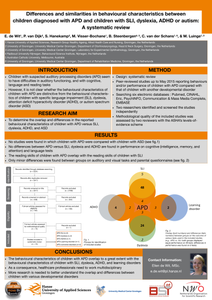
There is still no consensus about the nature of auditory processing disorders (APD). One of the most frequently reported symptoms for APD is difficulties with hearing and listening, especially in the presence of background noise, despite having normal peripheral hearing (ASHA, 2005; Jerger & Musiek, 2000). It is unclear whether there is a behavioral characteristic or whole set of symptoms that is solely attributable to problems with auditory processing. Such a distinctive feature could help audiologists and speech-language pathologists to differentiate APD from other developmental disorders. The purpose of this systematic review is to evaluate the literature on characteristics of children with suspected APD and to determine whether there is a distinctive feature.
DOCUMENT
DOCUMENT
As smart solutions for healthcare (eHealth) are becoming increasingly widespread, apps and other digital devices may effectively complement various forms of psychotherapy. We point at children and adolescents in psychological therapy as a yet-underserved public for similar solutions. Moreover, a shared design sensibility between interaction designers, game designers, and therapists is still lacking. The Games 4 Therapy initiative was launched to address this problem space through practical design explorations. We illustrate its design research agenda, we call for more attention to children and adolescents as important recipients of digitally-mediated psychological therapies, and we offer actionable concepts and game design tactics for interaction designers and psychotherapists. Finally, we discuss our findings by "thinking through" a selection of conceptual design explorations, pointing at the characteristics and tactics we identified in our sketches.
DOCUMENT
BACKGROUND: Although enhancing physical activity (PA) is important to improve physical and/or cognitive recovery, little is known about PA of patients admitted to an inpatient rehabilitation setting. Therefore, this study assessed the quantity, nature and context of inpatients PA admitted to a rehabilitation center. METHODOLOGY/PRINICIPAL FINDINGS: Prospective observational study using accelerometry & behavioral mapping. PA of patients admitted to inpatient rehabilitation was measured during one day between 7.00-22.00 by means of 3d-accelerometery (Activ8; percentage of sedentary/active time, number of sedentary/active bouts (continuous period of ≥1 minute), and active/sedentary bout lengths and behavioral mapping. Behavioral mapping consisted of observations (every 20 minutes) to assess: type of activity, body position, social context and physical location. Descriptive statistics were used to describe PA on group and individual level. At median the 15 patients spent 81% (IQR 74%-85%) being sedentary. Patients were most sedentary in the evening (maximum sedentary bout length minutes of 69 (IQR 54-95)). During 54% (IQR 50%-61%) of the observations patients were alone) and in their room (median 50% (IQR 45%-59%)), but individual patterns varied widely. CONCLUSION/SIGNIFICANCE: The results of this study enable a deeper understanding of the daily PA patterns of patients admitted for inpatient rehabilitation treatment. PA patterns of patients differ in both quantity, day structure, social and environmental contexts. This supports the need for individualized strategies to support PA behavior during inpatient rehabilitation treatment.
DOCUMENT

This study provides an illustration of a research design complementary to randomized controlled trial to evaluate program effects, namely, participatory peer research (PPR). The PPR described in current study was carried out in a small sample (N = 10) of young adults with mild intellectual disabilities (MID) and severe behavioral problems. During the PPR intervention, control and feedback to individuals is restored by training them to become participant-researchers, who collaborate in a small group of people with MID. Their research is aimed at the problems the young adults perceive and/or specific subjects of their interest. The study was designed as a multiple case study with an experimental and comparison group. Questionnaires and a semistructured interview were administered before and after the PPR project. Results of Reliable Change Index (RCI) analyses showed a decrease in self-serving cognitive distortions in the PPR group, but not in the comparison group. These results indicate that PPR helps to compensate for a lack of adequate feedback and control, and in turn may decrease distorted thinking and thereby possibly later challenging behavior.
DOCUMENT

As the two prime examples of sport light, running and walking have become very popular sports activities in the past decades. There are references in the literature of similarities between both sports, however these parallels have never been studied. In addition, the current digitalisation of society can have important influences on the further diversification of profiles. Data of a large-scale population survey among runners and walkers (n = 4913) in Flanders (Belgium) were used to study their sociodemographic, sports related and attitudinal characteristics, and wearable usage. The results showed that walkers are more often female, older, lower educated, and less often use wearables. To predict wearable usage, sports-related and attitudinal characteristics are important among runners but not among walkers. Motivational variables to use wearables are important to predict wearable usage among both runners and walkers. Additionally, whether or not the runner or walker registers the heart rate is the most important predictor. The present study highlights similarities and differences between runners and walkers. By adding attitudinal characteristics and including walkers this article provides new insights to the literature, which can be used by policymakers and professionals in the field of sport, exercise and health, and technology developers to shape their services accordingly.
DOCUMENT

The historically developed practice of learning to play a music instrument from notes instead of by imitation or improvisation makes it possible to contrast two types of skilled musicians characterized not only by dissimilar performance practices, but also disparate methods of audiomotor learning. In a recent fMRI study comparing these two groups of musicians while they either imagined playing along with a recording or covertly assessed the quality of the performance, we observed activation of a right-hemisphere network of posterior superior parietal and dorsal premotor cortices in improvising musicians, indicating more efficient audiomotor transformation. In the present study, we investigated the detailed performance characteristics underlying the ability of both groups of musicians to replicate music on the basis of aural perception alone. Twenty-two classically trained improvising and score-dependent musicians listened to short, unfamiliar two-part excerpts presented with headphones. They played along or replicated the excerpts by ear on a digital piano, either with or without aural feedback. In addition, they were asked to harmonize or transpose some of the excerpts either to a different key or to the relative minor. MIDI recordings of their performances were compared with recordings of the aural model. Concordance was expressed in an audiomotor alignment score computed with the help of music information retrieval algorithms. Significantly higher alignment scores were found when contrasting groups, voices, and tasks. The present study demonstrates the superior ability of improvising musicians to replicate both the pitch and rhythm of aurally perceived music at the keyboard, not only in the original key, but also in other tonalities. Taken together with the enhanced activation of the right dorsal frontoparietal network found in our previous fMRI study, these results underscore the conclusion that the practice of improvising music can be associated with enhanced audiomotor transformation in response to aurally perceived music.
LINK



