We investigate entrepreneurial ecosystems that support circular start-ups and innovation. We argue that entrepreneurial ecosystems for circularity are constellations of existing entrepreneurial and innovation ecosystems that extend across geographies and sectors. Our research question centres on understanding ecosystem intermediation that facilitates the embedding of circular start-ups in different ecosystems and addresses a pertinent gap in the literature about ecosystem intermediation for circular transitions and circular start-ups Focusing on the emerging circular transition in the textiles and apparel industry, we gathered data from in-depth interviews, field observations, and archival documentation over a seven-year period. Our findings show that entrepreneurial ecosystems for circular start-ups are purposefully intermediated at a meta level, combining elements of extant ecosystems to focus on circularity. Drawing on these insights, we conceptualize ecosystem intermediation as connecting diverse ecosystems across geographic and sectoral boundaries. Our study contributes to the literatures on circular entrepreneurship, circular ecosystems, and ecologies of system intermediation as well as provides practical implications for practitioners and policy makers.
DOCUMENT
This report describes the Utrecht regio with regard to sustainability and circular business models.
DOCUMENT

Our planet’s ecology and society are on a collision course, which manifests due to a contradiction in the assumptions of unlimited material growth fueling the linear economic paradigm. Our closed planetary ecosystem imposes confined amounts of space and a finite extent of resources upon its inhabitants. However, practically all the economic perspectives have been defiantly neglecting these realities, as resources are extracted, used and disposed of reluctantly (Ellen MacArthur Foundation 2015). The circular economy attempts to reconcile the extraction, production and usage of goods and resources with the limited availability of those resources and nature’s regenerative capabilities This perspective entails a shift throughout the supply chain, from material science (e g non-toxic, regenerative biomaterials) to novel logistical systems (e g low-carbon reverse logistics). Because of this, the circular economy is often celebrated for its potential environmental benefits and its usefulness as a blueprint for sustainable development (Ellen MacArthur Foundation 2017). Unfortunately, the promise of the circular economy aiming at enhanced sustainability through restorative intent and design (McDonough & Braungart 2010), is often inhibited by institutional barriers posed by the current linear economy of take, make, use and waste (Ghisellini et al. 2016). Underlying those barriers our cultural paradigm celebrates consumerism, exponential growth and financial benefit instead of human values such as diversity, care and trust. Based on a mapping exercise of the circular economy discourse in the Netherlands and an overview of international (academic) literature (Van den Berg 2020) supplemented with collaborative co-creation sessions, visiting events, conferences, giving talks and classes, we have defined a gap leading to the focus of the Professorship. First, we highlight the importance of a process approach in studying the transition from a linear to a circular economy, which is why we use the verb ‘entrepreneuring’ as it indicates the movement we collectively need to make. The majority of work in the field is based on start-ups and only captures snapshots while longitudinal and transition perspectives - especially of larger companies - are missing (Merli et al. 2019; Geissdoerfer et al. 2018; Bocken et al. 2014). We specifically adopt an entrepreneurship-as-practice lens (Thompson, Verduijn & Gartner 2020), which allows us to trace the doings – as opposed to only the sayings - of organizations involved in circular innovation. Such an approach also enables us to study cross-sector and interfirm collaboration, which is crucial to achieve ecosystem circularity (Raworth 2019). As materials flow between actors in a system, traditional views of ‘a value chain’ slowly make way for an ecosystem or value web perspective on ‘organizing business’. We summarize this first theme as ‘entrepreneurship as social change’ broadening dominant views of what economic activity is and who the main actors are supposed to be (Barinaga 2013; Calás, Smircich & Bourne 2009; Steyaert & Hjorth 2008; Nicholls 2008). Second, within the Circular Business Professorship value is a big word in two ways. First of all, we believe that a transition to a circular economy is not just a transition of materials, nor technologies - it is most of all a transition of values We are interested in how people can explore their own agency in transitioning to a circular economy thereby aligning their personal values with the values of the organization and the larger system they are a part of Second, while circularity is a broad concept that can be approached through different lenses, the way in which things are valued and how value is created and extracted lies at the heart of the transition (Mazzucato 2018). If we don’t understand value as collectively crafted it will be very hard to change things, which is why we specifically focus on multiplicity and co-creation in the process of reclaiming value, originating from an ethics of care Third, sustainability efforts are often concerned with optimization of the current – linear – system by means of ecoefficient practices that are a bit ‘less bad’; using ’less resources’, causing ‘less pollution’ and ‘having less negative impact’. In contrast, eco-effective practices are inherently good, departing from the notion of abundance: circular thinking celebrates the abundance of nature’s regenerative capacities as well as the abundance of our imagination to envision new realities (Ellen MacArthur Foundation 2015). Instead of exploiting natural resources, we should look closely in order to learn how we can build resilient self-sustaining ecosystems like the ones we find in nature. We are in need of rediscovering our profound connection with and appreciation of nature, which requires us to move beyond the cognitive and employ an aesthetic perspective of sustainability This perspective informs our approach to innovating education: aesthetics can support deep sustainability learning (Ivanaj, Poldner & Shrivastava 2014) and contribute to facilitating the circular change makers of the future. The current linear economy has driven our planet’s ecology and society towards a collision course and it is really now or never: if we don’t alter the course towards a circular economy today, then when? When will it become urgent enough for us to take action? Which disaster is needed for us to wake up? We desperately need substitutes for the current neo-liberal paradigm, which underlies our linear society and prevents us from becoming an economy of well-being In Entrepreneuring a regenerative society I propose three research themes – ‘entrepreneurship as social change’, ‘reclaiming value’ and ‘the aesthetics of sustainability’ – as alternative ways of embracing, studying and co-creating such a novel reality. LinkedIn: https://www.linkedin.com/in/kim-poldner-a003473/
MULTIFILE

This text has become a performance of (affirmative) entrepreneurship. This is done by a set of writing (and methodological) techniques: autoethnography, the triptych of mimesis, poiesis, kinesis and a life journey that forms the base of the chapter. As such, this text challenges some well-known shortcomings of entrepreneurship research such as being enacted by a distant observer/writer, decontextualized accounts of entrepreneurship and disregard of creativity and playfulness. The main contribution of the chapter is methodological, in its broadest sense (Steyaert, 2011): I propose autoethnography as “more than method” for engaging with processes of (affirmative) Entrepreneuring that speak to the increased attention for narrativity and playfulness in entrepreneurship (see for example Hjorth, 2017: Hjorth and Steyaert, 2004: Gartner, 2007; Johannisson, 2011). The autoethnographic story offers an engaging and relevant account of the practice of entrepreneurship and provides rich emic insight into the socio-materiality of lived experience. It also highlights the temporality of entrepreneurship – both in terms of chronos (continuous flow of time) and Kairos (taking advantage of the “right moment”) (Johannisson, 2011). And as I continue performing affirmations, I am curious how you are Entrepreneuring your life – tell me. This is a draft chapter/article. The final version is available in Research Handbook on Entrepreneurial Behavior, Practice and Process edited by William B. Gartner and Bruce T. Teague, published in 2020, Edward Elgar Publishing Ltd https://doi.org/10.4337/9781788114523
DOCUMENT

Young people and generation Z bring new values and appreciations into the business world. Entrepreneurship is more appreciated, and plenty of countries try to encourage young people for entrepreneurial paths. Here the interest is to see what kind of entrepreneurial qualities are needed with young business students from different cultures. Entrepreneurial qualities needed were measured with Courage, Willingness to take Risks, Motivation, Self-Esteem, Optimism, Resilience, Persistence, Decisiveness, Innovativeness, Mentor to Help Me, Team to Build Up the Business, More Knowledge of Entrepreneurship, Good Business Idea. Data was analyzed with SPSS-program and results concerning entrepreneurship education are discussed at the end of the paper.
LINK
This Whitepaper presents the essence of research into existing and emerging circular business models (CBMs). This results in the identification of seven basic types of CBM, divided into three groups that together form a classification. This Whitepaper consists of three parts.▪ The first part discusses the background and explains the circular economy (CE), the connection with sustainability, business models and an overview of circular business models.▪ In the second part, an overview is given of the developed classification of CBM, and each basic type is described based on its characteristics. This has resulted in seven knowledge maps. Finally, the last two, more future-oriented models are further explained and illustrated.▪ The third part looks back briefly at the reliability of the classification made and then at the aspects of change management in working on and with a CBM.
MULTIFILE
The QuickScan CBM (Circular Business Model) offers an approach to develop a circular business model. It focuses primarily on the manufacturing industry, even though it can be used in other sectors. It consists of three parts: (1) an introduction with an explanation of backgrounds and central concepts, (2) knowledge maps of seven business models that together form a classification and (3) the actual QuickScan.An interactive application can be found at Business Model Lab. This last version is bilingual (Dutch and English). Regardless of the version, it can be used to develop a new CBM or adapt an existing business model based on a qualitative approach. The starting point is that better design and organisation of a CBM contributes to the transformation and transition towards a sustainable and circular economy.
MULTIFILE
This communication aims to provide a framework on how to integrate the concept of Circular Economy (CE) when addressing real-life urban challenges such as resource scarcity, greenhouse gas emissions, pollution, waste, and high consumerism (Williams, 2019), through delivery of courses to students of various educational backgrounds. As part of the mission of Amsterdam University of Applied Sciences (AUAS) to be at the forefront of promoting sustainability through education and research, the Faculties of Technology and of Business and Economics joined forces to launch a new minor namely Circular Amsterdam: Mission Zero Waste. This minor focuses on the challenges and opportunities towards the circular transition in Amsterdam as well as in other European cities, by applying system level of thinking and real-life practical cases.CE model is a shift from the traditional linear “take, make, and dispose” way of doing business, to promoting circularity of the waste product through the 3R principles (reduce, reuse, recycle), which is nowadays extended to using 9R principles (0-Refuse, 1-Rethink, 2-Reduce, 3-Reuse, 4-Repair, 5-Refurbish, 6-Remanufacture, 7-Repurpose, 8-Recycle, and 9-Recover) (Potting et al., 2017). Transitioning to CE model needs intervention and multidisciplinary approach at different levels, hence requiring systems level of thinking. This means that technical, organizational, economic, behavioral, and regulatory aspects should be taken into account when designing business models, policies, or framework on CE. In the case of the minor, a system change including the challenges and opportunities needed in the cities, will be approached from different perspectives. In order to do this, the minor requires collaboration on a real-life problem using multiple backgrounds of students that include technical, economic, creative and social domains, as well as various stakeholders such as businesses, policy makers, and experts in circular economy.This minor will provide in-depth knowledge and skills based on its two tracks. The first track is called Circular Design & Technology. It focuses on the role of technology in CE, technological design, material use, production, use of circular resources in production, and impact analysis. The second track is called Circular Governance & Management. This track focuses on viable business case development, circular supply chain management, finance, regulations, entrepreneurship, and human capital. The focus of this communication will be the second track.Multidisciplinary teams each consisting of approximately four students will work on different projects. Examples of real-world, practical cases related to Circular Governance & Management track include: (1) development of business models addressing resource shortages and waste in the cities, (2) influencing consumer mindset when it comes to recycling and use of circular materials and products, (3) development of financially viable circular businesses, with due consideration of different instruments such as traditional bank loans, green/social bonds and loans, crowdfunding, or impact investing, and (4) tracking and reporting their sustainability performance with the voluntary use of sustainability metrics and reporting standards in order to better manage their risk and attract capital. These projects are linked to research expertises in AUAS. The course activities include (guest) lectures, workshops, co-creation sessions, excursions, presentations and peer reviews. The learning goals in the Circular Governance & Management track include being able to:1. Understand the foundations of CE and theory of change;2. Apply systems thinking to show how different interventions, such as consumer products, logistics models, business models or policy designs, can affect the transition from the existing linear to a CE model;3. Design an intervention, such as a product, logistic concept, business model, communication strategy or policy design supporting the CE, using students‘ backgrounds, ambitions and interests;4. Understand the financial and regulatory framework affecting the management and governance of (financially viable) circular businesses, including government incentives;5. Evaluate the economic, environmental and social impacts of developed intervention design on the city and its environment;6. Provide justification of students‘ design according to sustainability performance indicators;7. Collaborate with stakeholders in a multidisciplinary team; and8. Present, defend and communicate the results in English.
DOCUMENT

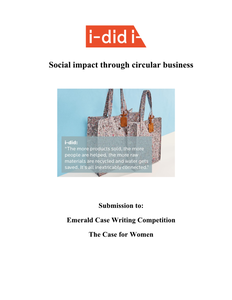
Study level/applicability Teaching formats for both BA/MA students and MBA/PhD students in sustainable entrepreneurship and strategic management are offered in the teaching notes. Subject area This case juxtaposes the company’s core values of gender equality, sustainability and inclusivity, with the financial pressures of expanding global operations in COVID-19 times. Case overview This case illustrates the founding and growth of i-did in the broader context of the global circular textile industry. Being the first company that reclaims value of discarded textiles by making design products out of felt, the dilemma is on how i-did can create a blueprint for sustainable leadership in a scalable (financial) business case. Expected learning outcomes The learning outcomes of this case are as follows: to understand the concepts of circular economy and social impact and how they can be translated to business; to apply their knowledge of strategy and entrepreneurship for sustainable business innovation; to be able to analyze a company according to the Sustainable Development Goals, specifically around gender issues, inclusivity and diversity; to evaluate opportunities for multiple value creation in business; and to have the knowledge and capacity to create a circular business with the help of the Business Model Template. Social implications This case engages students in critically reflecting on sustainability concepts in relation to i-did (theoretical value) and applying novel business model innovation tools to a real-world enterprise (practical value). The students get the chance to explore the ethical challenges the two entrepreneurial leaders face between short-term economic gains (or maybe even survival) and their core values of (gender) inclusivity, circularity and diversity. Supplementary materials Teaching notes and a summarizing two-pager are available for educators. Poldner, K. and Blanken, R. (2022), "i-did: social impact through circular business", . https://doi.org/10.1108/CFW.2022.000011
DOCUMENT
We investigate circular entrepreneurial ecosystems that support circular startups and innovation. We argue that circular entrepreneurial ecosystems are constellations of existing entrepreneurial ecosystems that extend across geographies and sectors, requiring ecosystem intermediaries to bridge institutional environments and provide access to actors and resources. Focusing on the emerging circular transition in the textiles and apparel industry, we gathered data from in-depth interviews, field observations, and archival documentation over a seven--year period. Our findings show that circular entrepreneurial ecosystems are purposefully intermediated at a meta level, generating nested and distributed ecosystems. To elucidate circular ecosystem intermediation, we devised a model of system level 5 intermediation that extends the conceptualization of ecologies of system intermediation across geographic and sector boundaries. Our study contributes to the literatures on circular entrepreneurship, circular ecosystems, and ecosystem intermediation as well as provides practical implications for practitioners and policy makers.
DOCUMENT



