Effects of climate change in cities are evident and are expected to increase in the future, demanding adaptation. In order to share knowledge, raise awareness, and build capacity on climate adaptation, the first concept of a “ClimateCafé” has been utilized since 2012 in 25 events all over the world. In 8 years ClimateCafé grew into a field education concept involving different fields of science and practice for capacity building in climate change adaptation. This chapter describes the need, method, and results of ClimateCafés and provides tools for organizing a ClimateCafé in a context-specific case. Early ClimateCafés in the Philippines are compared with the ClimateCafé in Peru to elucidate the development of this movement, in which one of the participants of ClimateCafé Philippines 2016 became the co-organizer of ClimateCafé Peru in 2019. The described progress of ClimateCafés provides detailed information on the dynamic methodological aspects, holding different workshops. The workshops aim at generating context-specific data on climate adaptation by using tools and innovative data collection techniques addressing deep uncertainties that come with climate change adaptation. Results of the workshops show that context-specific, relevant, multidisciplinary data can be gathered in a short period of time with limited resources, which promotes the generation of ideas that can be used by local stakeholders in their local context. A ClimateCafé therefore stimulates accelerated climate action and support for adaptation solutions, from the international and the local, from the public and private sector, to ensure we learn from each other and work together for a climate resilient future. The methodology of ClimateCafé is still maturing and the evaluation of the ClimateCafés over time leads to improvements which are applied during upcoming ClimateCafés, giving a clear direction for further development of this methodology for knowledge exchange, capacity building, and bridging the gap between disciplines within climate adaptation.
DOCUMENT

Effects of climate change in cities are evident and are expected to increase in the future, demanding adaptation. In order to share knowledge, raise awareness and build capacity on climate adaptation, “ClimateCafés” have been utilized since 2012 in over 50 global events. ClimateCafé is a field education concept involving different fields of science for capacity building in climate adaptation depending on the specific needs of stakeholders. This chapter describes the need, method and results of two ClimateCafés performed in North America in 2022. In North America, there was a clear demand for proof of the long-term efficiency of small-scale urban nature-based solutions (NbS), since the hydraulic capacity of rain gardens and swales is often questioned in low permeable soils and high groundwater tables. The main research question in the ClimateCafés is: Which variation of the (un)saturated infiltration capacity can be expected under conditions with low permeable soil and high groundwater tables (under sea level)? To answer this research question, participative monitoring of NbS has taken place on swales and rain gardens implemented in New Orleans (under sea level) and Vancouver (bed rock). The ClimateCafés aimed at generating context-specific data on nature-based solutions by using open-source tools and cost-effective data collection techniques. The results of the workshops show that relevant, multidisciplinary data can be gathered in a short period of time with limited resources. As example, over 500 individual NbS projects are mapped in both cities from which a selection is made for field research with several stakeholders. The method of the conducted research consisted of a full-scale testing method, measuring the long-term infiltration capacity of rain gardens and swales installed in the last two decades. The results show a high variation of empty times for rain gardens and swales (26–300 mm/h) with fast decreasing infiltration capacity after saturation of the soil (second test showed a decrease in the order of 35%). The ClimateCafés stimulated accelerated climate action and support for national and international knowledge exchange in adaptation solutions for a climate resilient future. Besides raising awareness and capacity building, the evaluation of the outcomes of the ClimateCafés Vancouver and New Orleans lead to practical guidelines and cost-effective interventions to optimize the performance of existing NbS and a strategy for implementing optimized NbS in the near future.
LINK
ClimateCafé is a multi-, trans-, interdisciplinary and international event of several days in which young professionals, stakeholders and scientist come together to collect data and design (potential) solutions for climate change adaptation in rural or urban areas. ClimateCafé mainly aims to enhance resilience and reduce vulnerability of communities by sharing knowledge, raising awareness and building capacity. ClimateCafé addresses global issues, such as climate change and sustainable development, on a local scale. In a ClimateCafé, context specific challenges, related to climate change and sustainable development, are proposed by local stakeholders and often relate to a specific problem area. Over the past decade, more than 28 ClimateCafés have been organised around the globe, including the Netherlands-Rotterdam, Sweden-Malmö, the Philippines-Manila, and Peru-Pirua. Since the first edition in Thailand (2012), ClimateCafé evolved in content and adopted a ‘learning by doing’ paradigm. Our results indicate ClimateCafé fosters integrated thinking across disciplines, cultures and knowledge sectors while reducing uncertainties affiliated with climate change adaptation. This is demonstrated by participants of previous ClimateCafés having various backgrounds including: law, civil engineering, water management, art, urban planning and environmental engineering. Furthermore, co-production is composed through workshops facilitated by stakeholders of the, so called, quadruple helix including academia, government, civic society and industry. Workshops make use of scientifically embedded methods, always related to the contextual challenge. For example, urban heat stress is measured by sensors on a bike and collecting urban green with online platform ClimateScan, community perceptions are collected through interviews, water quality is measured with the use of drones and perceptions and responsibilities of institutional actors are identified by interviews and field visits. Additionally, data is processed and design workshops facilitate integrated design of potential solutions which is disseminated through participants presenting their findings at conferences. Although ClimateCafé is resource intensive, requires active participation of stakeholders and currently mainly attracts students of affiliated universities, we argue this multi-, inter-, transdisciplinary and international knowledge exchange methodology fosters the innovation that is dearly needed to address global sustainability challenges and climate change adaptation.
LINK
Malmö is well known within the field of urban hydrology, as the city was a pioneer in integrated water management (Stahre 2008). In 1998 the Augustenborg neighbourhood was refurbished due to its reoccurring problems with flooding anddamage caused by water (Niemczynowicz 1999). The project “Ekostaden” (Eco-city) included many initiatives implementing nature-based solutions (NBS), such as swales and rain gardens for infiltrating surface (storm) water into the ground (Climate Adapt 2016) (Figure 1). International stakeholders want to know if these NBS still function satisfactorily after 20 years and what we can learn from the “Augustenborg strategy” and apply in other parts of the world. To quote the German philosopher Georg Wilhelm Friedrich Hegel, “we learn from history that we do not learn from history.” Augustenborg is an ideal location to demonstratethe sustainability of NBS, test the functionality for infiltration of surface water in swales, map the build-up of potential toxic elements (PTE), and test the water quality after 20 years operation. This evaluation is done in 2019 with theinternational, participatory and multidisciplinary method ‘ClimateCafé and the results are presented at the international seminar Cities, rain and risk,June 2019 in Malmö (Boogaard et al. 2019). ClimateCafé is a field education concept involving different fields of science and practice for capacity building in climate change adaptation. Over 20 ClimateCafés have already been carriedout around the globe (Africa, Asia, Europe), where different tools and methods have been demonstrated to evaluate climate adaptation. The 25th edition of ClimateCafé took place in Malmö, Sweden, in June 2019 and focussed on the Eco-city of Augustenborg. The main research question - “Are the NBS in Augustenborg still functioning satisfactorily?”- was answered by interviews, collecting data of water quality, pollution, NBS and heat stress mapping, and measuring infiltration rates (Boogaard et al. 2020).
DOCUMENT

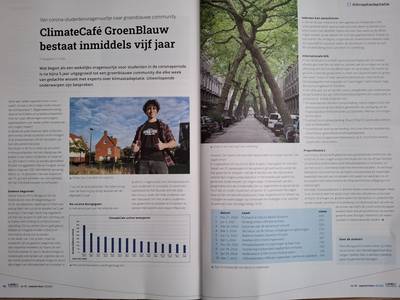
Wat begon als een wekelijks vragenuurtje voor studenten in de corona periode is na bijna 5 jaar uitgegroeid tot een groenblauwe community die elke week van gedachte wisselt met experts over klimaatadaptatie. Uiteenlopende onderwerpen kwamen voorbij als ‘welke vegetatie hoort in een wadi?’, of ‘wat is de ecologie onder drijvende zonnepanelen’, Regenwaterbenutting: diverse technieken en praktijk voorbeelden en ook een paar afleveringen over (regen) waterkwaliteit: welke stoffen moeten we ons (geen) zorgen over maken? In de eerste jaren kwamen deze onderwerpen voorbij omdat studenten erom vroegen of ze presenteerden zelf de resultaten van hun afstudeerdonderzoek. Na 5 jaar is de focus meer op actualiteit in klimaatadaptatie met een doelgroep breder dan alleen studenten. Er staan er ca 250 videos online en worden gemiddeld 50 keer teruggekeken met hoogste aantal kijkers ca 500 keer. Gemiddelde aanwezigheid is ca 10 personen met een maximum van ca 75, deze grote aantallen worden zijn niet wenselijk om het informele karakter te behouden.
IMAGE
Groenblauwe oplossingen...we zien ze meer en meer verschijnen. Gelukkig maar, want ze zijn hard nodig met het veranderende klimaat in het achterhoofd. Binnen het project "Groenblauwe oplossingen, kansen en risico's" kijken we naar het hydraulisch en milieutechnisch functioneren van deze oplossingen op de lange termijn. Deze nieuwsbrief houdt je op de hoogte van het onderzoek, de ontwikkelingen, events en de voortgang.
DOCUMENT

In 2024 the Low Impact Development Devices (LID) open-source international database ClimateScan consist of over 14.000 climate adaption related projects uploaded in the period of 2014–2024. For cities with over 500 projects, this offers an opportunity to construct a LID-DNA of the city. LID-DNA presents the ‘genetic information of the development and functioning of LID in a city’ and was first used in The Netherlands during ClimateCafés as evaluation for future design and maintenance of stormwater management strategies. The LID-DNA of several cities based on the quantity and categories of LID is visualized. The LID structure of early adaptor Amsterdam with over 500 LID measures implemented in 2000–2024, shows a large variety of over 20 types of individual LID. The relative new adaptor Riga shows a LID-DNA with a focus on bio-filtration with raingardens and swales (based on 40 data points). Stakeholders from different departments concluded that cities benefit from the insights of their urban LID-DNA earlier in the process. An early insight will support a targeted LID strategy choosing a limited cost-efficient group of LID than having a wide range of different LID without evaluation of their efficiency. Departments in the city asked for more detailed insights (earlier in the process) to prevent mal-adaptation and disinvestments and be more efficient with their capacity. The ClimateScan database holds over 300 monitored LID projects with research results in North America and Europe in cities as Vancouver, New Orleans, Amsterdam and Riga. Future work will focus on more detailed LID-DNA visualisation based on not only the amount of LID but on the dimensions such as water storage (m 3 ) and surface (m 2 ). Monitoring of LID will be stimulated to make strategic decisions on measured infiltration rates (m/d) of LID as most important criteria for possible damage by floodings and maintenance (clogging). Raising awareness and capacity building targeted on the high-ranking cost-efficient LID is set up in both cities focused on the design, construction and maintenance of LID.
DOCUMENT
AANLEIDING - Gemeenten en waterschappen hebben de taak om te zorgen voor een klimaatbestendige inrichting van de gebouwde omgeving om schade door hevige neerslag, hitte en droogte zoveel mogelijk te voorkomen. Om die reden zijn en worden zogenaamde groenblauwe oplossingen aangelegd, zoalsinfiltrerende stadsparken, wadi's en raingardens. Er zijn echter veel vragen over het functioneren en de risico’s van deze maatregelen. Inzicht in de kansen en risico’s ontbreekt om het adequaat lange termijn functioneren van groenblauwe oplossingen te garanderen. DOELEN - Professionals van gemeenten en waterschappen hebben behoefte aan meer inzicht in groenblauwe oplossingen, zoals: 1. kansen en risico’s 2. kennis over het lange termijn functioneren; 3. interdisciplinaire samenwerking van organisaties binnen de disciplines water, bodem en groen en 4. actuele richtlijnen voor ontwerp, aanleg en beheer. Op basis hiervan is de volgende onderzoeksvraag geformuleerd voor dit onderzoek: wat zijn de kansen en risico’s bij het lange termijn functioneren van groenblauwe klimaatadaptieve oplossingen?AANPAK - Om dit te onderzoeken hebben we op meer dan zestig locaties metingen gedaan naar het functioneren van groenblauwe oplossingen. Om te voorkomen dat appels met peren werden vergeleken is daarin de focus aangebracht op de wadi als de meest populaire en langst lopende groenblauwe oplossing in Nederland. Deze werden onderzocht op hydraulisch en milieutechnisch functioneren, maar ook op eigenschappen, beleving door omwonenden en beplanting. In zogenaamde ClimateCafés werden verschillende onderzoekinstrumenten en -methodes samen met studenten, onderzoekers en professionals toegepast. De data die daarin werd opgehaald wordt vertaald naar praktische richtlijnen, gevoed met ervaringen en lessen uit interviews met professionals van publieke en private partijen (met verschillende disciplines als water, bodem, groen en stedenbouw).SAMENWERKING - Het consortium dat aan dit onderzoek werkte bestond uit een multidisciplinaire samenwerking tussen hogescholen, gemeenten, waterschappen en provincies met diverse organisaties en bedrijven vanuit het hele land. Het consortium is ontstaan uit het Lectorenplatform Delta en Water en verstevigt de strategische samenwerking tussen praktijk professionals, onderzoek en onderwijs.UITKOMSTEN - In dit onderzoek is naar een aantal eindproducten toegewerkt. Allereerst een open source database op over groenblauwe oplossingen voor inspiratie en onderzoek: Climatescan. Hierin zijn voor alle groenblauwe oplossingen die onderdeel waren van dit onderzoek de belangrijkste eigenschappen en meetresultaten gedeeld ter terugkoppeling aan de praktijk. Ten tweede een opensource database met alle onderzochte locaties en de belangrijkste analyses. Tot slot is naar een inspiratieboek toegewerkt met illustraties van goede en slechte voorbeelden uit de praktijk.
DOCUMENT

ClimateCafé is a field education concept involving dierent fields of science and practice for capacity building in climate change adaptation. This concept is applied on the eco-city of Augustenborg in Malmö, Sweden, where Nature-Based Solutions (NBS) were implemented in 1998.ClimateCafé Malmö evaluated these NBS with 20 young professionals from nine nationalities and seven disciplines with a variety of practical tools. In two days, 175 NBS were mapped and categorised in Malmö. Results show that the selected green infrastructure have a satisfactory infiltration capacity and low values of potential toxic element pollutants after 20 years in operation. The question “Is capacity building achieved by interdisciplinary field experience related to climate change adaptation?” was answered by interviews, collecting data of water quality, pollution, NBS and heat stress mapping, and measuring infiltration rates, followed by discussion. The interdisciplinary workshops with practical tools provide a tangible value to the participants and are needed to advance sustainabilityeorts. Long term lessons learnt from Augustenborg will help stormwater managers within planning of NBS. Lessons learned from this ClimateCafé will improve capacity building on climate change adaptation in the future. This paper oers a method and results to prove the German philosopher Friedrich Hegel wrong when he opined that “we learn from history that we do not learn from history”
DOCUMENT

Cities are becoming increasingly vulnerable to climate change, and there is an urgent need to make them more resilient. The Climatescan adaptation tool www.climatescan.nl is applied as an interactive tool for knowledge exchange and raising awareness on Nature-Bases Solutions (NBS) targeting young professionals in ClimateCafes. Climatescan is a citizen science tool created through ‘learning by doing’, which is interactive, open source, and provide more detailed information on Best Management Practices (BMPs) as: exact location, website links, free photo and film material. BMPs related to Innovations for Climatic Events (INXCES) as stormwater infiltration by swales, raingardens, water squares, green roofs subsurface infiltration are mapped and published on social media. Climatescan is in continuous development as more data is uploaded by over 250 people around the world, and improvements are made to respond to feedback from users. In an early stage of the international knowledge exchange tool Climatescan, the tool was evaluated by semi-structured interviews in theClimatescan community with the following result: stakeholders demand tools that are interactive, open source, and provide more detailed information (location, free photo and film material). In 2016 Climatescan (first stage of INXCES) was turned into an APP and within two years the tool had over10,000 users and more than 3,000 international projects. More than 60% of the users are younger than 34 and 51% of users are female, resulting in engagement with an important target group: young professionals. The tool is applied in Climatecafe.nl around the world (The Netherlands, Sweden, Philippines, Indonesia, South Africa) where in a short period of time stakeholders in triple helix context (academia, public and private sector) work on climate related challenges and exchange their knowledge in a café setting. Climatescan has also been used in other water challenges with young professionals such as the Hanseatic Water City Challenge and Wetskills. During the INXCES project over 1000 BMPs related to Innovations for Climatic Events (INXCES) are mapped inall partner countries (figure 1). The points of interest vary from just a location with a short description to a full uploaded project with location, description and summary, photos and videos, presentations, links to websites with more information and scientific papers and books (as Bryggen in Norway: https://www.climatescan.nl/projects/16/detail ).
DOCUMENT




