The research examines junk news, followers of problematic sources as well as artificial amplification on Instagram during the 2019 Dutch provincial and European parliamentary elections. First, this study looks at the circulation of junk content in high-engagement political spaces on Instagram. Second, it takes up the question of the mainstreaming of Dutch junk news providers by looking at the intersection between the followers of Dutch political entities and those of junk news sources. Third, it looks at the presence of artificial engagement tactics (specifically fake followers) employed by Dutch political entities and news sources on Instagram. In all it was found that Dutch political Instagram is a relatively healthy space, but not for all issues or political entities.
MULTIFILE

The purpose of this research is to find evidence for the assumption that allowing children to create their own news messages is an effective approach to teach them how to distinguish between reliable news and fake news. Three students of the primary teacher training programme of The Hague University of Applied Sciences developed five lessons concerning fake news and five Kahoot! quizzes for each of those lessons. They taught the lessons they developed under the supervision of a primary school teacher and one of their lecturers from the university. A Friedman test on the scores of the Kahoot! quizzes indicate that the children made progress over the course of the study. In addition, it appears that the children appreciated the lessons and that they have learned how news is created and how fake news can be recognised. The outcomes of this study have prompted a larger, international Erasmus+ project. Schools and libraries in three countries will investigate similar innovative blended-learning approaches for pupils between ages 12 to 15.
MULTIFILE

The purpose of this literature study is to obtain information about educational approaches to teaching 11 to 12 years old children focusing on how to distinguish between real news and fake news. With this purpose we studied 16 academic papers about learning activities to make primary school children media-literate and able to recognise fake news. What we found is that having children create their own news messages seems to be the most effective approach. News messages that they create can be text messages as well as videos, audios, pictures and animations. Based on this conclusion, students from The Hague University of Applied Sciences Teacher Training Institute (PABO) have been asked to develop a set of learning materials that can be used for instruction in primary schools. The effectiveness of those materials is currently being tested at an elementary school in Rijswijk. The results of the literature and the field study will be shared in the Dutch centre of expertise for media literacy education, Mediawijzer.net.
MULTIFILE

SMILES is an international project where six organisations from three countries are collaborating to develop and test innovative approaches to combating the spread of fake news. The project is led by KB, the National Library of the Netherlands and the other partners are the Institute of Sound and Vision and The Hague University of Applied Sciences from the Netherlands, Fundación Goteo/Platoniq from Spain, and Public Libraries 2030 and the Media and Learning Association both of whom will focus on the situation in Belgium. In this article I would like to report on the main results from the baseline study that was carried out in recent months regarding the spread of disinformation in Belgium, the Netherlands and Spain, and existing measures and interventions that have taken place in those countries in combating such disinformation. Detailed reports for each country can be found on the project website.
MULTIFILE

Increasingly, Instagram is discussed as a site for misinformation, inau-thentic activities, and polarization, particularly in recent studies aboutelections, the COVID-19 pandemic and vaccines. In this study, we havefound a different platform. By looking at the content that receives themost interactions over two time periods (in 2020) related to three U.S.presidential candidates and the issues of COVID-19, healthcare, 5G andgun control, we characterize Instagram as a site of earnest (as opposedto ambivalent) political campaigning and moral support, with a rela-tive absence of polarizing content (particularly from influencers) andlittle to no misinformation and artificial amplification practices. Mostimportantly, while misinformation and polarization might be spreadingon the platform, they do not receive much user interaction.
MULTIFILE
Disinformation and so-called fake news are contemporary phenomena with rich histories. Disinformation, or the willful introduction of false information for the purposes of causing harm, recalls infamous foreign interference operations in national media systems. Outcries over fake news, or dubious stories with the trappings of news, have coincided with the introduction of new media technologies that disrupt the publication, distribution and consumption of news -- from the so-called rumour-mongering broadsheets centuries ago to the blogosphere recently. Designating a news organization as fake, or der Lügenpresse, has a darker history, associated with authoritarian regimes or populist bombast diminishing the reputation of 'elite media' and the value of inconvenient truths. In a series of empirical studies, using digital methods and data journalism, the authors inquire into the extent to which social media have enabled the penetration of foreign disinformation operations, the widespread publication and spread of dubious content as well as extreme commentators with considerable followings attacking mainstream media as fake.
MULTIFILE
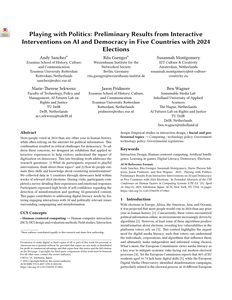
More people voted in 2024 than any other year in human history, while often relying on the internet for political information. This combination resulted in critical challenges for democracy. To address these concerns, we designed an exhibition that applied interactive experiences to help visitors understand the impact of digitization on democracy. This late-breaking work addresses the research questions: 1) What do participants, exposed to playful interventions, think about these topics? and 2) How do people estimate their skills and knowledge about countering misinformation? We collected data in 5 countries through showcases held within weeks of relevant 2024 elections. During visits, participants completed a survey detailing their experiences and emotional responses. Participants expressed high levels of self-confidence regarding the detection of misinformation and spotting AI-generated content. This paper contributes to addressing digital literacy needs by fostering engaging interactions with AI and politically relevant issues surrounding campaigning and misinformation.
MULTIFILE
Social media platforms such as Facebook, YouTube, and Twitter have millions of users logging in every day, using these platforms for commu nication, entertainment, and news consumption. These platforms adopt rules that determine how users communicate and thereby limit and shape public discourse.2 Platforms need to deal with large amounts of data generated every day. For example, as of October 2021, 4.55 billion social media users were ac tive on an average number of 6.7 platforms used each month per internet user.3 As a result, platforms were compelled to develop governance models and content moderation systems to deal with harmful and undesirable content, including disinformation. In this study: • ‘Content governance’ is defined as a set of processes, procedures, and systems that determine how a given platform plans, publishes, moder ates, and curates content. • ‘Content moderation’ is the organised practice of a social media plat form of pre-screening, removing, or labelling undesirable content to reduce the damage that inappropriate content can cause.
MULTIFILE

As youth workers increasingly offer support and guidance within digital environments, the question arises as to what impact this support has on the (online) lives of young people. This paper explores the contribution of youth work practice in the online lifeworld on young peoples’ development, building on previous studies concerning youth work outcomes and the developmental needs of young people. A qualitative research design was employed, including digital diaries of youth workers and semi-structured interviews with both young people (N = 37) and youth workers (N = 25). The findings highlight the role of youth work in helping young people navigate social media; develop new skills, talents, and social connections; and increase awareness of online risks. Youth workers also support young people in coping with negative online experiences, including loneliness and mental health challenges. The contribution of online youth work is less visible in certain aspects of developmental needs, namely online safety and privacy, self-image, and assessing online information. This paper concludes by emphasising the need for further research into the long-term impact of youth work in the online lifeworld, particularly in light of rapid technological developments, the growing influence of artificial intelligence, and the increasing involvement of youth in digital forms of crime. The findings described in this study can form a base for future research to better understand the impact of these emerging issues on youth development and youth work practice, as well as to develop appropriate interventions.
DOCUMENT
We propose a novel deception detection system based on Rapid Serial Visual Presentation (RSVP). One motivation for the new method is to present stimuli on the fringe of awareness, such that it is more difficult for deceivers to confound the deception test using countermeasures. The proposed system is able to detect identity deception (by using the first names of participants) with a 100% hit rate (at an alpha level of 0.05). To achieve this, we extended the classic Event-Related Potential (ERP) techniques (such as peak-to-peak) by applying Randomisation, a form of Monte Carlo resampling, which we used to detect deception at an individual level. In order to make the deployment of the system simple and rapid, we utilised data from three electrodes only: Fz, Cz and Pz. We then combined data from the three electrodes using Fisher's method so that each participant was assigned a single p-value, which represents the combined probability that a specific participant was being deceptive. We also present subliminal salience search as a general method to determine what participants find salient by detecting breakthrough into conscious awareness using EEG.
DOCUMENT




