This entry starts with a chronological discussion of the different conceptualizations of work-family balance over time. Where pioneering studies focused on work-family (and family-work) conflict, more recent studies introduced the concepts of work-family (and family-work) enrichment and more holistic work-family constructs. Subsequently, frequently examined antecedents and consequences of work-family conflict and enrichment are presented. In addition, a critical discussion of the work-family literature is given by, among others, reflecting on the small amount of studies examining work-family concepts within a (cross-) cultural or social context. This entry concludes with the presentation of several directions for future work-family research including the proposition of an integral framework.
LINK
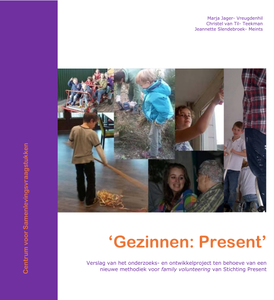
‘Gezinnen: Present!’ is de naam van het onderzoeks- en ontwikkelproject waarin Stichting Present en het Centrum voor Samenlevingsvraagstukken samenwerkten aan de ontwikkeling van een nieuwe methodiek voor family volunteering. Deze rapportage laat de opbrengst zien van anderhalf jaar samenwerken. Present heeft een subsidie gekregen van ZonMw om een aanpak te ontwikkelen speciaal voor gezinnen die zich vrijwillig in willen zetten. In 8 lokale Present-stichtingen (Amersfoort, Dordrecht, Ede, Houten, Gouda, Utrecht, Almere en Zwolle) werd in het onderzoeks- en ontwikkel-project ‘Gezinnen: Present!’ deze aanpak in de praktijk uitgeprobeerd, onderzocht en ontwikkeld. Het project vond plaats in de periode januari 2011 tot en met juni 2012. In deze periode begeleidden de Presentcoördinatoren uit de genoemde plaatsen in totaal 68 gezinnen die zich vrijwillig inzetten voor een ander. Het Centrum voor Samenlevingsvraagstukken ondersteunde het ontwikkel-proces en voerde het onderzoek uit rond de 68 gezinspro-jecten die plaatsvonden.
DOCUMENT
Background: Caregiving by family members of elderly with chronic conditions is currently intensifying in the context of an aging population and health care reform in the Netherlands. It is essential that nurses have attention for supporting roles of family caregivers of older patients and address family caregiving aspects on behalf of the continuity of care. This study aims to explore what aspects of family caregiving were addressed during planned discussions between nurses, patients and family caregivers in the hospital.Methods: Qualitative descriptive research was conducted using non-participant observation and audio-recordings of planned discussions between nurses, older patients and their family caregivers as they took place in the hospital.Through purposive sampling eligible patients (≥ 65 years) with one or more chronic conditions were included. These patients were admitted to the hospital for diagnostics or due to consequences of their chronic illness.Retrospective chart review was done to obtain patient characteristics. Data were collected in November/December 2013 and April/May 2014 in four hospitals. Qualitative content analysis was performed using the inductive approachin order to gain insight into addressed aspects of family caregiving.Results: A total of 62 patients (mean age (SD) 76 years (7.2), 52% male) were included in the study, resulting in 146 planned discussions (62 admission and discharge discussions and 22 family meetings). Three themes were identifiedregarding addressed aspects of family caregiving. Two themes referred to aspects addressing the patients’ social network, and included ‘social network structure’ and ‘social network support’. One theme referred to aspectsaddressing coordination of care issues involving family caregiving, referred to as ‘coordination of care’.Conclusions: During discussions nurses mostly addressed practical information on the patients’ social network structure. When specific family caregiving support was addressed, information was limited and nurses did not seem toexplore the nature of the family support. Patients discharge and after care needs were addressed occasionally as aspects of coordination of care. Current nursing policies could be evaluated on nursing and family oriented theories.Implications for education could include mirroring study findings with nurses in a group discussion to enhance their awareness on family caregiving aspects.
DOCUMENT

A new viral illness called coronavirus disease 2019 (COVID-19) is currently spreading throughout the world at an alarming rate (Dong et al., 2020). As family nursing practitioners, educators, and researchers, we work from a guiding assumption that health and “illness is a family affair” (Wright & Bell, 2009, p. ix). Patients, clients, residents, and their families are inextricably connected. The science and practice of Family Nursing is based on a systemic premise offered by Wright and Leahey (2013) that serious illness and life challenges impact the family unit, and reciprocally, the functioning of the family unit (including their structure, development, and function) influences the health and well-being of each family member. This especially holds true for the current coronavirus pandemic which is creating unique hardships and suffering in an alarmingly large number of patients and their families around the world.
DOCUMENT

Introduction of the special issue ‘Exploring the multilingual family repertoire: ethnographic approaches'.
LINK
In our Guest Editorial “The COVID-19 Pandemic: A Family Affair,” which was published in the Journal of Family Nursing by members of the FAMily Health in Europe–Research in Nursing (FAME-RN) group (Luttik et al., 2020), we highlighted the impact on nurses and families.The pandemic was at its beginning, and we described the situation of patients and families and the need for family nursing. Furthermore, we addressed the effect on the mental health of nurses and other health care professionals, due to the increasing workload they needed to manage. In this Guest Editorial, we discuss the impact of the COVID-19 on families during and post pandemic.
DOCUMENT

Artikel van Judith Huis in het Veld, docent onderzoeker van de Hogeschool Inholland verschenen in Research in Gerontological Nursing ABSTRACT The current article discusses how and by whom family caregivers want to be supported in selfmanagement when managing changes in behavior and mood of relatives with dementia and whether family caregivers consider eHealth a useful tool for self-management support. Four asynchronous online focus groups were held with 32 family caregivers of individuals with dementia. Transcripts of the online focus groups were analyzed using qualitative thematic analysis. Family caregivers need support from professionals or peers in the form of (a) information about dementia and its symptoms, (b) tips and advice on managing changes in behavior and mood, (c) opportunities to discuss experiences and feelings, and (d) appreciation and acknowledgement of caregiving. The opinions of family caregivers about self-management support through eHealth were also reported. Findings suggest a personal approach is essential to self-management support for family caregivers managing changes in behavior and mood of relatives with dementia. In addition, self-management support can be provided to some extent through eHealth, but this medium cannot replace personal contacts entirely.
DOCUMENT

The research presented examines how pervasive technology can support intra-family communication, supporting existing practices and complimenting them by addressing communication needs currently unmet by current communication media like mobile phones, social networking systems, and so forth. Specifically the investigation focused on busy families, understood here to be families with two working parents and at least one child sharing the same roof. The class of technologies the authors consider are awareness systems, defined as communication systems that support individuals to maintain, with low effort, a peripheral awareness of each other's activities and whereabouts. This research combined a variety of research methods including interviews, web surveys, experience sampling, and field testing of functional prototypes of mobile awareness systems. It also involved the development of several applications, which were either seen as research tools in support of the methods applied or as prototypes of awareness systems that embody some of the envisioned characteristics of this emerging class of technologies. The contribution of this research is along two main dimensions. First in identifying intra-family communication needs that drive the adoption of awareness systems and second in providing directions for the design of such systems.
DOCUMENT
Background: Involvement of families in physiotherapy-related tasks of critically ill patients could be beneficial for both patients and their family. Before designing an intervention regarding family participation in the physiotherapy-related care of critically ill patients, there is a need to investigate the opinions of critically ill patients, their family and staff members in detail. Objective: Exploring the perceptions of critically ill patients, their family and staff members regarding family participation in physiotherapy-related tasks of critically ill patients and the future intervention. Methods: A multicenter study with a qualitative design is presented. Semistructured interviews were conducted with critically ill patients, family and intensive care staff members, until theoretical saturation was reached. The conventional content method was used for data analyses. Results: Altogether 18 interviews were conducted between May 2019 and February 2020. In total, 22 participants were interviewed: four patients, five family members, and 13 ICU staff members. Six themes emerged: 1) prerequisites for family participation (e.g., permission and capability); 2) timing and interactive aspects of engaging family (e.g., communication); 3) eligibility of patients and family (e.g., first-degree relatives and spouses, and long stay patients); 4) suitability of physiotherapyrelated tasks for family (e.g., passive, active and breathing exercises); 5) expected effects (e.g., physical recovery and psychological wellbeing); and 6) barriers and facilitators, which may affect the feasibility (e.g., safety, privacy, and responsibility). Conclusion: Patients, family members and staff members supported the idea of increased family participation in physiotherapy-related tasks and suggested components of an intervention. These findings are necessary to further design and investigate family participation in physiotherapyrelated tasks.
LINK



