In very old and/or frail older people living in long-term care facilities, physical inactivity negatively affects activities of daily living. The main reason to assess older adults' perceived fitness is to establish the relation with their beliefs about their ability to perform physical activity adjusted to daily tasks. The Self-Assessment of Physical Fitness scale was developed to address these needs. The aim of this study was to estimate the test-retest reliability and construct validity of the scale. 76 elderly people (M age = 86.0 yr., SD = 6.3) completed the test. Cronbach's a was .71. One-week test-retest reliability ICC's ranged from .66 (SAPF aerobic endurance and SAPF balance) to .70 (SAPF sum score). Concurrent validity with the Groningen Fitness Test for the Elderly was fair to moderate. Despite the limited number of participants (N = 76), results suggest that the scale may be useful as an assessment of perceived fitness in older adults.
LINK
Voor een sportieve en vitale samenleving zijn openbare sportvoorzieningen in de directe woonomgeving van de inwoners van groot belang. Openbare ruimte is in Nederland echter schaars. De beperkte ruimte die beschikbaar is voor sport en recreatie moet zo optimaal mogelijk worden ingericht. Zo ook outdoor fitness locaties: openbare sportvoorzieningen met veilige en laagdrempelige fitness toestellen. In dit stappenplan worden 10 stappen benoemd die van belang zijn voor het creëren van succesvolle outdoor fitness locaties: 6 stappen die van belang zijn bij het aanleggen van een nieuwe locatie en 4 stappen die van belang zijn voor het bevorderen van het gebruik van zo’n locatie. Dit stappenplan is opgesteld aan de hand van een onderzoek van het lectoraat Gezonde Leefstijl in een Stimulerende Omgeving van De Haagse Hogeschool naar het gebruik van zeven ‘fitplaatsen’ in de gemeente Den Haag.
DOCUMENT

Outdoor fitness is een nieuwe sportvorm binnen de Nederlandse sportinfrastructuur die vijf jaar geleden in Nederland is ingevoerd. Het is een relatief nieuwe trend, over de meerwaarde en het gebruik is nog weinig bekend. In opdracht van DSP-groep is een beeld geschetst van de huidige situatie van het fenomeen in Nederland. Beleidsmakers hebben behoefte aan helderheid over de functie en het gebruik van outdoor fitness. Onderzoeksvraag: Hoe ziet het fenomeen outdoor fitness er in Nederland uit, wat is de meerwaarde en onder welke condities en voor wie kan het concept in Nederland succesvol zijn?
DOCUMENT

De gemeente Den Haag heeft zeven outdoor fitness locaties aangelegd ter beweegstimulering van haar inwoners. Om inzicht te krijgen in het gebruik, belangrijke randvoorwaarden en succesfactoren van de Haagse ‘fitplaatsen’ heeft het lectoraat Gezonde Leefstijl in een Stimulerende Omgeving op vier dagen systematisch geobserveerd. Daarnaast zijn enquêtes en interviews afgenomen onder (niet-) gebruikers en professionals. Fitplaats Zuiderpark is de meest succesvolle locatie van de onderzochte fitplaatsen. Op alle observatiemomenten was hier een aanzienlijke groep mensen actief (gemiddeld 14 per uur). Op twee andere fitplaatsen (Strand en Ketelplein) zijn af en toe actieve mensen geobserveerd, maar op de overige fitplaatsen was per uur gemiddeld minder dan 1 persoon aanwezig. Bekendheid, zichtbaarheid, goede bereikbaarheid en goed onderhoud zijn belangrijke randvoorwaarden. De belangrijkste succesfactoren zijn promotie en begeleiding. Het merendeel van de Haagse fitplaatsen wordt momenteel niet optimaal gebruikt. Om hier verandering in aan te brengen is een stappenplan opgesteld.
DOCUMENT

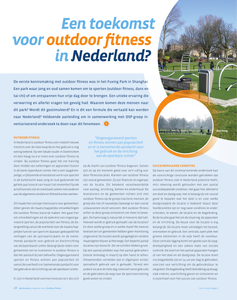
De eerste kennismaking met outdoor fitness was in het Fuxing Park in Shanghai, een park waar jong en oud samen komen om te sporten (outdoor fitness, dans en tai-chi) of om ontspannen hun vrije dag door te brengen. een unieke ervaring die verwarring en allerlei vragen tot gevolg had. waarom komen deze mensen naar dit park? wordt dit gestimuleerd? en is dit een formule die vertaald kan worden naar nederland? voldoende aanleiding om in samenwerking met DSP-groep inventariserend onderzoek te doen naar dit fenomeen.
DOCUMENT
Data collected from fitness trackers worn by employees could be very useful for businesses. The sharing of this data with employers is already a well-established practice in the United States, and companies in Europe are showing an interest in the introduction of such devices among their workforces. Our argument is that employers processing their employees’ fitness trackers data is unlikely to be lawful under the General Data Protection Regulation (GDPR). Wearable fitness trackers, such as Fitbit and AppleWatch devices, collate intimate data about the wearer’s location, sleep and heart rate. As a result, we consider that they not only represent a novel threat to the privacy and autonomy of the wearer, but that the data gathered constitutes ‘health data’ regulated by Article 9. Processing health data, including, in our view, fitness tracking data, is prohibited unless one of the specified conditions in the GDPR applies. After examining a number of legitimate bases which employers can rely on, we conclude that the data processing practices considered do not comply with the principle of lawfulness that is central to the GDPR regime. We suggest alternative schema by which wearable fitness trackers could be integrated into an organization to support healthy habits amongst employees, but in a manner that respects the data privacy of the individual wearer.
MULTIFILE

Background: Esophageal cancer and curative treatment have a significant impact on the physical fitness of patients. Knowledge about the course of physical fitness during neoadjuvant therapy and esophagectomy is helpful to determine the needs for interventions during and after curative treatment. This study aims to review the current evidence on the impact of curative treatment on the physical fitness of patients with esophageal cancer. Methods: A systematic literature search of PubMed, Embase, Cinahl and the Cochrane Library was conducted up to March 29, 2021. We included observational studies investigating the change of physical fitness (including exercise capacity, muscle strength, physical activity and activities of daily living) from pre-to post-neoadjuvant therapy and/or from pre-to post-esophagectomy. Quality of the studies was assessed and a meta-analysis was performed using standardized mean differences. Results: Twenty-seven articles were included. After neoadjuvant therapy, physical fitness decreased significantly. In the first three months after surgery, physical fitness was also significantly decreased compared to preoperative values. Subgroup analysis showed a restore in exercise capacity three months after surgery in patients who followed an exercise program. Six months after surgery, there was limited evidence that exercise capacity restored to preoperative values. Conclusion: Curative treatment seems to result in a decrease of physical fitness in patients with esophageal cancer, up to three months postoperatively. Six months postoperatively, results were conflicting. In patients who followed a pre- or postoperative exercise program, the postoperative impact of curative treatment seems to be less.
DOCUMENT

Background Testing aerobic fitness in youth is important because of expected relationships with health. Objective The purpose of the study was to estimate the validity and reliability of the Shuttle Ride Test in youth who have spina bifida and use a wheelchair for mobility and sport. Design Ths study is a validity and reliability study. Methods The Shuttle Ride Test, Graded Wheelchair Propulsion Test, and skill-related fitness tests were administered to 33 participants for the validity study (age = 14.5 ± 3.1 y) and to 28 participants for the reliability study (age = 14.7 ± 3.3 y). Results No significant differences were found between the Graded Wheelchair Propulsion Test and the Shuttle Ride Test for most cardiorespiratory responses. Correlations between the Graded Wheelchair Propulsion Test and the Shuttle Ride Test were moderate to high (r = .55–.97). The variance in peak oxygen uptake (VO2peak) could be predicted for 77% of the participants by height, number of shuttles completed, and weight, with large prediction intervals. High correlations were found between number of shuttles completed and skill-related fitness tests (CI = .73 to −.92). Intraclass correlation coefficients were high (.77–.98), with a smallest detectable change of 1.5 for number of shuttles completed and with coefficients of variation of 6.2% and 6.4% for absolute VO2peak and relative VO2peak, respectively. Conclusions When measuring VO2peak directly by using a mobile gas analysis system, the Shuttle Ride Test is highly valid for testing VO2peak in youth who have spina bifida and use a wheelchair for mobility and sport. The outcome measure of number of shuttles represents aerobic fitness and is also highly correlated with both anaerobic performance and agility. It is not possible to predict VO2peak accurately by using the number of shuttles completed. Moreover, the Shuttle Ride Test is highly reliable in youth with spina bifida, with a good smallest detectable change for the number of shuttles completed.
DOCUMENT

Peak oxygen uptake (V'O2peak) is recognised as the best expression of aerobic fitness. Therefore, it is essential that V'O2peak reference values are accurate for interpreting a cardiopulmonary exercise test (CPET). These values are country specific and influenced by underlying biological ageing processes. They are normally stratified per paediatric and adult population, resulting in a discontinuity at the transition point between prediction equations. There are currently no age-related reference values available for the lifespan of individuals in the Dutch population. The aim of this study is to determine the best-fitting regression model for V'O2peak in the healthy Dutch paediatric and adult populations in relation to age. In this retrospective study, CPET cycle ergometry results of 4477 subjects without reported somatic diseases were included (907 females, age 7.9-65.0 years). Generalised additive models were employed to determine the best-fitting regression model. Cross-validation was performed against an independent dataset consisting of 3518 subjects (170 females, age 6.8-59.0 years). An additive model was the best fitting with the largest predictive accuracy in both the primary (adjusted R2=0.57, standard error of the estimate (see)=556.50 mL·min-1) and cross-validation (adjusted R2=0.57, see=473.15 mL·min-1) dataset. This study provides a robust additive regression model for V'O2peak in the Dutch population.
LINK
Purpose - The purpose of this paper is to analyze whether the fitness industry in Belgium is financially viable in its position as a growing commercial player within the framework of the European sport model where non-profit and public sport providers still have a strong impact. Design/methodology/approach - The authors evaluate the financial performance of the Belgian fitness industry using a time-trend analysis applying a cross-sectional research design for the years 2002 through 2007. Findings - The analysis shows that the Belgian fitness industry is not able to generate positive income figures despite large increases in sales revenues. In particular fitness chains generally accumulate losses. However, the Belgian fitness industry pursues an active investment policy resulting in high noncash expenses in depreciations negatively influencing accounting profit numbers. The operating cash flow generated by the Belgian fitness industry is, nevertheless, largely positive. Although no immediate liquidity problem exists, the fitness industry needs to improve its profitability in the long run in order to stay in business. Research limitations/implications - This study can be a starting point for further and more in depth financial performance evaluations of commercial actors in the field of sport. Differences and similarities between European countries should be investigated in order to generalize the findings. Practical implications - The conclusions could support regulators in policy decisions and business managers in strategic decisions relying on financial information in order to pilot their organization. Originality/value - Analyzing the financial performance of a sport industry at a national scale is challenging. However, this kind of analysis is not frequently performed for commercial sport providers such as the fitness industry. This is precisely where this paper wants to contribute.
DOCUMENT



