Ageing potentially poses a threat to independent functioning of older adults. Although clinicians commonly focus on physical factors limiting Functional Independence (FI), it is likely that personal and environmental interactions also seem important to maintain FI. Herewith, FI exceeds several professional borders and calls for a uniform, multidisciplinary interdisciplinary supported definition of FI. This study aims to provide such a definition of FI in community dwelling older people. A scoping review was performed. Pubmed/Medline, Psychinfo and CINAHL were searched for studies describing aspects of FI. A literature-based definition of FI was discussed by experts (n = 7), resulting in a formulated final definition of FI and insight into contributing factors to FI. A multidisciplinairy focusgroup a stakeholder consultation (n = 15) ensured clinical relevance for daily practice. Data from the focusgroup stakeholder consultation were analyzed by using Atlas.ti (version 8). Based on the literature search, 25 studies were included. FI was finally defined as “Functioning physically safely and independent from another person, within one’s own context”. The contributing factors of FI comprised physical capacity combined with coping, empowerment and health literacy. Moreover, the level of FI is influenced by someone’s own context. This study confirms the relevance of the physical aspect of FI, but additionally stresses the importance of psychological factors. In addition, this study shows that one’s context may affect the level of FI as well. This underlines the importance of a holistic view and calls for multidisciplinary interdisciplinary collaboration in community-dwelling older people.
LINK
DOCUMENT
The Sport Empowers Disabled Youth 2 (SEDY2) project encourages inclusion and equal opportunities in sport for youth with a disability by raising their sports and exercise participation in inclusive settings. This SEDY2 Inclusive (Online) Focus Group Guidance aimed to develop an easy-to-use guidance document on how to deliver inclusive focus groups to attain the authentic views, wishes and feelings of children and youth with a disability about inclusion in sport in practice. This guidance document was produced in order to support other practitioners in conducting inclusive focus groups. The focus group guidance can easily be adapted to cover other topics and can also be used effectively with all (young) people.
DOCUMENT

Introduction - Life long sport and PA pleasure in an inclusive environment (Nationaal Sportakkoord, 2020) - Aging population (Loket Gezond Leven, 2024) - Physical activity in elderly (65+) 38% (Loket Gezond Leven, 2024) - Loneliness is limiting factor (Volksgezondheid en Zorg, 2024) - Save and inviting outer space, also for elderly
DOCUMENT

Het primaire doel van het project ‘het Leren van de toekomst 3’ is de versterking van de innovatiekracht van de lerarenopleidingen voor het basisonderwijs door de inzet van innovatieve ICT-toepassingen en technologie om het onderwijs voor docenten, studenten en leerlingen toekomstgerichter te maken. Het begrip innovatiekracht is ten behoeve van dit onderzoek nader gedefinieerd om de onderzoeksinstrumenten uit te kunnen werken die deze innovatiekracht meetbaar moeten maken. Innovatiekracht heeft primair te maken met het vermogen, van zowel de opleiders als een opleiding als geheel, om het didactisch handelen te transformeren als reactie op een onvrede met de bestaande situatie, waarbij de mogelijkheden van technologie en ICT-toepassingen optimaal worden benut. Het project moet resulteren in overdraagbare kennis voor andere lerarenopleidingen voor het basisonderwijs met betrekking tot het experimenteren met en het onderzoeken en inzetten van innovatieve ICT-toepassingen en technologie, zodat deze opleidingen studenten optimaal kunnen voorbereiden in het zo goed mogelijk gebruik te maken van ICT in hun toekomstige onderwijsloopbaan.
DOCUMENT

The Sport Empowers Disabled Youth 2 (SEDY2) project encourages inclusion and equal opportunities in sport for youth with a disability by raising their sports and exercise participation in inclusive settings. It was important to ensure that the authentic views, wishes and feelings of youth with a disability regarding inclusion in sport were attained. Therefore, online focus groups were conducted with youth with a disability, their parents and sport professionals in Finland, Lithuania, Portugal and The Netherlands. During the online EUCAPA 2020 conference the preliminary results of these focus groups were presented.
DOCUMENT

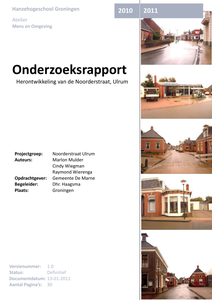
Dit is het onderzoeksrapport voor de Herontwikkeling van de Noorderstraat, Ulrum. De projectgroep die dit verslag heeft geschreven bestaat uit een multidisciplinair team bestaande uit één student van Bouwkunde en Architectuur: Marlon Mulder, één student Civiele Techniek, Raymond Wierenga en een studente Human Technology, Cindy Wiegman De Noorderstraat in Ulrum voelt op dit moment niet aan als de hoofdstraat van het dorp, ondanks dat deze dat wel is. De projectgroep streeft ernaar om de Noorderstraat weer zijn oude allure terug te brengen, door middel van het bedenken van passende concepten. De concepten zijn bedacht naar aanleiding van een door de projectgroep uitgevoerd onderzoek. Na gedegen onderzoek, bleek dat het concept van een dorpsplein het best naar voren kwam. Naar aanleiding van dit rapport, is het Adviesrapport Herontwikkeling van de Noorderstraat, Ulrum gemaakt. Hierin staan de eindconcepten voor de Noorderstraat.Studentonderzoek in het kader van het thema Werklandschappen.
DOCUMENT
DOCUMENT
In ‘Het Leren van de Toekomst 4’ werd opnieuw geëxperimenteerd met versnelde onderwijsvernieuwing met innovatieve inzet van ict ten behoeve van de versterking van de innovatiekracht van Fontys lerarenopleiding Sittard. Innovatiekracht is de mate waarin onderwijsprofessionals in staat zijn structureel te innoveren met ict om het onderwijs te verbeteren. In het voor dit project ontwikkelde model voor innovatiekracht worden drie fasen onderscheiden: ideegeneratie, ideepromotie en ideerealisatie. Bij ideegeneratie spelen drie factoren in samenhang een rol: ‘willen’ innoveren (motivatie), ‘kunnen’ innoveren (de vakinhoudelijke, didactische en ict-competetie van docenten), en ‘mogen’ innoveren (leiderschap en ondersteuning door de organisatie). De drie factoren zijn belangrijk op zowel het niveau van de individuele docent als het team. Bij ideepromotie worden dezelfde niveaus onderscheiden. Een maat voor de innovatiekracht is het aantal gerealiseerde en duurzaam geïmplementeerde innovatieve ict-toepassingen in een gegeven tijdsperiode.
DOCUMENT

Presentation given at EURCRIM 2022 conference
DOCUMENT




