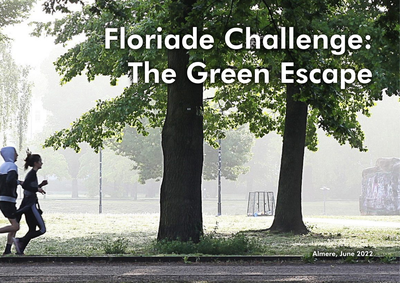
Almere is a green city where the greenery extends into the centre through a framework of nature, forests, parks and canals. With this green environment, Almere fulfils an important condition for a liveable city, where it is pleasant to live and work. An important goal for the municipality is to challenge its residents to develop a healthy lifestyle by using that green framework.But what really motivates Almeerders to go outside to exercise, enjoy the surroundings and meet each other? Are there sufficient green meeting or sports facilities nearby? Could the routes that connect the living and working environment with the larger parks or forests be better designed? And can those routes simultaneously contribute to climate adaptation?With the Green Escape Challenge, we invited students and young professionals to work on these assignments together.
DOCUMENT
Cities worldwide are growing at unprecedented rates, compromising their surrounding landscapes, and consuming many scarce resources. As a consequence, this will increase the compactness of cities and will also decrease the availability of urban green space. In recent years, many Dutch municipalities have cut back on municipal green space and itsmaintenance. To offer a liveable environment in 30 to 50 years, cities must face challenges head-on and strive to create green urban areas that build on liveable and coherent sustainable circular subsystems.
DOCUMENT

The concept of Smart Healthy Age-Friendly Environments (SHAFE) emphasises the comprehensive person-centred experience as essential to promoting living environments. SHAFE takes an interdisciplinary approach, conceptualising complete and multidisciplinary solutions for an inclusive society. From this approach, we promote participation, health, and well-being experiences by finding the best possible combinations of social, physical, and digital solutions in the community. This initiative emerged bottom-up in Europe from the dream and conviction that innovation can improve health equity, foster caring communities, and sustainable development. Smart, adaptable, and inclusive solutions can promote and support independence and autonomy throughout the lifespan, regardless of age, gender, disabilities, cultural differences, and personal choices, as well as promote happier and fairer living places.
DOCUMENT

This booklet is a short reflection on the workshop activities by the research group, Popular culture Sustainability and Innovation (PSI), of the Hanze University in Groningen for the CCC Reloaded: CREALAB project over the last one and half years. Based on a series of explorative workshops this booklet includes reflections on art, design & sustainability. A broad range of different stakeholders share their views on bio based design, the value of waste and the artist as agent of sustainable change. The urgency of the topic and the innovative opportunities it generates are highlighted by contributors like creative entrepreneurs, scientists, teachers and art students that collaborated in the past workshop series. A Sense of Green includes contributions by Han Brezet, Nathalie Beekman, Klaas Pieter Lindeman, Aart van Bezooijen, Anouk Zeeuw van der Laan, Anne Nigten and others.
DOCUMENT

More and more people worldwide live in urban areas, and these areas face many problems, of which a sustainable food provision is one. In this paper we aim to show that a transition towards more sustainable, regionally organized food systems strongly contributes to green, livable cities. The article describes a case study in the Dutch region of Arnhem–Nijmegen. Partners of a network on sustainable food in this region were interviewed on how they expect the food system to develop, and in design studies possible futures are explored. Both the interviews and the designs give support to the idea that indeed sustainable food systems can be developed to contribute to green livable cities. They show that the quality and meaning of existing green areas can be raised; new areas can be added to a public green system, and connections with green surroundings are enforced. They also show that inhabitants or consumers can be stimulated to become so called food citizens, highlighting that the relation of food systems and livable cities is a very close one.
DOCUMENT

This booklet reports on experiments carried out by Van Hall Larenstein University of Applied Sciences in the context of the VALUE project. It consists of three parts. The first two chapters describe some experiments carried out in the Dutch town of Amersfoort and the students’ input and approach. This is followed by an intermezzo on sources of inspiration outside the Netherlands and examples of the way urban green spaces and elements can provide an impulse for towns and cities. The final two chapters concern the way such a green strategy can be designed in Dutch urban settings. Chapter 5 discusses how local governments can use the added value provided by urban green spaces for new investments:value capturing. Chapter 6 focuses on a new type of planning: Planning by Surprise, which combines dreams and pragmatism. The photo essay at the centre of the book tells the story of the many sides of green spaces in towns and cities. Unintentional, intentional, planned, dreamed of, drawn,remembered, pictured, developed: Planning by Surprise.
DOCUMENT

With the beautiful new building of Aeres University of Applied Sciences Almere in the Floriade park, we have materialized our wish to lead the way in the green transition and its challenges. We want to be green changemakers and have the ambition to take on the challenges that we are faced with in agriculture, food and healthy living environments. We bring this about with our study programmes and increasingly with our Practice-Based Research Team. In 10 years’ time, this team has grown from our first professorship into a mature team of 20 people, of whom 7 are research professors.In this edition, three of our new professors will be introduced to you.
DOCUMENT
This paper conceptualises tourist idleness as a temporary engagement in slow, slothful and entirely unstructured holiday activities. We aim to extend the studies that prioritise the modalities of holidays in nature that encourage simplified, slower, immersive experiences, and which celebrate mindfulness, slowness and stillness as part of a tourist journey. In framing idleness as a relaxing, creative and recuperative holiday practice, we suggest that creating places of otium which encourage ‘doing nothing’ can in many ways enhance tourist wellbeing. To this end, we discuss the significance of spatial, temporal and existential elements of tourist idleness, whilst arguing that this ‘practice’ should be more celebrated in our modern, high-speed societies.
MULTIFILE
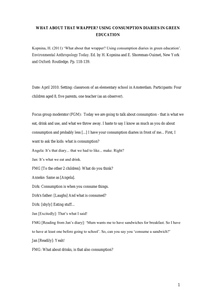
Environmental or ‘green' education is an important driving force behind the ‘greening' of society as it plays a critical role in raising environmental awareness and preparing students for green jobs. None of the existing environmental attitudes and behavior measures is focused on the evaluation of green education, especially in relation to consumption. To date, no longitudinal studies of children and students' attitudes towards consumption influenced by education exist. Also, little has been done to explore the socio-cultural context in which attitudes toward consumption are being formed and to explain the cross-cultural differences in environmental attitudes. This pilot study is designed to take the first step towards developing methods complementing existing quantitative measurements with qualitative strategies, such as consumption diaries, focus groups, and concept mapping. While this research is just a first attempt to tackle children's knowledge and attitudes consumption, preliminary results of the research on which this chapter is based and enthusiasm of the research participants encourage the author to stress the importance of consumption studies as part of green education for educational program developers. As a chapter of this volume, the author hopes that this study will add to the anthropological depository of research on the cultural variants in the perception of the environment in children. This chapter draws upon the consumption diaries collected from the upper-elementary school children in Amsterdam, The Netherlands, between September 2009 and May 2010. Consumption diaries are chronological documents recording purchase, use, and waste of materials, which can be used both as analytical tools and the means to stimulate environmental awareness. The four main methodological steps involved in this research were as follows. Children were asked to complete the consumption diary, paying specific attention to use and waste materials. Consequently, focus group meetings were held with parents and their children to discuss the diaries. Finally, interviews with the children were conducted in order to generate statements that supplement those generated by focus groups for carrying out the concept mapping analysis. The concept mapping analysis was then conducted to organize the order and analyze the ideas expressed in the focus group and interview sessions. This is an Accepted Manuscript of a book chapter published by Routledge/CRC Press in "Environmental Anthropology Today" on 8/5/11 available online: https://doi.org/10.4324/9780203806906 LinkedIn: https://www.linkedin.com/in/helenkopnina/
MULTIFILE
Storymaps met overzicht van alle groene plekken in de binnenstad van Groningen. Een verkennend onderzoek in het kader van het onderzoeksproject 'Groene Parels'. Focus ligt op het verkennen van verborgen groen en hun zichtbaarheid en aantrekkelijkheid als koelteplekken.
LINK



