The primary purpose of this study was to examine whether grip strength is related to total muscle strength in children, adolescents, and young adults. The second purpose was to provide reference charts for grip strength, which could be used in the clinical and research setting. This cross-sectional study was performed at primary and secondary schools and the University of Applied Sciences. Three hundred and eighty-four healthy Dutch children, adolescents, and young adults at the age of 8 to 20 years participated. Isometric muscle strength was measured with a handheld dynamometer of four muscle groups (shoulder abductors, grip strength, hip flexors, and ankle dorsiflexors). Total muscle strength was a summing up of shoulder abductors, hip flexors, and ankle dorsiflexors. All physical therapists participated in a reliability study. The study was started when intratester and intertester reliability was high (Pearson correlation coefficient >0.8). Grip strength was strongly correlated with total muscle strength, with correlation coefficients between 0.736 and 0.890 (p < 0.01). However, the correlation was weaker when controlled for weight (0.485-0.564, p < 0.01). Grip strength is related to total muscle strength. This indicates, in the clinical setting, that grip strength can be used as a tool to have a rapid indication of someone's general muscle strength. The developed reference charts are suitable for evaluating muscle strength in children, adolescents, and young adults in clinical and research settings.
DOCUMENT
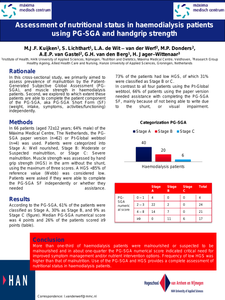
In this cross-sectional study, we primarily aimed to assess prevalence of malnutrition by the Patient Generated Subjective Global Assessment (PGSGA), and muscle strength in haemodialysis patients. Second, we explored to which extent these patients are able to complete the patient component of the PG-SGA, aka PG-SGA Short Form (SF) (weight, intake, symptoms, activities/functioning) independently.
DOCUMENT
Background and Purpose: Decreased muscle mass and muscle strength are independent predictors of poor postoperative recov- ery in patients with esophageal cancer. If there is an association between muscle mass and muscle strength, physiotherapists are able to measure muscle strength as an early predictor for poor postoperative recovery due to decreased muscle mass. Therefore, in this cross-sectional study, we aimed to investigate the association between muscle mass and muscle strength in predominantly older patients with esophageal cancer awaiting esophagectomy prior to neoadjuvant chemoradiation. Methods: In patients with resectable esophageal cancer eligible for surgery between March 2012 and October 2015, we used computed tomographic scans to assess muscle mass and compared them with muscle strength measures (hand- grip strength, inspiratory and expiratory muscle strength, 30 seconds chair stands test). We calculated Pearson correla- tion coefficients and determined associations by multivariate linear regression analysis. Results and Discussion: A tertiary referral center referred 125 individuals to physiotherapy who were eligible for the study; we finally included 93 individuals for statistical analysis. Mul- tiple backward regression analysis showed that gender (95% confidence interval [CI], 2.05-33.82), weight (95% CI, 0.39- 1.02), age (95% CI, −0.91 to −0.04), left handgrip strength (95% CI, 0.14-1.44), and inspiratory muscle strength (95% CI, 0.08-0.38) were all independently associated with muscle surface area at L3. All these variables together explained 66% of the variability (R2) in muscle surface area at L3 (P < .01). Conclusions: This study shows an independent association between aspects of muscle strength and muscle mass in patients with esophageal cancer awaiting surgery, and phys- iotherapists could use the results to predict muscle mass on the basis of muscle strength in preoperative patients with esophageal cancer.
DOCUMENT
Purpose. This cross-sectional study investigates deficits and associations in muscle strength, 6-minute walking distance (6MWD), aerobic capacity (VO2peak), and physical activity (PA) in independent ambulatory children with lumbosacral spina bifida. Method. Twenty-tree children participated (13 boys, 10 girls). Mean age (SD): 10.4 (±3.1) years. Muscle strength (manual muscle testing and hand-held dynamometry), 6MWD, VO2peak (maximal exercise test on a treadmill), and PA (quantity and energy expenditure [EE]), were measured and compared with aged-matched reference values. Results. Strength of upper and lower extremity muscles, and VO2peak were significantly lower compared to reference values. Mean Z-scores ranged from -1.2 to -2.9 for muscle strength, and from -1.7 to -4.1 for VO2peak. EE ranged from 73 - 84% of predicted EE. 6MWD was significantly associated with muscle strength of hip abductors and foot dorsal flexors. VO2peak was significantly associated with strength of hip flexors, hip abductors, knee extensors, foot dorsal flexors, and calf muscles. Conclusions. These children have significantly reduced muscle strength, 6MWD, VO2peak and lower levels of PA, compared to reference values. VO2peak and 6MWD were significantly associated with muscle strength, especially with hip abductor and ankle muscles. Therefore, even in independent ambulating children training on endurance and muscle strength seems indicated.
DOCUMENT
BACKGROUND: A significant number of older patients planned for transcatheter aortic valve implantation (TAVI) experience a decline in physical functioning and death, despite a successful procedure.OBJECTIVE: To systematically review the literature on the association of preprocedural muscle strength and physical performance with functional decline or long-term mortality after TAVI.METHODS: We followed the PRISMA guidelines and pre-registered this review at PROSPERO (CRD42020208032). A systematic search was conducted in MEDLINE and EMBASE from inception to 10 December 2021. Studies reporting on the association of preprocedural muscle strength or physical performance with functional decline or long-term (>6 months) mortality after the TAVI procedure were included. For outcomes reported by three or more studies, a meta-analysis was performed.RESULTS: In total, two studies reporting on functional decline and 29 studies reporting on mortality were included. The association with functional decline was inconclusive. For mortality, meta-analysis showed that low handgrip strength (hazard ratio (HR) 1.80 [95% confidence interval (CI): 1.22-2.63]), lower distance on the 6-minute walk test (HR 1.15 [95% CI: 1.09-1.21] per 50 m decrease), low performance on the timed up and go test (>20 s) (HR 2.77 [95% CI: 1.79-4.30]) and slow gait speed (<0.83 m/s) (HR 2.24 [95% CI: 1.32-3.81]) were associated with higher long-term mortality.CONCLUSIONS: Low muscle strength and physical performance are associated with higher mortality after TAVI, while the association with functional decline stays inconclusive. Future research should focus on interventions to increase muscle strength and physical performance in older cardiac patients.
DOCUMENT

BackgroundPatients undergoing total knee arthroplasty (TKA) often experience strength deficits both pre- and post-operatively. As these deficits may have a direct impact on functional recovery, strength assessment should be performed in this patient population. For these assessments, reliable measurements should be used. This study aimed to determine the inter- and intrarater reliability of hand-held dynamometry (HHD) in measuring isometric knee strength in patients awaiting TKA.MethodsTo determine interrater reliability, 32 patients (81.3% female) were assessed by two examiners. Patients were assessed consecutively by both examiners on the same individual test dates. To determine intrarater reliability, a subgroup (n = 13) was again assessed by the examiners within four weeks of the initial testing procedure. Maximal isometric knee flexor and extensor strength were tested using a modified Citec hand-held dynamometer. Both the affected and unaffected knee were tested. Reliability was assessed using the Intraclass Correlation Coefficient (ICC). In addition, the Standard Error of Measurement (SEM) and the Smallest Detectable Difference (SDD) were used to determine reliability.ResultsIn both the affected and unaffected knee, the inter- and intrarater reliability were good for knee flexors (ICC range 0.76-0.94) and excellent for knee extensors (ICC range 0.92-0.97). However, measurement error was high, displaying SDD ranges between 21.7% and 36.2% for interrater reliability and between 19.0% and 57.5% for intrarater reliability. Overall, measurement error was higher for the knee flexors than for the knee extensors.ConclusionsModified HHD appears to be a reliable strength measure, producing good to excellent ICC values for both inter- and intrarater reliability in a group of TKA patients. High SEM and SDD values, however, indicate high measurement error for individual measures. This study demonstrates that a modified HHD is appropriate to evaluate knee strength changes in TKA patient groups. However, it also demonstrates that modified HHD is not suitable to measure individual strength changes. The use of modified HHD is, therefore, not advised for use in a clinical setting.
MULTIFILE

Background: Lipoedema is a chronic disorder of adipose tissue typically involving an abnormal build-up of fat cells in the legs, thighs and buttocks. Occurring almost exclusively in women, it often co-exists with obesity. Due to an absence of clear objective diagnostic criteria, lipoedema is frequently misdiagnosed as obesity, lymphoedema or a combination of both. The purpose of this observational study was to compare muscle strength and exercise capacity in patients with lipoedema and obesity, and to use the findings to help distinguish between lipoedema and obesity. Design: This cross-sectional, comparative pilot study performed in the Dutch Expertise Centre of Lymphovascular Medicine, Drachten, a secondary-care facility, included 44 women aged 18 years or older with lipoedema and obesity. Twenty-two women with lipoedema (diagnosed according the criteria of Wold et al, 1951) and 22 women with body mass index ≥30kg/m2 (obesity) were include in the study. No interventions were undertaken as part of the study. Results: Muscle strength of the quadriceps was measured with the MicroFET™, and functional exercise capacity was measured with the 6-minute walk test. The group with lipoedema had, for both legs, significantly lower muscle strength (left: 259.9 Newtons [N]; right: 269.7 N; p < 0.001) than the group with obesity. The group with lipoedema had a non-significant, but clinically relevant lower exercise-endurance capacity (494.1±116.0 metres) than the group with obesity (523.9±62.9 metres; p=0.296). Conclusions: Patients with lipoedema exhibit muscle weakness in the quadriceps. This finding provides a potential new criterion for differentiating lipoedema from obesity. We recommend adding measuring of muscle strength and physical endurance to create an extra diagnostic parameter when assessing for lipoedema.
LINK
IMPORTANCE: Sarcopenia and obesity are 2 global concerns associated with adverse health outcomes in older people. Evidence on the population-based prevalence of the combination of sarcopenia with obesity (sarcopenic obesity [SO]) and its association with mortality are still limited.OBJECTIVE: To investigate the prevalence of sarcopenia and SO and their association with all-cause mortality.DESIGN, SETTING, AND PARTICIPANTS: This large-scale, population-based cohort study assessed participants from the Rotterdam Study from March 1, 2009, to June 1, 2014. Associations of sarcopenia and SO with all-cause mortality were studied using Kaplan-Meier curves, Cox proportional hazards regression, and accelerated failure time models fitted for sex, age, and body mass index (BMI). Data analysis was performed from January 1 to April 1, 2023.EXPOSURES: The prevalence of sarcopenia and SO, measured based on handgrip strength and body composition (BC) (dual-energy x-ray absorptiometry) as recommended by current consensus criteria, with probable sarcopenia defined as having low handgrip strength and confirmed sarcopenia and SO defined as altered BC (high fat percentage and/or low appendicular skeletal muscle index) in addition to low handgrip strength.MAIN OUTCOME AND MEASURE: The primary outcome was all-cause mortality, collected using linked mortality data from general practitioners and the central municipal records, until October 2022.RESULTS: In the total population of 5888 participants (mean [SD] age, 69.5 [9.1] years; mean [SD] BMI, 27.5 [4.3]; 3343 [56.8%] female), 653 (11.1%; 95% CI, 10.3%-11.9%) had probable sarcopenia and 127 (2.2%; 95% CI, 1.8%-2.6%) had confirmed sarcopenia. Sarcopenic obesity with 1 altered component of BC was present in 295 participants (5.0%; 95% CI, 4.4%-5.6%) and with 2 altered components in 44 participants (0.8%; 95% CI, 0.6%-1.0%). An increased risk of all-cause mortality was observed in participants with probable sarcopenia (hazard ratio [HR], 1.29; 95% CI, 1.14-1.47) and confirmed sarcopenia (HR, 1.93; 95% CI, 1.53-2.43). Participants with SO plus 1 altered component of BC (HR, 1.94; 95% CI, 1.60-2.33]) or 2 altered components of BC (HR, 2.84; 95% CI, 1.97-4.11) had a higher risk of mortality than those without SO. Similar results for SO were obtained for participants with a BMI of 27 or greater.CONCLUSIONS AND RELEVANCE: In this study, sarcopenia and SO were found to be prevalent phenotypes in older people and were associated with all-cause mortality. Additional alterations of BC amplified this risk independently of age, sex, and BMI. The use of low muscle strength as a first step of both diagnoses may allow for early identification of individuals at risk for premature mortality.
DOCUMENT

BACKGROUND: Survival of kidney transplant recipients (KTR) is low compared with the general population. Low muscle mass and muscle strength may contribute to lower survival, but practical measures of muscle status suitable for routine care have not been evaluated for their association with long-term survival and their relation with each other in a large cohort of KTR.METHODS: Data of outpatient KTR ≥ 1 year post-transplantation, included in the TransplantLines Biobank and Cohort Study (ClinicalTrials.gov Identifier: NCT03272841), were used. Muscle mass was determined as appendicular skeletal muscle mass indexed for height 2 (ASMI) through bio-electrical impedance analysis (BIA), and by 24-h urinary creatinine excretion rate indexed for height 2 (CERI). Muscle strength was determined by hand grip strength indexed for height 2 (HGSI). Secondary analyses were performed using parameters not indexed for height 2. Cox proportional hazards models were used to investigate the associations between muscle mass and muscle strength and all-cause mortality, both in univariable and multivariable models with adjustment for potential confounders, including age, sex, body mass index (BMI), estimated glomerular filtration rate (eGFR) and proteinuria. RESULTS: We included 741 KTR (62% male, age 55 ± 13 years, BMI 27.3 ± 4.6 kg/m 2), of which 62 (8%) died during a median [interquartile range] follow-up of 3.0 [2.3-5.7] years. Compared with patients who survived, patients who died had similar ASMI (7.0 ± 1.0 vs. 7.0 ± 1.0 kg/m 2; P = 0.57), lower CERI (4.2 ± 1.1 vs. 3.5 ± 0.9 mmol/24 h/m 2; P < 0.001) and lower HGSI (12.6 ± 3.3 vs. 10.4 ± 2.8 kg/m 2; P < 0.001). We observed no association between ASMI and all-cause mortality (HR 0.93 per SD increase; 95% confidence interval [CI] [0.72, 1.19]; P = 0.54), whereas CERI and HGSI were significantly associated with mortality, independent of potential confounders (HR 0.57 per SD increase; 95% CI [0.44, 0.81]; P = 0.002 and HR 0.47 per SD increase; 95% CI [0.33, 0.68]; P < 0.001, respectively), and associations of CERI and HGSI with mortality remained independent of each other (HR 0.68 per SD increase; 95% CI [0.47, 0.98]; P = 0.04 and HR 0.53 per SD increase; 95% CI [0.36, 0.76]; P = 0.001, respectively). Similar associations were found for unindexed parameters. CONCLUSIONS: Higher muscle mass assessed by creatinine excretion rate and higher muscle strength assessed by hand grip strength are complementary in their association with lower risk of all-cause mortality in KTR. Muscle mass assessed by BIA is not associated with mortality. Routine assessment using both 24-h urine samples and hand grip strength is recommended, to potentially target interdisciplinary interventions for KTR at risk for poor survival to improve muscle status.
DOCUMENT
Background The plantar intrinsic foot muscles (PIFMs) have a role in dynamic functions, such as balance and propulsion, which are vital to walking. These muscles atrophy in older adults and therefore this population, which is at high risk to falling, may benefit from strengthening these muscles in order to improve or retain their gait performance. Therefore, the aim was to provide insight in the evidence for the effect of interventions anticipated to improve PIFM strength on dynamic balance control and foot function during gait in adults. Methods A systematic literature search was performed in five electronic databases. The eligibility of peer-reviewed papers, published between January 1, 2010 and July 8, 2020, reporting controlled trials and pre-post interventional studies was assessed by two reviewers independently. Results from moderate- and high-quality studies were extracted for data synthesis by summarizing the standardized mean differences (SMD). The GRADE approach was used to assess the certainty of evidence. Results Screening of 9199 records resulted in the inclusion of 11 articles of which five were included for data synthesis. Included studies were mainly performed in younger populations. Low-certainty evidence revealed the beneficial effect of PIFM strengthening exercises on vertical ground reaction force (SMD: − 0.31-0.37). Very low-certainty evidence showed that PIFM strength training improved the performance on dynamic balance testing (SMD: 0.41–1.43). There was no evidence for the effect of PIFM strengthening exercises on medial longitudinal foot arch kinematics. Conclusions This review revealed at best low-certainty evidence that PIFM strengthening exercises improve foot function during gait and very low-certainty evidence for its favorable effect on dynamic balance control. There is a need for high-quality studies that aim to investigate the effect of functional PIFM strengthening exercises in large samples of older adults. The outcome measures should be related to both fall risk and the role of the PIFMs such as propulsive forces and balance during locomotion in addition to PIFM strength measures.
MULTIFILE




