Introduction: Losing items is a time-consuming occurrence in nursing homes that is ill described. An explorative study was conducted to investigate which items got lost by nursing home residents, and how this affects the residents and family caregivers. Method: Semi-structured interviews and card sorting tasks were conducted with 12 residents with early-stage dementia and 12 family caregivers. Thematic analysis was applied to the outcomes of the sessions. Results: The participants stated that numerous personal items and assistive devices get lost in the nursing home environment, which had various emotional, practical, and financial implications. Significant amounts of time are spent on trying to find items, varying from 1 hr up to a couple of weeks. Numerous potential solutions were identified by the interviewees. Discussion: Losing items often goes together with limitations to the participation of residents. Many family caregivers are reluctant to replace lost items, as these items may get lost again.
LINK
How to find out what students, starters, and other new households of transformed buildings need to create a home environment with a comfortable climate without losing meanings attributed to the home?
DOCUMENT

Background Parenting a child with profound intellectual and multiple disabilities has great implications. Parents generally rely heavily on healthcare and social welfare services in caring for the child at home. Previous studies indicated mismatch between what parents need to preserve family and personal wellbeing and what is typically provided by services. This study focused on the role of healthcare and social welfare services in childcare and aims to contribute to understanding how parents perceive their interactions with service providers. Methods We interviewed 25 Dutch parents who cared for their child at home. Data were analysed using Framework Method. Findings Two overarching themes were found: “Being the lifeline” addressed that parents had central roles in fragmented services, and “Losing ownership” highlighted that parents were constrained in living life according to own beliefs and values while interacting with providers. Conclusions Findings illuminated that many parents became overburdened and compromised heavily on agency over family thriving due to functioning of healthcare and social welfare services. Findings supported working with integrated family case managers, creating effective and proactive access to equipment and services, and enacting high quality facilities for help with childcare and respite. These are important conditions to enable parents to construct family life more autonomously and make their further contribution to society. This may also lead to improved connotations of dependence on healthcare and social welfare services.
MULTIFILE

This paper will query whether a dedicated news platform can attune to young people’s civic needs? That is to ask: can this be a space that follows a social media logic of conversation and ‘give and take’ – with producers and consumers changing roles or even losing the distinction? How could and would such a news source be of interest to urban young, arguably the group that feels most removed from citizen status and social acceptance for who they happen to be? ‘Urban youth’ for us refers to a very specific group of young people. They are Marokko.nl’s community members. As the name suggests a fair number of them will consider themselves to be Moroccan-Dutch. From our perspective it is important to understand this group as identifying with ethnic minority groups in the Netherlands, although most of them will have been born in the Netherlands and hold Dutch citizenship. More than other young people they will recognize Islam as the religion they feel closest to. They also share a sense, as will become clear below, that they are caught ‘between two worlds’ (Elias and Lemish, 2008; Singla, 2004; Gezduci and D’Haenens, 2010). Mainstream Dutch media cast preciously few actors, anchors, audience members and experts from ethnic minority groups. Not surprisingly, this is often given as a reason to distrust hegemonic media and as underlining a sense of distance and alienation from Dutch society (see also Awad and Roth, 2011: 401).
DOCUMENT
Background: Around 13% of the world’s population suffers from obesity. More than 40% of people with obesity display emotional eating behaviour (eating in response to negative emotions or distress). It is an alternate to moreeffective coping strategies for negative emotions. Our study explored the opportunities for helping adults with emotional overeating using a virtual coach, aiming to identify preferences for tailored coaching strategies applicable in a personal virtual coach environment. Three different coaching strategies were tested: a validating, a focus-on-change, and a dialectical one – the latter being a synthesis of the first two strategies. Methods: A qualitative study used vignettes reflecting the two most relevant situations for people with emotional eating: 1. experiencing negative emotions, with ensuing food cravings; and 2. after losing control to emotional eating, with ensuing feelings of low self-esteem. Applied design: 2 situations × 3 coaching strategies. Participants: 71 adult women (Mage 44.4/years, range 19–70, SD = 12.86) with high scores on the DEBQ-emotional eating scale (Memo 3.65, range 1.69–4.92, SD = .69) with mean BMI 30.1 (range 18–46, SD = 6.53). They were recruited via dieticians’ practices, were randomly assigned to the conditions and asked how they would face and react to thepresented coaching strategies. Data were transcribed and a thematic analysis was conducted. Results: Qualitative results showed that participants valued both the validating coaching strategy and the focus-onchange strategy, but indicated that a combination of validation and focus-on-change provides both mental supportand practical advice. Data showed that participants differed in their level of awareness of the role that emotions play in their overeating and the need for emotion-regulation skills. Conclusion: The design of the virtual coach should be based on dialectical coaching strategies as preferred by participants with emotional eating behaviour. It should be tailored to the different stages of awareness of their emotions and individual emotion-regulation skills.
DOCUMENT

Each of us has a story that comes alive as we wake up in the morning, develops throughout the day, and holds layers of meaning as we lay our heads down at night – it might be called a narrative of our identity. When loss occurs, our story fragments into unfamiliar pieces, and who we identify as becomes scattered – sometimes even shattered. We must work to reconstruct meaning in our lives and to rebuild our identity. As leading author on this editorial, with an article of my own in this issue, I confronted this when my father died. I felt his story slipping away, becoming blurred, forgotten, and for some, erased – and the same held true for me. The chaos of my shattered identity exacerbated the deep pain of losing him and I experienced complicated grief. I had to reshape my narrative to remember the authentic parts of me and rebuild a new self in a fatherless world. This journey is in part what motivated me to become a symposium co-editor for the journal. All four of us editors of this special issue have experienced “living with loss” following the premature loss of either our father or spouse, and I wanted to see what lived experience and knowledge we could bring to the readers about loss in the fields of both guidance and counselling.
MULTIFILE

Due to the increase in scale due to (digital) technology, we are increasingly losing sight of our "common grounds". Our behaviour becomes bizarre, almost psychotic, but decimated by social media. In these Big Tech 'village squares ', we are both consumers and producers, like the sheep of yesteryear, overstimulated and overfed with hyper food, craving human contact.
MULTIFILE

Op basis van een cross-sectioneel onderzoek onder deelnemers aan een hardloopevenement worden verschillen tussen snelle en langzame hardlopers onderzocht. Verschillen in motieven voor hardlopen en ervaren belang van app functionaliteiten werden in kaart gebracht. Ook werd gekeken naar verschillen in hun intentie om te blijven hardlopen, hoe apps gebruikt worden en verwachte effecten van app gebruik.
DOCUMENT
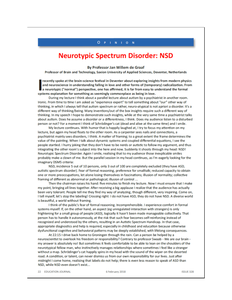
A colomn about Neurotypic Spectrum Disorder (NSD). Incidence 5 out of 10 persons, only 3 out of 100 are completely excluded (they have ASD, autistic spectrum disorder). NSD means a reduced capacity to obtain one or more preoccupations, let alone losing themselves in fascinations; Superficial knowledge of everything in general, reduced ability to specific expertise; Illusion of normality; Reduced tolerance to any form of differentness; Collective framing of different as abnormal or pathological; Illusion of control ... It is opposed tot ASD.
MULTIFILE
Europe’s urban economies do not look the same as ten years ago. And in ten years from now,they will again be different. The digital revolution is particularly disruptive: entire sectors are being transformed, old playersare losing out, newcomers are taking over, and competition is fiercer than ever. At the same time, citizens are not just workers in companies, but many become independent entrepreneurs, and active producers.Innovation is becoming open, involving interaction between companies, universities and users. Working, living and recreation become intertwined in place and time.
MULTIFILE




