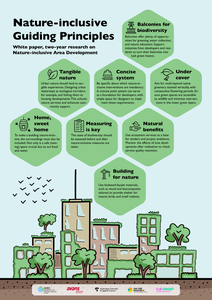
Urban nature enhancement is a theme that needs to be considered across different scales. From pocket parks and façade-greening to urban green infrastructure, biodiversity thrives best through connectivity.In the SIA-project, Nature-inclusive Area Development, four universities of applied sciences - Aeres University of Applied Sciences, Avans University of Applied Sciences, Amsterdam University of Applied Sciences, and Van Hall Larenstein University of AppliedSciences- researched three levels of area development to accelerate the transition to nature-inclusive area development. The study consisted of three case studies: Waarder Railway Zone (building), Knowledge Mile Park (KMP - street - Amsterdam), and AlmereCentre-Pampus (area).
DOCUMENT
The Caribbean Netherlands are dealing with a situation where imported vegetables and fruits are mostly imported and hardly affordable. This leads to consuming unhealthy food and high obesities rates as a consequence. A lack of good agricultural practices with regard to water-smart and nature inclusive agriculture, as well as limited coping capacities to deal with hazards and climate change, results in very limited local production and interest. Initiatives that focused only on agrotechnological solutions for food resilient futures turned out to be ineffective due to a lack of local ownership, which jeopardizes sustainability. Moreover, the 'green' and 'blue' domains are not seen as attractive career perspectives among youth, hampering a bright future for those domains.
DOCUMENT

Urban Agriculture (UA) is rapidly evolving and changing and often entails more than the production of food. EFUA’s Working Package 3 therefore aims to identify the types and benefits of UA in the European context. This report is an update of the typology as described in the COST Action UAE. As existing typologies are often based on subjective observation rather than on empirical data and are also one-dimensional, this study is based on a systematic literature review about characteristics and existing typologies of UA, interviews with sixteen experts in the field representing eleven European countries and a questionnaire about specific UA initiatives amongst 112 respondents.
DOCUMENT
Presentation held at the National Conference ADT Baramati, India on the 6th February 2024
DOCUMENT

This paper analyses the initiative AgroAgenda in the northern Netherlands. The AgroAgenda is a platform in which multiple stakeholders together stimulate a circular, and nature-inclusive agro-food system in the Dutch provinces of Friesland, Groningen and Drenthe. Stakeholders come from, among others, provincial governments, farmers’ and nature organizations, educational and research institutes and processing companies. They join forces to realize a system change, a transition, in the region, while promoting knowledge circulation, knowledge co-creation and joint learning. The platform, is a front runner of five national, comparable initiatives. The AgroAgenda has the potential to lead to a more nature-inclusive and circular farming. Several of the 40 experiments have already led to good results. However, to bring about a real system change, more attention to innovations in governmental organizations (including law and regulations), policy, the value chains (division of margins, pricing and marketing) and the educational system are needed.
DOCUMENT

VHL University of Applied Sciences (VHL) is a sustainable University of AppliedSciences that trains students to be ambitious, innovative professionals andcarries out applied research to make a significant contribution to asustainable world. Together with partners from the field, they contribute to innovative and sustainable developments through research and knowledge valorisation. Their focus is on circular agriculture, water, healthy food & nutrition, soil and biodiversity – themes that are developed within research lines in the variousapplied research groups. These themes address the challenges that are part ofthe international sustainability agenda for 2030: the sustainable developmentgoals (SDGs). This booklet contains fascinating and representative examplesof projects – completed or ongoing, from home and abroad – that are linked tothe SDGs. The project results contribute not only to the SDGs but to their teaching as well.
DOCUMENT

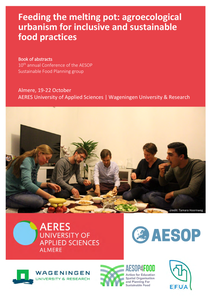
This book contains the abstracts to the sessions presented at the AESOP Sustainable Food Planning conference in 2022. The conference was made up of four tracks: social inclusion; urban agriculture; urban planning, design and development; food governance.
DOCUMENT
This open access book states that the endemic societal faultlines of our times are deeply intertwined and that they confront us with challenges affecting the security and sustainability of our societies. It states that new ways of inhabiting and cultivating our planet are needed to keep it healthy for future generations. This requires a fundamental shift from the current anthropocentric and economic growth-oriented social contract to a more ecocentric and regenerative natural social contract. The author posits that in a natural social contract, society cannot rely on the market or state alone for solutions to grand societal challenges, nor leave them to individual responsibility. Rather, these problems need to be solved through transformative social-ecological innovation (TSEI), which involves systemic changes that affect sustainability, health and justice. The TSEI framework presented in this book helps to diagnose and advance innovation and change across sectors and disciplines, and at different levels of governance. It identifies intervention points and helps formulate sustainable solutions for policymakers, administrators, concerned citizens and professionals in moving towards a more just and equitable society.
MULTIFILE

How can the stewards of our planet be rewarded and become an existential part of a brand-experience? Is our “Consumer mindset” actually able to always take our planet Earth’s viability in consideration while we’re consuming or buying products? Erwin van Woudenberg is a professor at HAS University of Applied sciences, leading a research program, Innovative Entrepreneurship in Rural Areas, aiming to develop new business models including nature-inclusive agriculture. Erwin comes up with unconventional solutions that inspire action, especially within agriculture and in connection with biodiversity and supply chains. He proudly tells us about his travels to the village of Lubuklinggau, on Sumatra, Indonesia where he is working on a rather revolutionary solution with Mr. Karmain. This farmer works on his rubber farm every day, while making decisions to either protect the forest or provide food for his family. This talk was given at a TEDx event using the TED conference format but independently organized by a local community.
LINK
The transition towards a sustainable and healthy food system is one of the major sustainability challenges of today, next to the energy transition and the transition from a linear to circular economy. This paper provides a timely and evidence-based contribution to better understand the complex processes of institutional change and transformative social-ecological innovation that takes place in the food transition, through a case study of an open innovation and food transition network in The Netherlands, the South-Holland Food Family (Zuid-Hollandse Voedselfamilie). This network is supported by the provincial government and many partners, with the ambition to realize more sustainable agricultural and food chains, offering healthy, sustainable and affordable food for everyone in the Province of South-Holland in five to ten years from now. This ambition cannot be achieved through optimising the current food system. A transition is needed – a fundamental change of the food system’s structure, culture and practice. The Province has adopted a transition approach in its 2016 Innovation Agenda for Sustainable Agriculture. This paper provides an institutional analysis of how the transition approach has been established and developed in practice. Our main research question is what interventions and actions have shaped the transition approach and how does the dynamic interplay between actors and institutional structures influence institutional change, by analysing a series of closely related action situations and their context, looking at 'structure' and 'agency', and at the output-outcomes-impact of these action situations. For this purpose, we use the Transformative Social-Ecological Innovation (TSEI)-framework to study the dynamic interplay between actors and institutional structures influencing institutional change. The example of TSEI-framework application in this paper shows when and how local agents change the institutional context itself, which provides relevant insights on institutional work and the mutually constitutive nature of structure and agency. Above institutional analysis also shows the pivotal role of a number of actors, such as network facilitators and provincial minister, and their capability and skills to combine formal and informal institutional environments and logics and mobilize resources, thereby legitimizing and supporting the change effort. The results are indicative of the importance of institutional structures as both facilitating (i.e., the province’s policies) and limiting (e.g. land ownership) transition dynamics.
DOCUMENT