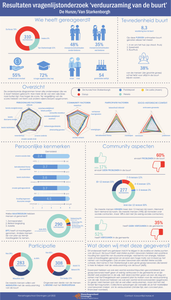
Grafische samenvatting van de onderzoeksresultaten.
DOCUMENT
The neighborhood of Houtlaan in Assen, the Netherlands, has ambitious targets for reducing the neighborhood’scarbon emissions and increasing their production of their own, sustainable energy. Specifically, they wish toincrease the percentage of houses with a heat pump, electric vehicle (EV) and solar panels (PV) to 60%, 70%and 80%, respectively, by the year 2030. However, it was unclear what the impacts of this transition would be onthe electricity grid, and what limitations or problems might be encountered along the way.Therefore, a study was carried out to model the future energy load and production patterns in Houtlaan. Thepurpose of the model was to identify and quantify the problems which could be encountered if no steps are takento prevent these problems. In addition, the model was used to simulate the effectiveness of various proposedsolutions to reduce or eliminate the problems which were identified.
DOCUMENT

Citizen participation is booming, especially the number of urban bottom-up initiatives where information and communication technologies (ICT) are deployed is increasing rapidly. This growth is good news for society as recent historical research shows that the more citizens actively and persistently interfere with public issues, the more likely a society will be resilient. And yet, at the same time, a growing number of scholars argue that due to the unprecedented impact of ICT, the public sphere is at stake. How to understand both trends? How do the anti-‘public sphere’ developments relate to the growing number of citizens’ initiatives using ICT? And if these citizen initiatives can indeed be understood as manifestations of public spheres, how can ICT foster or hinder the development of these public spheres? These questions will be explored by analyzing a Dutch citizen initiative called ‘Buuv’ (an online ‘market’ place for and by local residents) from a ‘public sphere’ perspective. The author will turn to The human condition (1958) of Hannah Arendt in order to elaborate a ‘public sphere’ perspective. An Arendtian perspective (as any perspective) highlights, however, some aspects and underexposes other aspects. Furthermore, chances are that Arendt’s thoughts are somewhat outdated, in the sense that we now live in a world where the online and the offline life intertwine — an experience that is referred to with the term ‘onlife’. Bearing these remarks in mind, the author will elaborate on the value of Arendt’s ideas to 1) the endeavor of understanding current trends in society—more urban bottom-up initiatives and anti-‘public sphere’ developments due to the broad uptake of ICT—and 2) the endeavor of revitalizing the public sphere in an onlife world. IEEE copyright
MULTIFILE

The goal of a local energy community (LEC) is to create a more sustainable, resilient, and efficient energy system by reducing dependence on centralized power sources and enabling greater participation and control by local communities and individuals. LEC requires transformations in local energy systems, and strongly depends on the preferences and actions of the local actors involved. The necessity for extensive stakeholder involvement adds complexity to the energy transition, posing a significant challenge for all involved parties. The municipality of Leidschendam-Voorburg has committed to the national decision for energy transition. It has taken a strategic approach by proceeding De Heuvel/Amstelwijk as the pioneer in this initiative, leading the way for other neighborhoods to follow. It is crucial to devise strategies that effectively facilitate stakeholder engagement. To this end, a thorough stakeholder analysis is needed. Such an analysis can focus on the identification of key stakeholders, their interests, their influence, and their behavioral characteristics in relation to the energy transition. Additionally, it's crucial to uncover the challenges encountered by these stakeholders and finally develop appropriate strategies to address them hence enhance their engagement. This thesis begins with an introduction to the research background, including a presentation of the case study and a statement of the problem identified in the field, followed by the research questions underpinning the study. A thorough literature review ensues, providing a robust synthesis of existing research relating to stakeholder engagement in LECs, with a view to expediting energy transitions. The literature review not only forms the foundation for the research methods adopted in this study but also promotes in the construction of the conceptual model. Subsequent to the literature review, the research method is detailed. The filed research is conducted in five steps: Step 1 - identification of stakeholders, Step 2 - prioritization of stakeholders, Step 3 - interviewing, Step 4 - data analysis, including stakeholder profiling with mapping and addressing challenges, and finally, Step 5 - proposal of strategies for stakeholder engagement enhancement based on the expected and current levels of stakeholders engagement. This research collects necessary information to understand the profiles of stakeholders in De Heuvel/Amstelwijk, tackle challenges faced by different stakeholders, propose strategies to increase stakeholders engagement. It not only aims to enrich the depth of theoretical knowledge on the subject matter but also strives to aid in the development of a localized energy strategy that is optimally suited for the De Heuvel/Amstelwijk neighborhood as good example for other neighborhoods.
DOCUMENT

Objective: To investigate the effects of a school-based once-a-week sports program on physical fitness, physical activity, and cardiometabolic health in children and adolescents with a physical disability. Methods: This controlled clinical trial included 71 children and adolescents from four schools for special education [mean age 13.7 (2.9) years, range 8–19, 55% boys]. Participants had various chronic health conditions including cerebral palsy (37%), other neuromuscular (44%), metabolic (8%), musculoskeletal (7%), and cardiovascular (4%) disorders. Before recruitment and based on the presence of school-based sports, schools were assigned as sport or control group. School-based sports were initiated and provided by motivated experienced physical educators. The sport group (n = 31) participated in a once-a-week school-based sports program for 6 months, which included team sports. The control group (n = 40) followed the regular curriculum. Anaerobic performance was assessed by the Muscle Power Sprint Test. Secondary outcome measures included aerobic performance, VO2 peak, strength, physical activity, blood pressure, arterial stiffness, body composition, and the metabolic profile. Results: A significant improvement of 16% in favor of the sport group was found for anaerobic performance (p = 0.003). In addition, the sport group lost 2.8% more fat mass compared to the control group (p = 0.007). No changes were found for aerobic performance, VO2 peak, physical activity, blood pressure, arterial stiffness, and the metabolic profile. Conclusion: Anaerobic performance and fat mass improved following a school-based sports program. These effects are promising for long-term fitness and health promotion, because sports sessions at school eliminate certain barriers for sports participation and adding a once-a-week sports session showed already positive effects for 6 months.
DOCUMENT

Bijna de helft van de Nederlandse volwassenen voelt zich eenzaam. Tussen 2012 en 2022 is het percentage dat zich matig of sterk eenzaam voelt toegenomen van 39% naar 49%. Het percentage volwassenen dat zich sterk eenzaam voelt, nam toe van 8 naar 14% (VZinfo, 2023). De inrichting van de openbare ruimte kan bijdragen aan het verlichten van gevoelens van eenzaamheid. Het doel van dit onderzoek is om te achterhalen welke kenmerken van de openbare ruimte het sterkst samenhangen met gevoelens van eenzaamheid onder jongvolwassenen.
LINK
Like the professionals, design students tend to avoid the complexity of the user context, and moral issues are largely overlooked. This inspired us to explore whether we could engage design students in thinking about moral issues by exploring different ethical frameworks in their designing. As a case environment we chose smart-grid product service combinations. In this paper we first discuss the ethical frameworks of four selected philosophers’: Plato, Rousseau, Kant, & Mill. Then we will describe the student design process, the resulting four smart grid service concepts and the user insights that came from a user evaluation. We discuss how this approach allowed the students to get insights in their own ethical stance and how they allowed users to reflect on possible futures. We also discuss how these ‘probing’ concepts were used within the larger smart grid project.
DOCUMENT

ClimateCafé is a field education concept involving dierent fields of science and practice for capacity building in climate change adaptation. This concept is applied on the eco-city of Augustenborg in Malmö, Sweden, where Nature-Based Solutions (NBS) were implemented in 1998.ClimateCafé Malmö evaluated these NBS with 20 young professionals from nine nationalities and seven disciplines with a variety of practical tools. In two days, 175 NBS were mapped and categorised in Malmö. Results show that the selected green infrastructure have a satisfactory infiltration capacity and low values of potential toxic element pollutants after 20 years in operation. The question “Is capacity building achieved by interdisciplinary field experience related to climate change adaptation?” was answered by interviews, collecting data of water quality, pollution, NBS and heat stress mapping, and measuring infiltration rates, followed by discussion. The interdisciplinary workshops with practical tools provide a tangible value to the participants and are needed to advance sustainabilityeorts. Long term lessons learnt from Augustenborg will help stormwater managers within planning of NBS. Lessons learned from this ClimateCafé will improve capacity building on climate change adaptation in the future. This paper oers a method and results to prove the German philosopher Friedrich Hegel wrong when he opined that “we learn from history that we do not learn from history”
DOCUMENT

from the repository of Utrecht University: "PURPOSE: Previously, a high prevalence of certain psychiatric disorders was shown among non-Western immigrants. This study explores whether this results in more prescriptions for psychotropic medication. METHODS: Data on dispensing of medication among adults living in the four largest Dutch cities in 2013 were linked to demographic data from Statistics Netherlands. Incident (i.e., following no dispensing in 2010-2012) and prevalent dispensing among immigrants was compared to that among native Dutch (N = 1,043,732) and analyzed using multivariable Poisson and logistic regression. RESULTS: High adjusted Odds Ratios (ORadj) of prevalent and high Incidence Rate Ratios (IRRadj) of incident dispensing of antipsychotics were found among Moroccan (N = 115,455) and Turkish individuals (N = 105,460), especially among young Moroccan males (ORadj = 3.22 [2.99-3.47]). Among Surinamese (N = 147,123) and Antillean individuals (N = 41,430), slightly higher rates of dispensed antipsychotics were found and the estimates decreased after adjustment. The estimates for antipsychotic dispensing among the Moroccan and Turkish increased, following adjustment for household composition. Rates for antidepressant dispensing among Turkish and Moroccan subjects were high (Moroccans: ORadj = 1.74 [1.70-1.78]). Among Surinamese and Antillean subjects, the rates for antidepressant dispensing were low and the ORadjlagged behind the IRRadj(Surinamese: 0.69 [0.67-0.71] vs. 1.06 [1.00-1.13]). Similar results were found for anxiolytics. For ADHD medication, lower dispensing rates were found among all migrant groups. CONCLUSIONS: The findings agree with earlier reports of more mental health problems among Moroccan and Turkish individuals. Surinamese/Antillean individuals did not use psychotropic drugs at excess and discontinued antidepressants and anxiolytics earlier. The data strongly suggest under-treatment for ADHD in all ethnic minority groups."
LINK




