Wat is de beroepsidentiteit van sociaal werk, wat behoort zij te zijn? Sociaal werk wordt wel omschreven als een professie maar ook als een ambacht, vaak zonder duidelijk onderscheid tussen en wellicht zelfs door impliciete gelijkstelling van deze kwalificaties. Met behulp van de ideaaltypische benadering kan echter worden aangetoond dat deze twee typen beroepen niet alleen veel overeenkomsten delen maar ook op enkele punten fundamenteel van elkaar verschillen. Op basis van het werk van Freidson (2001) en Sennett (2008) kan worden aangetoond dat het ideaaltypische doel van professies het realiseren van een abstracte waarde (zoals rechtvaardigheid) is, terwijl ambachten gericht zijn op het manipuleren van concrete materialen (bijvoorbeeld steen). Bijgevolg zijn (enkel) professies beroepen met een morele identiteit. In alle zelfdefinities van sociaal werk is deze morele identiteit, deze humanitaire kern aanwezig (zie bv. IFSW, NVMW). Daarom moet sociaal werk worden beschouwd als een professie en niet als een ambacht. Dit is niet louter een academische discussie maar beïnvloedt bijvoorbeeld de positie van dit beroep in de samenleving, zoals aan de hand van de ministeriële richtlijnen betreffende Welzijn Nieuwe Stijl kan worden geïllustreerd.
DOCUMENT

How societies respond to the challenges of human migration is one of the most morally defining and socioeconomically consequential policy decisions of our time. As anti-immigrant parties across the Global North seek to capitalize on public concerns about immigrant inclusion and border control, immigration has turned into a deepening social and political cleavage. Meanwhile, the greatest immigration challenges are faced in the Global South. The vast majority of refugees who are forcibly displaced by war, political violence, poverty and environmental disasters seek refuge in neighbouring regions where many states lack the capacity to adequately support them. Given these challenges it is imperative for occupational therapists and scientists to work collaboratively to support equitable occupational possibilities for immigrants, refugees and internally displaced persons.
MULTIFILE

The focus of the thesis is an exploration into students’ vocational knowledge in the context of Dutch vocational education and training (VET). The reason students’ vocational knowledge requires exploration is because there is no consensus among scholars in the field of VET about how to theorise the nature of students’ vocational knowledge; most (not all) scholars rely on dichotomous conceptualisations, such as theory versus practice, general versus specific or explicit versus implicit. However, such commonly used dichotomies are not very helpful to understand the complex nature of vocational knowledge. Vocational knowledge is more than putting bits of theoretical and practical knowledge together, it is characterised by sometimes-intimate relationships between knowledge and actions. As a result of the above-mentioned gap in the VET literature, there is little empirical research on how VET students develop vocational knowledge and the extent to which this is occupation-specific knowledge. To understand students’ vocational knowledge, four different aims are formulated and carried out in four studies. The aim of the first study is to identify powerful vocational learning environments to enable the selection of a case that represents high quality vocational learning and teaching. With an eye on analysing students’ vocational knowledge, the second study aims to conceptualise the nature of vocational knowledge that avoids dichotomies. Therefore, two conceptual frameworks are integrated; the idea of contextualising is introduced which is based on cultural-historical theory to highlight the crucial role activity plays in knowledge development and to understand the relationships between the mind (i.e., what people think (and feel)), and action (i.e., what people do). Secondly, the theory is supplemented with ideas from inferentialism, a philosophical semantic theory of meaning to provide a useful way to focus on students’ processes of knowing and to reveal students’ vocational knowledge in terms of ongoing reasoning processes. The third study uses the conceptualisation of vocational knowledge to explore how students develop vocational knowledge in occupational practice, and to illustrate the process of contextualising. The forth study aims to describe what characterises students’ vocational knowledge using an analytic framework that distinguishes between occupation-specific knowledge components and qualities. This thesis contributes to research scholarship in the field of VET and an understanding of students’ vocational knowledge in practice. The theoretical framework of contextualising supplemented with inferentialism provides an alternative way to focus on students’ processes of knowing and helps to reveal students’ vocational knowledge in terms of reasoning processes. The empirical explorations and illustrations of students’ vocational knowledge contribute to the scholarly literature and practice on understanding the nature of vocational knowledge, how students develop vocational knowledge and what characterises their vocational knowledge. The intention to introduce the idea of contextualising is not about reinventing the wheel but rather an attempt to understand how it turns and how it functions. The intention of this thesis is to encourage dialogue and move the debate about the nature of vocational knowledge further, and hence, to provide some “food for thought”.
DOCUMENT

Meten is weten. Daar zijn we het allemaal over eens. Maar hoe zorg je er voor dat je op het goede moment en met het juiste meetinstrument een zinvolle meting doet? Meten is immers geen doel op zich. Onlangs kwam een nieuwe uitgave van het boek Meten in de praktijk: Stappenplan voor het gebruik van meetinstrumenten in de praktijk uit. Hoog tijd om stil te staan bij meten in de dagelijkse ergotherapiepraktijk en daar een stappenplan voor te presenteren.
DOCUMENT

Introduction:Community development approaches are increasingly used by occupational therapists in response to occupational justice theory, which posits that both individuals and community groups may be denied access to meaningful occupations through societal powers outside their control. Previous research has found that occupational therapists feel insufficiently prepared for a role in community development and tend to use their general skill set, sometimes in combination with generic community development approaches. This study explored whether the reflective framework for community development in occupational therapy is applicable and useful for occupational therapists in the United Kingdom.Methods:A mixed methods approach was used, combining an online questionnaire and focus groups with occupational therapists who already work in community development. Findings were compared with the framework.Findings:The participants recognised most aspects of the Framework in their own practice, but some key aspects such as collaboration with the community at every stage were less prominent. They found the framework applicable to the UK context, particularly for occupational therapists inexperienced in community development practice.Conclusion:This study has highlighted community development practice by occupational therapists in the United Kingdom and concluded that the framework would support them in fulfilling this role more effectively.
DOCUMENT
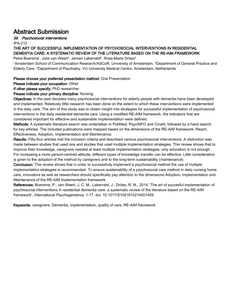
Presentatie gegeven over de review in Brussel Objectives: In the past decades many psychosocial interventions for elderly people with dementia have been developed and implemented. Relatively little research has been done on the extent to which these interventions were implemented in the daily care. The aim of this study was to obtain insight into strategies for successful implementation of psychosocial interventions in the daily residential dementia care. Using a modified RE-AIM framework, the indicators that are considered important for effective and sustainable implementation were defined.
MULTIFILE
Evidence-based practice (EBP) is tegenwoordig niet meer weg te denken als we praten over de kwaliteit en de status van het beroep. Maar in de dagelijkse praktijk zijn er nog veel vragen: 'Betekent EBP nu dat we alleen maar mogen doen waarvoor voldoende evidence bestaat?' 'Hoe komen we aan die evidence?' 'Hoe verhoudt EBP zich ten opzichte van het binnen de ergotherapie centrale uitgangspunt: clïentgecentreerde zorg?' In dit artikel gaan we in op deze laatste vraag rondom EBP en cliëntgericht werken.
DOCUMENT

In deze volledig herziene derde druk van Ergovaardig zijn veelgebruikte ergotherapeutische vaardigheden beschreven met aandacht voor recente ontwikkelingen in de gezondheidszorg, de ergotherapeutische beroepspraktijk en het onderwijs. De vaardigheden zijn beschreven vanuit de uitgangspunten cliëntgericht werken, evidence-based practice en occupation-based ergotherapie. De vaardigheden zijn waar mogelijk beschreven als zogenoemde ‘bouwstenen’ die eerst enkelvoudig geoefend kunnen worden. Zodra de betreffende vaardigheid beheerst wordt, kunnen combinaties gemaakt worden met andere vaardigheden en kunnen variaties worden aangebracht. Op deze wijze wordt geleerd om de vaardigheid wendbaar toe te passen en in verschillende niveaus van complexiteit.In dit deel ‘Uitvoeren van interventies’ komt een breed scala aan ergotherapeutische interventies aan bod.Voor deze derde druk zijn alle vaardigheden geactualiseerd en herschreven, en zijn er nieuwe vaardigheden toegevoegd: motiverende gespreksvoering en cognitief-gedragstherapeutisch werken.De online leeromgeving op www.ergovaardig.nl is nieuw vormgegeven en uitgebreid met nieuwe vaardighedenopnames, voorbereidende en oefenopdrachten, kennistests en digitaal in te vullen oefenlijsten.Ergovaardig is tot stand gekomen als samenwerking tussen de Hogeschool van Amsterdam, Hogeschool van Arnhem en Nijmegen, Hogeschool Rotterdam en Zuyd Hogeschool Heerlen.Doelgroep•Studenten ergotherapie•Professionals (zoals stagebegeleiders)
DOCUMENT
This paper reports on the collective ideas of the occupational scientists and therapists who attended the “Refugees – Addressing Key Social Issues” think tank at the Occupational Science Conference held in Hildesheim (2017). Forced migration is recognized as a prevalent issue in today’s society. Forced migrants face many occupational challenges, which are being exacerbated by restrictive migration policies. This paper outlines the discussions held during the think tank and presents an occupational perspective of forced migrants’ needs, followed by a desired vision of what an occupationally just world would look like for forced migrants, and future directions to guide occupation-based social transformation.
DOCUMENT
In deze volledig herziene derde druk van Ergovaardig zijn veelgebruikte ergotherapeutische vaardigheden beschreven met aandacht voor recente ontwikkelingen in de gezondheidszorg, de ergotherapeutische beroepspraktijk en het onderwijs. De vaardigheden zijn beschreven vanuit de uitgangspunten cliëntgericht werken, evidence-based practice en occupation-based ergotherapie. De vaardigheden zijn waar mogelijk beschreven als zogenoemde ‘bouwstenen’ die eerst enkelvoudig geoefend kunnen worden. Zodra de betreffende vaardigheid beheerst wordt, kunnen combinaties gemaakt worden met andere vaardigheden en kunnen variaties worden aangebracht. Op deze wijze wordt geleerd om de vaardigheid wendbaar toe te passen en in verschillende niveaus van complexiteit. In dit deel ‘Inventarisatie en analyse’ zijn verschillende vaardigheden beschreven die nodig zijn in de eerste fase van het ergotherapeutisch proces. Kennismaking, vraagverheldering en de analyse van de handelingsvraag van de cliënt en zijn omgeving staan centraal.Voor deze derde druk zijn alle vaardigheden geactualiseerd en herschreven, en is een nieuwe vaardigheid toegevoegd: werken met de Activiteitenweger.De online leeromgeving op www.ergovaardig.nl is nieuw vormgegeven en uitgebreid met nieuwe vaardighedenopnames, voorbereidende en oefenopdrachten, kennistests en digitaal in te vullen oefenlijsten. Ergovaardig is tot stand gekomen als samenwerking tussen de Hogeschool van Amsterdam, Hogeschool van Arnhem en Nijmegen, Hogeschool Rotterdam en Zuyd Hogeschool Heerlen. Doelgroep- Studenten ergotherapie- Professionals (zoals stagebegeleiders)
DOCUMENT



