Voelen kinderen en jongeren zich voldoende gerepresenteerd en aangesproken in het kunstonderwijs dat ze aangeboden krijgen? Deze vraag stond centraal op de Hanze Kunsteducatie werkveldbijeenkomst over Re/Presentatie in Kunsteducatie van 21 november 2024. Het thema van de bijeenkomst komt voort uit een deelproject van het onderzoeksproject Re/Presenting Europe1 waarin het lectoraat Kunsteducatie participeert.
DOCUMENT

Greenhouses are in need of new monitoring tools, as they size grow bigger and bigger but still using old labour intensive methods ways of caring for the crop. HiPerGreen is set out to create a new tool, which can drive onto the pre-existing heating pipes to provide a birds eye perspective for image analysis purposes. However, clear images are necessary for consistent usable data. This presentation resumes the steps taken during the reporting: the optimisation of a rail based system towards clear images. This is done through analysis of resulting images, understanding vibrations and oscillations, and finally presents results based on prototyping. Moreover, a re-design of the electronics and hardware was also introduce to facilitate prototyping. The results are promising, laying within the requirements.
DOCUMENT

Rivers all over the world are deteriorating in a fast rate. As a response, movements in the defence of rivers emerge and aim to restore and protect rivers. One of these defence strategies is to politicise fish to generate arguments for the protection of rivers, drawing from a fish-friendly river imaginary. The concept of river imaginaries describes that power is exercised through and by knowledge generated in truth regimes. In this poster presentation, we elaborate on two cases in which fishing people and their allies use a variety of truth strategies, resonating with specific fish-friendly river imaginaries. Both case studies are influenced by harmful mining and industry practices that pollute the river and wetland.The Dutch case study of the Border Meuse river reveals that the main argument to politicise fish is that infrastructural interventions and hydropower is killing and damaging fish. Through knowledge generating on the amount of fish-death and the aquatic state, a knowledge agenda is set and power is exercised to stop harmful river activities. The Colombian case of the Zapatosa wetlands reveals that the main argument to politicise fish is that fish is the main source of food. Through knowledge generating that focusses on re-learning from past artisanal fishing strategies and biocultural adaptation, a knowledge agenda is set and power is exercised to stop harmful mining practices. Although these river movements are using truth regimes to defend rivers, counter facts, counter norms, and counter agendas in the defence of harmful practices remain to exist.
DOCUMENT

Presentatie gegeven over de review in Brussel Objectives: In the past decades many psychosocial interventions for elderly people with dementia have been developed and implemented. Relatively little research has been done on the extent to which these interventions were implemented in the daily care. The aim of this study was to obtain insight into strategies for successful implementation of psychosocial interventions in the daily residential dementia care. Using a modified RE-AIM framework, the indicators that are considered important for effective and sustainable implementation were defined.
MULTIFILE
Een fles rode wijn per dag drinken is ongezond, maar een glas per dag reduceert mogelijk de kans op hartkwalen. Dit is een voorbeeld van ‘hormese’: het verschijnsel dat een agens dat in grote hoeveelheden schadelijk is, bij lage doses juist gezond is. Iets vergelijkbaars geldt voor zonlicht: lage doses worden geassocieerd met positieve gezondseffecten, hoge doses met verbranden en een hogere kans op huidkanker. Er zijn onderzoekers die zich op het omstreden standpunt stellen dat ook ioniserende straling hormetische eigenschappen heeft. In dit artikel gaan we nader in op de verschillende standpunten omtrent lage-dosiseffecten, de argumenten voor en tegen hormese en de consequenties van recente inzichten.
DOCUMENT

Economische impact World Rowing Championships 2014 Van 24 tot 31 augustus 2014 vond op de Bosbaan in Amsterdam de World Rowing Championships (WRC) plaats. Met het oog op de verdere ontwikkeling van het evenement wil de World Rowing Federation (FISA inzicht krijgen in de economische impact van dit evenement. Zij heeft de Hogeschool van Amsterdam in samenwerking met Hogeschool Inholland en Sport2B gevraagd hier onderzoek naar te doen. Daarnaast heeft de FISA enkele aanvullende vragen geformuleerd over de tevredenheid van bezoekers en vrijwilligers. Bezoekers Het bezoekersaantal wordt geschat op 40.000, waarvan 30.000 unieke bezoekers. Buitenlandse bezoekers besteedden gemiddeld 77 euro per dag, Nederlandse bezoekers 27 euro en Amsterdamse bezoekers 20 euro. De bezoekers waren goed voor 28.500 overnachtingen in de dagen rondom het evenement. De totale bestedingsimpuls gerealiseerd door bezoekers bedroeg 3,1 miljoen. Deelnemers In totaal namen 1.800 atleten en begeleiders deel aan het evenement. Conservatief geschat gaven de deelnemers gemiddeld 25 euro per dag uit. De totale additionele uitgaven van atleten en begeleiders komen daarmee op 534.000 euro. In totaal waren de atleten goed voor 19.500 overnachtingen. De totale uitgaven voor de accommodatie komen daarmee op meer dan 2 miljoen euro. Zes nationale teams hebben als voorbereiding op WRC in juni deelgenomen aan de International Rowing Regatta Amsterdam (IRRA), dit genereerde een lokale economische impact van 149.000 euro. De totale bestedingsimpuls gerealiseerd door deelnemers bedroeg 2,7 miljoen euro. Organisatie en media Het saldo van in- en uitgaande geldstromen veroorzaakt door de organisatie en de media bedroeg 0,8 miljoen euro. De totale directe en indirecte economische impact: 9,2 miljoen euro.
DOCUMENT

Een website waarop online tools op het gebied van psychosociale informatie en hulp aan jeugd/jongeren en gezinnen worden beschreven
LINK
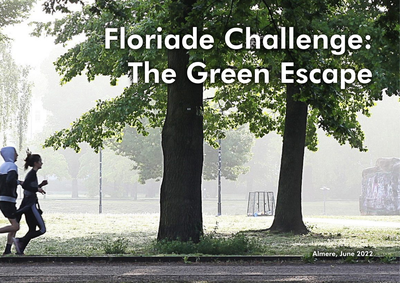
Almere is a green city where the greenery extends into the centre through a framework of nature, forests, parks and canals. With this green environment, Almere fulfils an important condition for a liveable city, where it is pleasant to live and work. An important goal for the municipality is to challenge its residents to develop a healthy lifestyle by using that green framework.But what really motivates Almeerders to go outside to exercise, enjoy the surroundings and meet each other? Are there sufficient green meeting or sports facilities nearby? Could the routes that connect the living and working environment with the larger parks or forests be better designed? And can those routes simultaneously contribute to climate adaptation?With the Green Escape Challenge, we invited students and young professionals to work on these assignments together.
DOCUMENT
According to a governmental decision, all (re)constructions in Dutch cities starting by 2020 have to be climate resilient. Part of this climate resilience is also adaptation to (extreme) heat. Although urban heat, its causes, consequences, and potential adaptation measures, have been extensively studied by scientists all over the world, the understanding of this problem among practitioners is still limited. Local governments are struggling with defining the urgency and finding the right arguments for adaptation to this aspect of climate change. Also questions asked by municipality officers often differ from those asked (and answered) by scientists. How do you define “heat stress”? What are the best adaptation measures for our city? How do we know we have reached “heat resilience”? Or; Shall we just do what they do in Italy?Project Heat Resilient Cities is a cooperation of two research institutes, 13 municipalities, and a water authority in Netherlands. The aim of this project is to bring the current knowledge of urban heat adaptation to practice and to fill in the research gabs. The research focuses on clear visualizations of problematic areas, applicable heat resilient measures in Dutch context, and design guidelines leading towards more heat resilient cities. In this presentation, we will present an overview of practical tools (maps, instruments measures, visualizations, guidelines) that cities could use put heat resilience into practice.
DOCUMENT





