During an interview at Georgetown University’s School of Foreign Service one student questioned Prime Minister Rutte about an official apology for slavery. The Dutch Prime Minister assured that each island-nation to whom the Kingdom apologized “has full power to decide to leave the Kingdom. They are not colonized. They are independent.” Rutte described the current role of The Netherlands as that of a “gateway” to bring their products to Europe. The emphasis on trade relationship smacks of neo-colonial interests. Rutte’s portrayal of The Netherlands acting as the “in” to the European market for the former colonies is far from the recovery that one would expect for the descendants of the enslaved. In fact, the Slavery Past Dialogue made a number of recommendations to the Dutch Kingdom, including “active prevention of discrimination and institutional racism throughout society” and “the establishment of a Kingdom Fund […] for structural and sustainable financing of recovery measures.” The Dutch Prime Minister’s comments belie a singular focus on trade with the Caribbean nations rather than a holistic approach, looking at non-pecuniary interests involving the well-being of the descendants and the societies in which they live today. The “republicanization” serves as a backdrop to the years-long journey during which the Dutch government (and the Dutch crown) seemingly dragged their feet, refusing to issue a formal apology for the trade of Africans by the Dutch West Indies corporation. That much-solicited apology was finally issued in December 2022, despite warnings that any gesture that excluded reparations would not be favorably received by the Dutch Caribbean nations.
MULTIFILE

The purpose of this study was to identify predictors of oral hygiene behaviour (OHB) based on the Theory of Planned Behaviour (TPB) among dental care seekers in two cultural different regions: the Caribbean (Aruba/Bonaire) and Nepal. In addition, measures of oral health knowledge (OHK) and the expected social outcomes of having healthy teeth (ESO) were investigated. The main effects of the predictors as well as their interactions with region (Caribbean vs. Nepal) were examined. The interaction term contributed significantly to the amount of explained variance. In the Caribbean, OHB was determined by Attitude and Social Norms, and in Nepal by Perceived Behaviour Control and ESO. On the basis of these findings, quite different oral health care interventions are called for in developing and underdeveloped countries.
DOCUMENT
Description of the establishment of both Gymnophthalmus underwoodi and Indotyphlops braminus on Saba, Dutch Caribbean.
DOCUMENT

Biographical information of Jan Floris de Jongh
DOCUMENT

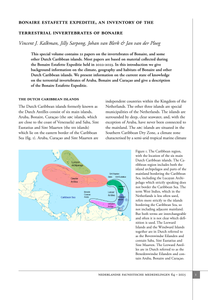
This special volume contains 21 papers on the invertebrates of Bonaire, and someother Dutch Caribbean islands. Most papers are based on material collected during the Bonaire Estafette Expeditie held in 2022-2023. In this introduction we give background information on the climate, geography and habitats of Bonaire and other Dutch Caribbean islands. We present information on the current state of knowledge on the terrestrial invertebrates of Aruba, Bonaire and Curaçao and give a description of the Bonaire Estafette Expeditie.
DOCUMENT
Baseline data on anthropogenic seafloor debris contamination in the year 2000 is provided for 24 submersible video transects at depths of 80–900 m, off the Dutch ABC-islands (Aruba, Bonaire, Curaçao), in the southeastern Caribbean Sea. In total, 202 objects were documented from a combined 21,184 m of transect, ranging from sandy lower island-slope to rocky upper island-slope habitat. Debris densities differed significantly with depth. Highest debris accumulation (0.459 items 100 m−2 or 4590 items per km2) occurred at depths of 300–600 m on more shallow-sloping (20–30°) sand and silt bottoms. The overall average debris density was 0.27 objects per 100 m2 (or 2700 items per km2), which is an order of magnitude higher than most other deepwater debris studies. What we describe may be representative for other small, populated, steep volcanic Caribbean islands. Food and beverage-related items were the single largest usage category identified (44% of objects; mostly glass beverage bottles).
DOCUMENT

The promotor was Prof. Erik Jan Hultink and copromotors Dr Ellis van den Hende en Dr R. van der Lugt. The title of this dissertation is Armchair travelling the innovation journey. ‘Armchair travelling’ is an expression for travelling to another place, in the comfort of one’s own place. ‘The innovation journey’ is the metaphor Van de Ven and colleagues (1999) have used for travelling the uncharted river of innovation, the highly unpredictable and uncontrollable process of innovation. This research study began with a brief remark from an innovation project leader who sighed after a long and rough journey: ‘had I known this ahead of time…’. From wondering ‘what could he have known ahead of time?’ the immediate question arose: how do such innovation journeys develop? How do other innovation project leaders lead the innovation journey? And could I find examples of studies about these experiences from an innovation project leader’s perspective that could have helped the sighing innovation project leader to have known at least some of the challenges ahead of time? This dissertation is the result of that quest, as we do know relatively little how this process of the innovation project leader unfolds over time. The aim of this study is to increase our understanding of how innovation project leaders lead their innovation journeys over time, and to capture those experiences that could be a source for others to learn from and to be better prepared. This research project takes a process approach. Such an approach is different from a variance study. Process thinking takes into account how and why things – people, organizations, strategies, environments – change, act and evolve over time, expressed by Andrew Pettigrew (1992, p.10) as catching “reality in flight”.
MULTIFILE

Background and aim Self-management support is an integral part of current chronic care guidelines. The success of self-management interventions varies between individual patients, suggesting a need for tailored self-management support. Understanding the role of patient factors in the current decision making of health professionals can support future tailoring of self-management interventions. The aim of this study is to identify the relative importance of patient factors in health professionals’ decision making regarding self-management support. Method A factorial survey was presented to primary care physicians and nurses. The survey consisted of clinical vignettes (case descriptions), in which 11 patient factors were systematically varied. Each care provider received a set of 12 vignettes. For each vignette, they decided whether they would give this patient self-management support and whether they expected this support to be successful. The associations between respondent decisions and patient factors were explored using ordered logit regression. Results The survey was completed by 60 general practitioners and 80 nurses. Self-management support was unlikely to be provided in a third of the vignettes. The most important patient factor in the decision to provide self-management support as well as in the expectation that self-management support would be successful was motivation, followed by patient-provider relationship and illness perception. Other factors, such as depression or anxiety, education level, self-efficacy and social support, had a small impact on decisions. Disease, disease severity, knowledge of disease, and age were relatively unimportant factors. Conclusion This is the first study to explore the relative importance of patient factors in decision making and the expectations regarding the provision of self-management support to chronic disease patients. By far, the most important factor considered was patient’s motivation; unmotivated patients were less likely to receive self-management support. Future tailored interventions should incorporate strategies to enhance motivation in unmotivated patients. Furthermore, care providers should be better equipped to promote motivational change in their patients.
DOCUMENT

Despite the notable strides that have been made in terms of participation in sport, women continue to be underrepresented in sport leadership roles such as coaching and officiating. The 2014 United Nations (UN) International Working Group on Women’s Sport (IWG) noted that: ‘Women are significantly under-represented in management, administration, coaching and officiating, particularly at the higher levels’ (IWG, 2014 p. 6). This statement, part of the Helsinki Declaration, was made in the context of how sport can support the UN Millennium Development Goals. Across today’s sporting landscape, women’s sport experiences typically occur in male-dominated contexts, which favour men and masculinity (Norman, 2016). Recent data indicates the men to women ratio in high-performance coaching over the last four consecutive Olympic cycles has been approximately 10:1. Among US high school sporting officials, only 11% are women, and even a greater disparity exists with officiating sports traditionally played by men (Nordstrom, Warner, & Barnes, 2016). This data highlights a systemic absence of women in coaching and officiating leadership roles across sport. In this chapter we will discuss the impact this has on developing sport for women and girls. Specifically, this chapter aims to: - Provide an understanding of the roles and responsibilities of coaches and officials in women and girls sport delivery. - Explore career development pathways for improving opportunities for women in coaching and officiating. - Present a critical reflection of the differences and similarities between athlete development and coach/official development (systems and structures) for women and girls. We begin by discussing the gendered nature of coaching before turning our attention to women’s experiences in sport officiating. We draw on relevant literature throughout the chapter and identify issues and opportunities for further research. We conclude by providing practical actions and recommendations to help facilitate coaching and officiating development for women and girls LinkedIn: https://www.linkedin.com/in/donna-de-haan/
MULTIFILE

This article focuses on engagements with elephants in diverse contexts, inquiring why some scholars are indifferent or even actively opposed to discourses that emphasise elephant suffering. In order to address this question, this article will explore three interrelated streams within social science: one that criticises conservation as an elitist, neo-colonial enterprise; one that is preoccupied with the social construction and cultural interpretation of natural phenomenon; and a third sometimes referred to as the new conservation science that focuses on economic valuations of the benefits nature, viewing “nature is a warehouse for human use.” https://doi.org/10.1080/13880292.2016.1204882 LinkedIn: https://www.linkedin.com/in/helenkopnina/
MULTIFILE




