In the housing market enormous challenges exist for the retrofitting of existing housing in combination with the ambition to realize new environmentally friendly and affordable dwellings. Bio-based building materials offer the possibility to use renewable resources in building and construction. The efficient use of bio-based building materials is desirable due to several potential advantages related to environmental and economic aspects e.g. CO2 fixation and additional value. The potential biodegradability of biomaterials however demands also in-novative solutions to avoid e.g. the use of environmental harmful substances. It is essential to use balanced technological solutions, which consider aspects like service life or technical per-formance as well as environmental aspects. Circular economy and biodiversity also play an im-portant role in these concepts and potential production chains. Other questions arise considering the interaction with other large biomass users e.g. food production. What will be the impact if we use more bio-based building materials with regard to biodiversity and resource availability? Does this create opportunities or risks for the increasing use of bio-based building materials or does intelligent use of biomass in building materials offer the possibility to apply still unused (bio) resources and use them as a carbon sink? Potential routes of intelligent usage of biomass as well as potential risks and disadvantages are highlighted and discussed in relation to resource efficiency and decoupling concept(s).
DOCUMENT

Stedelijke natuurversterking is bij uitstek een thema dat door de schalen heen moet worden bekeken. Van pocket park en gevelbekleding tot stedelijke groenstructuur, de biodiversiteit komt het beste tot bloei door samenhang.In het SIA-project Natuurinclusieve Gebiedsontwikkeling onderzochten vier hogescholen - Aeres Hogeschool, Avans Hogeschool, Hogeschool van Amsterdam en Hogeschool Van Hall Larenstein - drie schaalniveaus van gebiedsontwikkeling om de transitie naar natuurinclusieve gebiedsontwikkeling te versnellen. Gekoppeld aan drie casussen waren dit: gebouw (Spoorzone Waarder), straat (Knowledge Mile Park - KMP - Amsterdam), en gebied (Almere Centrum-Pampus). De casussen belichten veelvoorkomende typen ingrepen, zoals kleinschalige nieuwbouw, verbetering van de publieke ruimte, en binnenstedelijke woningbouw. Ondanks dat elke case een eigen thematisch zwaartepunt had - biobased materialen (Spoorzone Waarder), natuurlijke vergroening (KMP), en governance (Almere) - heeft via deelonderzoeken en tussen hogescholen kruisbestuiving plaatsgevonden. De white paper geeft de belangrijkste resultaten en lessen hiervan weer.Urban nature enhancement is a theme that needs to be considered across different scale levels. From pocket parks and façade greening to urban green infrastructure, biodiversity thrives best through connectivity.In the SIA-project Nature-inclusive Area Development, four universities of applied sciences - Aeres University of Applied Sciences, Avans UAS, Amsterdam UAS, and Van Hall Larenstein UAS- researched three scale levels of area development to accelerate the transition to nature-inclusive area development. This was linked to three case studies: Waarder Railway Zone (building), Knowledge Mile Park (KMP - street - Amsterdam), and Almere Centre-Pampus (area). The case studies represent common types of urban interventions, such as small-scale new developments, improvement of public space, and inner-city densification. Despite each case having its own thematic focus - biobased materials (Waarder Railway Zone), natural greening (KMP), and governance (Almere) - cross-pollination took place through sub-studies and collaboration between universities. The following pages present the main results and lessons learnt.
MULTIFILE

Positioning paper bij de inauguratie van Vincent Voet als lector Circular Plastics.
DOCUMENT
![People. Planet. Polymer: een Wereld te Winnen [Inaugurele rede]](https://publinova-harvester-content-prod.s3.amazonaws.com/thumbnails/files/previews/pdf/20250506132442742072.Positioning20Paper20Vincent20Voet202024-thumbnail-400x300.png)
Op 28 maart 2024 vond de slotbijeenkomst van het project Natuurinclusieve Gebiedsontwikkeling plaats in het Natural Pavilion te Almere. Tijdens deze bijeenkomst werden de belangrijkste bevindingen en aanbevelingen per case gepresenteerd van twee jaar onderzoek met als hoogtepunt de presentatie van de whitepaper met natuurinclusieve uitgangspunten. Naast de presentaties was er een posterexpositie georganiseerd waarbij op de posters de belangrijkste uitkomsten van diverse deelonderzoeken werden gepresenteerd. De posters van onderzoekers en studenten zijn in deze publicatie gebundeld.
DOCUMENT

Closed loop or ‘circular’ production systems known as Circular Economy and Cradle to Cradle represent a unique opportunity to radically revise the currently wasteful system of production. One of the challenges of such systems is that circular products need to be both produced locally with minimum environmental footprint and simultaneously satisfy demand of global consumers. This article presents a literature review that describes the application of circular methodologies to education for sustainability, which has been slow to adopt circular systems to the curriculum. This article discusses how Bachelor and Master-level students apply their understanding of these frameworks to corporate case studies. Two assignment-related case studies are summarized, both of which analyze products that claim to be 'circular'. The students' research shows that the first case, which describes the impact of a hybrid material soda bottle, does not meet circularity criteria. The second case study, which describes products and applications of a mushroom-based material, is more sustainable. However, the students' research shows that the manufacturers have omitted transport from the environmental impact assessment and therefore the mushroom materials may not be as sustainable as the manufacturers claim. As these particular examples showed students how green advertising can be misleading, applying “ideal” circularity principles as part of experiential learning could strengthen the curriculum. Additionally, this article recommends that sustainable business curriculum should also focus on de-growth and steady-state economy, with these radical alternatives to production becoming a central focus of education of responsible citizens. https://doi.org/10.1016/j.jclepro.2019.02.005 LinkedIn: https://www.linkedin.com/in/helenkopnina/
MULTIFILE

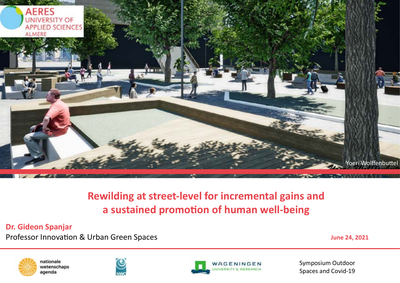
People during this Covid-19 year were forced to spend more time at home due to the lockdown and extreme weather conditions. Before the crisis, people already spent approximately 90 percent of their time indoors and relied on nearby public outdoor spaces for social and physical activities to maintain their health and well-being. During the pandemic, unhealthy, overcrowded, uncomfortable outdoor public spaces and a lack of greenery likely encouraged people to stay indoors even more. In city centres, greenery is often scarce: municipalities struggle to find nature-based solutions that meet the multiple functions of these areas.Fortunately, pandemics appear to spur cities to create healthier, greener environments. The nineteenth-century cholera pandemics, for example, led many western cities to establish large public parks to act as green lungs. These include Central Park and Prospect Park in New York, designed by the influential landscape architect Frederick Law Olmsted. The Covid-19 crisis creates the momentum to bring nature back into our cities and to repair vital ecosystem functions and derived Urban Ecosystem Services (UESs).In this action-research study we adopted the Panarchy model and its principle that initiatives on a fine-grained scale can eventually have a positive impact on the entire ecosystem. Green interventions at street-level hold the promise that they may activate communities to initiate change for more social-ecological resilience. This paper describes two experimental projects: The Climate Cube, installed at a shopping centre in the Nieuw-West district in Amsterdam, and the Rewilding Stepping Stones in the centre of New Town Almere. The Climate Cube consists of a pergola, large, interconnected planter boxes, and benches on each side and acts as a cool social spot. The aim is to explore how it might improve visitors’ (thermal) comfort and to build community support before larger redevelopment projects are launched. The Rewilding Stepping Stones are made of biobased and recycled materials and planted with native species to encourage nature to return to the city centre.
DOCUMENT
This document combines four reports on existing regional business support programmes for inclusion or understanding of circular economy (CE) objectives, deliverable DT3.1.2 from the transform-CE project. Besides a general overview on national and regional level, the focus is on a selection of national and regional programmes aimed at the plastics industry. After explaining the format to structure the programmes, the results for the four regions are presented: Greater Manchester (UK), Rhineland Palatinate and North-Rhine Westphalia (DE), Wallonia (BE), Central Netherlands (NL).
MULTIFILE
Het lectoraat Innoverend ondernemen verbonden aan De Haagse Hogeschool heeft op 12 november 2015 een seminar georganiseerd over nieuwe businessmodellen en de nieuwe economie. Van deze dag hebben we een verslag gemaakt middels deze uitgave. Een interessant naslagwerk voor alle ruim 150 deelnemers van dit seminar, die kunnen teruglezen wat ze deze dag hebben geleerd, maar ook kunnen leren van de workshops waarin ze niet hebben geparticipeerd. Daarnaast is deze uitgave leerzaam voor iedereen die geïnteresseerd is in nieuwe businessmodellen vanuit verschillende perspectieven, waarin theorie en praktijk samen komen.
DOCUMENT

The climate change and depletion of the world’s raw materials are commonly acknowledged as the biggest societal challenges. Decreasing the energy use and the related use of fossil fuels and fossil based materials is imperative for the future. Currently 40% of the total European energy consumption and about 45% of the CO2 emissions are related to building construction and utilization (EC, 2015). Almost half of this energy is embodied in materials. Developing sustainable materials to find replacement for traditional building materials is therefore an increasingly important issue. Mycelium biocomposites have a high potential to replace the traditional fossil based building materials. Mycelium is the ‘root network’ of mushrooms, which acts as a natural glue to bind biomass. Mycelium grows through the biomass, which functions simultaneously as a growth substrate and a biocomposite matrix. Different organic residual streams such as straw, sawdust or other agricultural waste can be used as substrate, therefore mycelium biocomposites are totally natural, non-toxic, biological materials which can be grown locally and can be composted after usage (Jones et al., 2018). In the “Building On Mycelium” project Avans University of Applied Sciences, HZ University of Applied Sciences, University of Utrecht and the industrial partners will investigate how the locally available organic waste streams can be used to produce mycelium biocomposites with properties, which make them suitable for the building industry. In this project the focus will be on studying the use of the biocomposite as raw materials for the manufacturing of furniture or interior panels (insulation or acoustic).
The postdoc candidate, Giuliana Scuderi, will strengthen the connection between the research group Biobased Buildings (BB), (collaboration between Avans University of Applied Sciences and HZ University of Applied Sciences (HZ), and the Civil Engineering bachelor programme (CE) of HZ. The proposed research aims at deepening the knowledge about the mechanical properties of biobased materials for the application in the structural and infrastructural sectors. The research is relevant for the professional field, which is looking for safe and sustainable alternatives to traditional building materials (such as lignin asphalt, biobased panels for bridge constructions, etc.). The study of the mechanical behaviour of traditional materials (such as concrete and steel) is already part of the CE curriculum, but the ambition of this postdoc is that also BB principles are applied and visible. Therefore, from the first year of the programme, the postdoc will develop a biobased material science line and will facilitate applied research experiences for students, in collaboration with engineering and architectural companies, material producers and governmental bodies. Consequently, a new generation of environmentally sensitive civil engineers could be trained, as the labour market requires. The subject is broad and relevant for the future of our built environment, with possible connections with other fields of study, such as Architecture, Engineering, Economics and Chemistry. The project is also relevant for the National Science Agenda (NWA), being a crossover between the routes “Materialen – Made in Holland” and “Circulaire economie en grondstoffenefficiëntie”. The final products will be ready-to-use guidelines for the applications of biobased materials, a portfolio of applications and examples, and a new continuous learning line about biobased material science within the CE curriculum. The postdoc will be mentored and supervised by the Lector of the research group and by the study programme coordinator. The personnel policy and job function series of HZ facilitates the development opportunity.



