Het onderzoek in het artikel is geïnspireerd door de casus 'platooning' uit de Grand Cooperative Driving Challenge. Er is een PreScan®/Sumulink® model opgesteld met daarin twee auto's. De voorste auto volgt een vastgesteld snelheidsprofiel, de tweede auto volgt de eerste auto waarbij de tweede auto de snelheid van de eerste meet met behulp van een AIR-sensor. De besturing van het gaspedaal in beide auto's vindt plaats met Fuzzy Logic Control in plaats van met een klassieke regelaar. Concluderend mag worden gesteld dat in dit verkennend onderzoek gebleken is dat de Fuzzy Logic Control techniek in principe werkt.
DOCUMENT

This article draws on Robinson, McNeill and Maruna’s argument (2012) about the adaptability of community sanctions and measures, observed through four distinctive penal narratives, in order to shed light on the regional development of community service in Wroclaw, Poland. While the managerial adaptation of community sanctions is underpinned by an inter-agency cooperation to fulfil the goals of the system, the contemporary rehabilitation iteration has become a toolkit of measures predominantly phrased around risk management, the reparative discourse seeks various means to repair harm, and the punitive orientation represent the turn to desert-based and populist sentencing frameworks. In this article, the first three are reflected upon along with the emerging, restorative adaptation of community sanctions. The last one is added to expand on the findings of previous research, which suggests the viability of the restorative orientation for community service in Poland (Matczak, 2018). A brief discussion of how punishment, probation and restorative justice can be reconciled is followed by the introduction of Polish Probation and the role of probation officers in delivering community service in Poland. Although the penal narratives are visible in the Wrocław model to different degrees and in various combinations, more research is required to evaluate the viability of a progressive orientation to punishment during a gradual optimisation of community orders. Originally published: Anna Matczak, The penal narratives of community sentence and the role of probation: The case of the Wrocław model of community service, European journal of probation (Vol. 13 nr. 1) pp. 72-88. Copyright © 2021year (The Author). DOI: 10.1177/2066220320976105
MULTIFILE

The theoretical framework of this dissertation is based on Amartya Sen’s capability approach (Chapter 2). In the early 1980s, development economist Amartya Sen developed the capability framework as a broad normative framework for the evaluation and assessment of individual well-being and social arrangements mainly in countries in the Global South (Sen, 1999, 2009). I chose the capability approach was chosen because of its strong focus on the notion of freedom as the capability to live the life each individual is aiming for. The freedom to choose a particular lifestyle is an intrinsic part of Sen’s notions of agency and well-being (Sen, 1999). After elaborating on notions of agency and well-being in detail, I turn to the role of financial self-help groups and how their members are influenced by social structures. This chapter concludes by operationalizing the theoretical framework into three capabilities (C1–C3) that serve as sensitizing concepts throughout the dissertation. These capabilities focus on the potential impact CAF groups have on members’ abilities to develop social networks (C1), to control their financial household management (C2), and to adopt an enterprising attitude (C3). Chapter 3 discusses my research methodology. I describe how the three capabilities (C1–C3) were applied as sensitizing concepts in the set-up of this particular action research (Blumer, 1954). I also explain in more detail how, by using sensitizing concepts, I combined an inductive research approach with a deductive angle. Then, I elaborate on the fundamental elements of this action research project: the implementation of the CAF groups as well as the collection and analysis of the empirical data. Finally, I reflect on how I designed and carried out this action research, with a special focus on the interaction between researcher and CAF members as research participants. A more detailed background description of the Dutch financial landscape is provided in Chapter 4. The chapter focuses on two particular financial self-help groups: ROSCAs among Ethiopians and Ghanaians living in the Netherlands. Compared to the formal banking system dominating the current financial landscape, these financial self-help groups claim effectivity instead of efficiency in the operation and management of their respective groups. By exploring developments in the current financial landscape, this chapter argues that distinguishing different kinds of resilience creates possibilities for analysing the different roles of financial arrangements and institutions for the financial landscape. Thus, this explorative study on ROSCAs questions the dominance of the financial side of the coin that has resulted from the efficiency-driven institutions of the financial sector. Chapter 5 presents each CAF group in more detail. The reader gets to know the different members of each CAF group and their motivations to join. Financial performance is assessed according to members’ savings and loan behaviour during the period of their participation. The quantitative data is analysed on how much the members of a respective CAF group saved and how much they borrowed from the group’s fund during the entire period of the research. These insights help the reader to better understand the differences and similarities between the five CAF groups. Chapter 6 discusses the empirical findings from the first three CAF groups. This chapter explores whether and how participation in a CAF group improves individuals’ well-being with regard to expanding their social networks, improving their financial household management, and strengthening their entrepreneurial positions. It also shows how participating in CAF groups at the grassroots level contributes to the well- Balancing the social and financial sides of the coin26being of vulnerable people in the Netherlands. Finally, the chapter reconsiders Sen’s notion of freedom for the particular context of overconsumption, inequality, and overindebtedness. In applying Sen’s capability approach, I realized that the approach has a “blind spot” regarding individuals’ possible impacts on the structures within and around them. By adding notions of Giddens’s structuration theory to the core concepts of the capability approach, I rendered the capability approach more sensitive to how CAF-group members may interact with their surrounding structures (Chapter 7). The relation between individuals and surrounding societal structures is extensively discussed in what is often referred to as the agency-structure debate (Ritzer, 2003). This debate is based on differing views about whether and to what extent individuals have a free will and can act according to their preferences, values, and personal feelings, or to what extent they are the “product” of their surrounding social structures. By expanding the capability approach with the notions of internal structures, on the one hand, and more proximate and more distant societal structures, on the other (Stones, 2008), I detail not only how individual agents are influenced by their surrounding structures, but how they might also have – however small and modest – an impact on those structures themselves. As a result, this chapter not only provides answers to how CAF-group participation affects individual members’ access to social networks, their financial household management, and their entrepreneurial positioning, but it also enabled me to investigate how and why individuals join a CAF group to take part in a so-called countermovement. Thus, I also consider how CAF members could possibly play a role in their surrounding social structures, like the existing financial landscape and the emerging participation society in the Netherlands.One way in which a CAF group can play a role in the surrounding structures is to become a community of practice. Wenger (1998) describes a community of practice as a group of people who share a certain domain of interest that distinguishes them from others. In a community of practice, it is crucial to learn from each other by engaging in joint activities and discussions. To discuss whether and how some of the CAF groups studied here turned into a community of practice, I apply the criteria of a common goal, trust, democratic leadership, and accumulation of knowledge in Chapter 8. The application of these criteria to the functioning of the CAF groups also provides more insight into how members interacted which each other in the different CAF groups. I will show how two of the five CAF groups indeed turned into communities of practice. Chapter 9 concludes this dissertation by linking the empirical findings on the individual level (Chapters 6 and 7) with those on the group level (Chapter 8). I follow this with a general discussion of the main contribution to theory development made by the Balancing the social and financial sides of the coin27expansion of Sen’s capability approach with Giddens’s structuration theory. Then, I discuss the role of CAF groups in enabling individual participants to balance the social and financial sides of the coin. Finally, I conclude this dissertation by showing how CAF groups have the potential to empower their members to meet the expectations of the participation society and the challenges of the contemporary financial landscape. I also provide recommendations for how engaged scholars doing action research can be reflective about the way they interact with their research participants and for how practitioners can set up CAF groups in the field. In the Epilogue, I tell the story of Cash2Grow. Based on the experiences and findings of my research, I co-founded the Cash2Grow foundation to promote savings groups in the Netherlands as a tool for financial and social empowerment. By developing improved savings-group methodologies and financial education tools, the foundation aims to train staff and volunteers from different types of (welfare) organizations to establish savings groups among their target populations. At the moment, we are also collaborating with similar organizations in Spain, Italy, Germany, and Poland to learn more from each other in a project subsidized by the EU.
DOCUMENT

Aligning IT and business needs is still one of the most important concerns for senior management. The message of Business and IT Alignment (BIA) is logical and undisputed, but implementation is apparently difficult. Luftman and Kempaiah [11] conclude that business and IT alignment needs a tool that can provide an assessment of an organization’s level of alignment and a roadmap on how to improve alignment. A broadly used framework for assessing business and IT alignment maturity is Luftman’s Strategic Alignment Maturity (SAM) model [10]. The paper presents a survey study into the perceived contribution of the different variables and sub-variables of the SAM model. We found that the perceived contribution of the variables are not equally spread and suggest a modification of the model
DOCUMENT

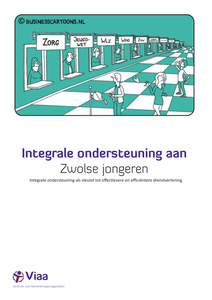
Het doel van het onderzoek is het ontwikkelen van een beleidsmatige en financieel haalbare interventie gericht op het vergroten de integrale samenwerking tussen gemeentelijke professionals zodat de maatschappelijke participatie van Zwolse jongeren tussen 16 en 27 jaar vergroot. De fasen van het Precede-Proceed-model werden gevolgd voor de drie deelonderzoeken interventieontwerp, disseminatiestrategie en businesscase. Data werden verzameld door literatuuronderzoek, deskresearch en veldonderzoek. De interventie van een integraal jongerenteam leidt tot betere vindbaarheid van ondersteuning en tijdigere ondersteuning. Jongeren hebben één casemanager en één toekomstplan gebaseerd op de wens en de mogelijkheden van de jongere. Professionals werken nauwer samen, door casuïstiekbespreking, kennisdeling en gezamenlijke besluitvorming, waardoor de integrale samenwerking versterkt. Professionals zijn gebaat bij formulering van een gemeenschappelijke norm voor integrale samenwerking. Het delen van inzichten met onderwijsinstellingen kan bijdragen aan ontwikkeling van beter passende onderwijsvormen om schooluitval te voorkomen. De interventie biedt een proactieve aanpak voor jongeren die door de coronacrisis geraakt worden. De interventie versterkt integrale samenwerking tussen gemeentelijke professionals door onderlinge kennisdeling en gezamenlijke besluitvorming, waardoor ondersteuning aan jongeren efficiënter en effectiever wordt. De interventie sluit aan bij het beleid, is financieel haalbaar en leidt naar verwachting tot toename van de maatschappelijke participatie onder jongeren
DOCUMENT
Stakeholders must purposely reflect on the suitability of process models for designing tourism experience systems. Specific characteristics of these models relate to developing tourism experience systems as integral parts of wider socio-technical systems. Choices made in crafting such models need to address three reflexivity mechanisms: problem, stakeholder and method definition. We systematically evaluate application of these mechanisms in a living lab experiment, by developing evaluation episodes using the framework for evaluation in design science research. We outline (i) the development of these evaluation episodes and (ii) how executing them influenced the process and outcomes of co-crafting the process model. We highlight both the benefits of and an approach to incorporate reflexivity in developing process models for designing tourism experience systems.
MULTIFILE
The Internet is changing the way we organize work. It is shifting the requirements for what we call the “schedule push” and the hierarchical organization that it implies, and therefore it is removing the type of control that is conventionally used to match resources to tasks, and customer demand to supplies and services. Organizational hierarchies have become too expensive to sustain, and in many cases their style of coordination is simply no longer necessary. The cost complexity of the industrial complex starts to outweigh the benefits, and the Internet is making it redundant. The question I put forward in this Article, after a short description of how I envision “the change,” is what new requirements should be met by software in order to meet the requirements of the networked economy. Business will develop from Business-to-Consumer (B2C) to Consumer-to- Business (C2B) to People-to-People (P2P), customers more and more taking control over business activities, overhead being replaced by customer focus. This is also a new reality for the software world.
DOCUMENT

Digitalisering is van groot belang voor de ruim 13.000 mkb-bedrijven in de metaalindustrie in Nederland om internationaal een sterke concurrentiepositie te behouden. Deze digitalisering brengt ook risico's met zich mee. Uit eerder onderzoek van De Haagse Hogeschool is gebleken dat de metaalbranche zeer kwetsbaar is voor cybercriminaliteit. Een manier om de risico's van digitalisering te minimaliseren is het gebruik van een cybersecurity risicomodel. Bestaande risicomodellen voor cybersecurity lijken echter lastig bruikbaar voor mkb-bedrijven. In dit onderzoek staan daarom de volgende vragen centraal: (1) Op we/ke wijze organiseren midden-en kleinbedrijven in de metaa/sector hun cybersecurity risico-management; en (2) hoe kan dit proces warden verbeterd? Doel van dit project is om via onderzoek te komen tot een voor het mkb te hanteren risicomodel dat kan warden gebruikt om het cybersecurity risicomanagement van mkb-metaalbedrijven te verbeteren. Om dit te bereiken zijn drie stappen ondernomen. Ten eerste is een literatuurstudie uitgevoerd. Ten tweede is een theoretisch cybersecurity risicomodel ontwikkeld. Ten derde is het model vervolgens getoetst in de praktijk. LinkedIn: https://www.linkedin.com/in/raoul-nott%C3%A9-290b6661/ https://www.linkedin.com/in/susanne-van-t-hoff-de-goede/ https://www.linkedin.com/in/rutgerleukfeldt/
DOCUMENT

Studenten ervaren maar beperkt dat ze regie kunnen nemen op hun eigen leerproces. Regie nemen op je leerproces vraagt van studenten dat zij zelfregulerende vaardigheden bezitten. Ontwikkelingsgerichte feedback biedt enorme kansen om de zelfregulatie van studenten te ontwikkelen. De processen die ten grondslag liggen aan feedback en zelfregulatie kennen grote overeenkomsten. Wil feedback bijdragen aan zelfregulatie, dan moet de student een actievere rol krijgen in het feedbackproces. Om het gesignaleerde probleem van te weinig zelfregulatie door studenten en een te weinig actieve rol van studenten in het feedbackproces aan te pakken, zijn in dit project een aantal interventies ingezet gericht op het ontwikkelen van feedbackgeletterdheid bij studenten. De innovatie in dit project bestaat uit een feedbacktraining die wordt uitgevoerd in het propedeusejaar van een hbo opleiding. Met de training leert de student in het feedbackproces vier activiteiten: de student leert (1) de feedback te begrijpen, (2) de feedback te gebruiken, (3) op de feedback te reageren en (4) gericht te vragen naar feedback. Om de invloed van de training te bepalen is de feedbackgeletterdheid en zelfregulatie van studenten gemeten. Deelnemers aan het rondetafelgesprek worden geïnformeerd over de opbrengsten en uitgenodigd kritisch mee te denken om de interventie door te ontwikkelen.
DOCUMENT

Bij de pabo van de Hogeschool Utrecht zijn twee cursussen ontworpen op basis van de principes van programmatisch toetsen. In de voltijd jaar 1 van de propedeuse is dit experiment in het studiejaar 2022-2023 gestart. Met het experiment wil de opleiding onderzoeken of de principes van dit onderwijsconcept passend zijn bij de pabo. Studenten nemen bewijsmateriaal op in een portfolio systeem en verschillende feedbackgevers geven daar feedback op. Na het geven van feedback wordt zo’n bewijsstuk een datapunt. Een datapunt is niet meer dan 1 brokje informatie die iets zegt over het functioneren van de student. De examinator beoordeelt in het portfolio niet het bewijsmateriaal zelf, maar integreert de feedback die is gegeven door experts (vakdocenten en praktijkopleider) en combineert dit met de feedback van de student zelf en zijn medestudenten. Tijdens deze workshop hebben deelnemers ervaring opgedaan met dit experiment. Hoe beoordelen onze examinatoren het programmatische portfolio. De deelnemers hebben zelf een beoordeling uitgevoerd enkel op basis van feedback van anderen. Lukt het zonder inhoudelijk expert te zijn tot een holistisch oordeel te komen van de leeruitkomsten die centraal staan.
DOCUMENT




