‘Creating the Difference’ is the theme of the 2014 edition of the Chi Sparks conference. It is also the challenge that the Human-Computer Interaction (HCI) community is facing today. HCI is a creative field where practitioners engage in design, production, and evaluation of interactions between people and digital technology. Creating excellent interfaces for people, they make a difference in media and systems that people are eager to use. Usability and user experience are fundamental for achieving this, as are abilities at the forefront of technology, but key to a successful difference is getting the right concepts, addressing genuine, intrinsic, human needs. Researchers and practitioners contribute to this area from theory as well as practice by sharing, discussing, and demonstrating new ideas and developments. This is how HCI creates a difference for society, for individuals, businesses, education, and organizations. The difference that an interactive product or service makes might lie in the concept of it but also in the making, the creation of details and the realisation. It is through powerful concepts and exceptional quality of realisation that innovation is truly achieved. At the Chi Sparks 2014 conference, researchers and practitioners in the HCI community convene to share and discuss their efforts on researching and developing methods, techniques, products, and services that enable people to have better interactions with systems and other people. The conference is hosted at The Hague University of Applied Sciences, and proudly built upon the previous conferences in Arnhem (2011) and Leiden (2009). Copyright van de individuele papers ligt bij de betreffende auteurs.
DOCUMENT

In this paper we discuss the general approach and choices we made in developing a prototype of a social media monitor. The main goal of the museum monitor is to offer museum professionals and researchers better insight in the effects of their own social media usage and compare this with other actors in the cultural heritage sector. It gives researchers the opportunity to consider communication within the sector as whole. In the research project “Museum Compass” we have developed a prototype of a social media monitor, which contains data of current and historic online activities on Facebook, Twitter, YouTube, Foursquare and Flickr of all registered Dutch museums. We discuss – mostly in a practical sense – our approach for developing the monitor and give a few examples as a result of its usage.
DOCUMENT

In order to empower more people to become more selfreliant in society, interactive products and services should better match the skills and values of diverse user groups. In inclusive design, relevant end-user groups are involved early on and throughout the design and development process, leading to a better user experience. However, for IT businesses not operating in the academic domain, getting access to appropriate user research methods is difficult. This paper describes the design and prototype development of the Include Toolbox, in close cooperation with practitioners of small to medium sized enterprises (SMEs) in IT. It consists of an interactive app paired with a book. The app helps to find suitable research methods for diverse user groups such as older people, people with low literacy, and children. The book offers background information on the advantages of inclusive design, information on different user groups, and best practices shared by other companies.
DOCUMENT

Objective This scoping review aims to identify complex health interventions (CHI’s) to prevent early childhood caries (ECC), explore the level of complexity of the identified CHI’s, and explore the details of their development, evaluation, and implementation. Introduction Many interventions to prevent ECC have multiple interacting components and can be seen as CHI’s. Recent reviews on these interventions have found inconclusive effects, which may be due to differences in the development, evaluation, and implementation of CHI’s. Inclusion criteria This scoping review will consider clinical trials reporting CHI’s to prevent ECC that starts during pregnancy or in the first year of life. Studies in the English language will be included regardless of the country of origin, sociocultural setting, or context. Methods This review will follow the Joanna Briggs Institute methodology for scoping reviews. An initial search of PubMed identified keywords and Medical Subject Headings terms. A second search of PubMed, Embase, Clarivate Analytics/Web of Science Core Collection, ClinicalTrials.gov, and the Wiley/Cochrane Library will follow. Two independent reviewers will perform title and abstract screening, retrieve and review full-text studies, and extract data. The reference lists of all included sources will be screened for additional CHI’s or relevant publications about a specific CHI. Data charting will be utilised based on study characteristics and intervention complexity. A 39-item instrument will be used to explore the details in the description of the CHI’s development, evaluation, and implementation. The results will be presented in tables, visual outputs, and a narrative summary in response to the review questions. Discussion The proposed review will generate evidence which may provide a direction for the future design of studies on CHI’s to prevent ECC and more complete information for those who want to adopt successful interventions to prevent ECC.
LINK
Abstract: Background: Little is known about frailty among patients hospitalized with heart failure (HF). To date, the limited information on frailty in HF is based on a unidimensional view of frailty, in which only physical aspects are considered when determining frailty. The aims of this study were to study different dimensions of frailty (physical, psychological and social) in patients with HF and the effect of different dimensions of frailty on the incidence of heart failure. Methods: The study used a cross-sectional design and included 965 patients hospitalized for heart failure and 164 healthy controls. HF was defined according to the ESC guidelines. The Tilburg Frailty Indicator (TFI) was used to assess frailty. Probit regression analyses and chi-square statistics were used to examine associations between the occurrence of heart failure and TFI domains of frailty. Results: Patients diagnosed with frailty were 15.3% more likely to develop HF compared to those not diagnosed with frailty (p < 0.001). An increase in physical, psychological and social frailty corresponded to an increased risk of HF of 2.9% (p < 0.001), 4.4% (p < 0.001) and 6.6% (p < 0.001), respectively. Conclusions: We found evidence of the association between different dimensions of frailty and incidence of HF.
DOCUMENT

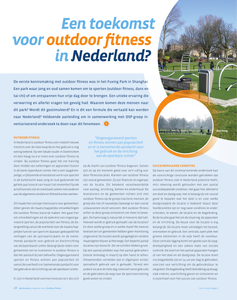
De eerste kennismaking met outdoor fitness was in het Fuxing Park in Shanghai, een park waar jong en oud samen komen om te sporten (outdoor fitness, dans en tai-chi) of om ontspannen hun vrije dag door te brengen. een unieke ervaring die verwarring en allerlei vragen tot gevolg had. waarom komen deze mensen naar dit park? wordt dit gestimuleerd? en is dit een formule die vertaald kan worden naar nederland? voldoende aanleiding om in samenwerking met DSP-groep inventariserend onderzoek te doen naar dit fenomeen.
DOCUMENT
Limited evidence is available about (non)-representativeness of participants in health-promoting interventions. The Dutch Healthy Primary School of the Future (HPSF)-study is a school-based study aiming to improve health through altering physical activity and dietary behaviour, that started in 2015 (registered in ClinicalTrials.gov on14-06-2016, NCT02800616). The study has a response rate of 60%. A comprehensive non-responder analysis was carried out, and responders were compared with schoolchildren from the region and the Netherlands using a cross-sectional design. External sources were consulted to collect non-responder, regional, and national data regarding relevant characteristics including sex, demographics, health, and lifestyle. The Chi-square test, Mann-Whitney U test, or Student's t-test were used to analyse differences.
DOCUMENT

Background: The strain on health care services is increasing due to an ageing population and the increasing prevalence of chronic health conditions. eHealth could contribute to optimise effective and efficient care to older adults with one or more chronic health conditions in the general practice. Aim: The aim of this study was to identify the needs, barriers and facilitators amongst community-dwelling older adults (60þ) suffering from one or more chronic health conditions, in using online eHealth applications to support general practice services. Methods: A qualitative study, using semi-structured followed by think-aloud interviews, was conducted in the Netherlands. The semi-structured interviews, supported by an interview guide were conducted and analysed thematically. The think-aloud method was used to collect data about the cognitive process while the participant was completing a task within online eHealth applications. Verbal analysis according to the Chi approach was conducted to analyse the think-aloud interviews. Findings: A total of n = 19 older adults with a mean age of 73 years participated. The ability to have immediate contact with the GP on important health issues was identified as an important need. Identified barriers were non-familiarity with the online eHealth applications and a mismatch of user health needs. The low computer experience resulted in non-familiarity with the online eHealth applications. Faltering applications resulted in participants refusing to participate in the use of online eHealth applications. Convenience, efficiency and the instant availability of eHealth via applications were identified as important facilitators. Conclusion: To improve the use and acceptability of eHealth applications amongst older adults in the general practice, the applications should be tailored to meet individual needs. More attention should be given to improving the user-friendliness of these applications and to the promotion of the benefits such as facilitating older adults independent living for longer.
DOCUMENT

Objective. Hospital in Motion is a multidimensional implementation project aiming to improve movement behavior during hospitalization. The purpose of this study was to investigate the effectiveness of Hospital in Motion on movement behavior. Methods. This prospective study used a pre-implementation and post-implementation design. Hospital in Motion was conducted at 4 wards of an academic hospital in the Netherlands. In each ward, multidisciplinary teams followed a 10-month step-by-step approach, including the development and implementation of a ward-specific action plan with multiple interventions to improve movement behavior. Inpatient movement behavior was assessed before the start of the project and 1 year later using a behavioral mapping method in which patients were observed between 9:00 am and 4:00 pm. The primary outcome was the percentage of time spent lying down. In addition, sitting and moving, immobility-related complications, length of stay, discharge destination home, discharge destination rehabilitation setting, mortality, and 30-day readmissions were investigated. Differences between pre-implementation and post-implementation conditions were analyzed using the chi-square test for dichotomized variables, the Mann Whitney test for non-normal distributed data, or independent samples t test for normally distributed data. Results. Patient observations demonstrated that the primary outcome, the time spent lying down, changed from 60.1% to 52.2%. For secondary outcomes, the time spent sitting increased from 31.6% to 38.3%, and discharges to a rehabilitation setting reduced from 6 (4.4%) to 1 (0.7%). No statistical differences were found in the other secondary outcome measures. Conclusion. The implementation of the multidimensional project Hospital in Motion was associated with patients who were hospitalized spending less time lying in bed and with a reduced number of discharges to a rehabilitation setting. Impact. Inpatient movement behavior can be influenced by multidimensional interventions. Programs implementing interventions that specifically focus on improving time spent moving, in addition to decreasing time spent lying, are recommended.
DOCUMENT

Rationale, aims and objective: Primary Care Plus (PC+) focuses on the substitution of hospital-based medical care to the primary care setting without moving hospital facilities. The aim of this study was to examine whether population health and experience of care in PC+ could be maintained. Therefore, health-related quality of life (HRQoL) and experienced quality of care from a patient perspective were compared between patients referred to PC+ and to hospital-based outpatient care (HBOC). Methods: This cohort study included patients from a Dutch region, visiting PC+ or HBOC between December 2014 and April 2018. With patient questionnaires (T0, T1 and T2), the HRQoL and experience of care were measured. One-to-two nearest neighbour calliper propensity score matching (PSM) was used to control for potential selection bias. Outcomes were compared using marginal linear models and Pearson chi-square tests. Results: One thousand one hundred thirteen PC+ patients were matched to 606 HBOC patients with well-balanced baseline characteristics (SMDs <0.1). Regarding HRQoL outcomes, no significant interaction terms between time and group were found (P > .05), indicating no difference in HRQoL development between the groups over time. Regarding experienced quality of care, no differences were found between PC+ and HBOC patients. Only travel time was significantly shorter in the HBOC group (P ≤ .001). Conclusion: Results show equal effects on HRQoL outcomes over time between the groups. Regarding experienced quality of care, only differences in travel time were found. Taken as a whole, population health and quality of care were maintained with PC+ and future research should focus more on cost-related outcomes.
DOCUMENT




