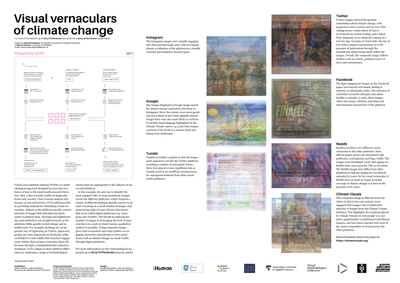
Visual cross-platform analysis (VCPA) is a methodological approach designed to overcome two forms of bias in the social media research literature: first, a bias towards studies of single plat- forms and, second, a bias towards analysis that focuses on text and metrics. VCPA addresses this by providing methods for identifying visual vernaculars, defined as the platform-specific content and style of images that articulate any given social or political issue.
IMAGE
Soil organic carbon (SOC) prediction from remote sensing is often hindered by disturbing factors at the soil surface, such as photosynthetic active and non–photosynthetic active vegetation, variation in soil moisture or surface roughness. With the increasing amount of freely available satellite data, recent studies have focused on stabilizing the soil reflectance by building reflectance composites using time series of images. Although composite imagery has demonstrated its potential in SOC prediction, it is still not well established if the resulting composite spectra mirror the reflectance fingerprint of the optimal conditions to predict topsoil properties (i.e. a smooth, dry and bare soil).
LINK
Greenhouses are in need of new monitoring tools, as they size grow bigger and bigger but still using old labour intensive methods ways of caring for the crop. HiPerGreen is set out to create a new tool, which can drive onto the pre-existing heating pipes to provide a birds eye perspective for image analysis purposes. However, clear images are necessary for consistent usable data. This presentation resumes the steps taken during the reporting: the optimisation of a rail based system towards clear images. This is done through analysis of resulting images, understanding vibrations and oscillations, and finally presents results based on prototyping. Moreover, a re-design of the electronics and hardware was also introduce to facilitate prototyping. The results are promising, laying within the requirements.
DOCUMENT

This work investigates the connection among optical aspects of photographic composition and the quality, perception and interpretation of the level of realism of images. Therefore, to investigate this connection, an experiment was carried out in two steps: The first step consisted of performing analyzes of the optical or photographic contrasts of previously selected images. The second step was the elaboration of a questionnaire with 19 images selected in the first step, aiming to collect data about the perception and opinion of the users. Finally, the objective data from the first step was crossed with the subjective data from the second. The conclusion indicates evidence of the connection or convergence between images that obey the principles of photographic composition that are perceived as having better realism by the users. It is plausible to consider the importance of photo-graphic theory to image design for the users perceive the images as more realistic.
LINK
Background: Nurse-sensitive indicators and nurses’ satisfaction with the quality of care are two commonly used ways to measure quality of nursing care. However, little is known about the relationship between these kinds of measures. This study aimed to examine concordance between nurse-sensitive screening indicators and nurse-perceived quality of care. Methods: To calculate a composite performance score for each of six Dutch non-university teaching hospitals, the percentage scores of the publicly reported nurse-sensitive indicators: screening of delirium, screening of malnutrition, and pain assessments, were averaged (2011). Nurse-perceived quality ratings were obtained from staff nurses working in the same hospitals by the Dutch Essentials of Magnetism II survey (2010). Concordance between the quality measures was analyzed using Spearman’s rank correlation. Results: The mean screening performances ranged from 63 % to 93 % across the six hospitals. Nurse-perceived quality of care differed significantly between the hospitals, also after adjusting for nursing experience, educational level, and regularity of shifts. The hospitals with high-levels of nurse-perceived quality were also high-performing hospitals according to nurse-sensitive indicators. The relationship was true for high-performing as well as lower-performing hospitals, with strong correlations between the two quality measures (r S = 0.943, p = 0.005). Conclusions: Our findings showed that there is a significant positive association between objectively measured nurse sensitive screening indicators and subjectively measured perception of quality. Moreover, the two indicators of quality of nursing care provide corresponding quality rankings. This implies that improving factors that are associated with nurses’ perception of what they believe to be quality of care may also lead to better screening processes. Although convergent validity seems to be established, we emphasize that different kinds of quality measures could be used to complement each other, because various stakeholders may assign different values to the quality of nursing care.
DOCUMENT

This study presents an automated method for detecting and measuring the apex head thickness of tomato plants, a critical phenotypic trait associated with plant health, fruit development, and yield forecasting. Due to the apex's sensitivity to physical contact, non-invasive monitoring is essential. This paper addresses the demand for automated, contactless systems among Dutch growers. Our approach integrates deep learning models (YOLO and Faster RCNN) with RGB-D camera imaging to enable accurate, scalable, and non-invasive measurement in greenhouse environments. A dataset of 600 RGB-D images captured in a controlled greenhouse, was fully preprocessed, annotated, and augmented for optimal training. Experimental results show that YOLOv8n achieved superior performance with a precision of 91.2 %, recall of 86.7 %, and an Intersection over Union (IoU) score of 89.4 %. Other models, such as YOLOv9t, YOLOv10n, YOLOv11n, and Faster RCNN, demonstrated lower precision scores of 83.6 %, 74.6 %, 75.4 %, and 78 %, respectively. Their IoU scores were also lower, indicating less reliable detection. This research establishes a robust, real-time method for precision agriculture through automated apex head thickness measurement.
DOCUMENT
Studying images in social media poses specific methodological challenges, which in turn have directed scholarly attention towards the computational interpretation of visual data. When analyzing large numbers of images, both traditional content analysis as well as cultural analytics have proven valuable. However, these techniques do not take into account the circulation and contextualization of images within a socio-technical environment. As the meaning of social media images is co-created by networked publics, bound through networked practices, these visuals should be analyzed on the level of their networked contextualization. Although machine vision is increasingly adept at recognizing faces and features, its performance in grasping the meaning of social media images is limited. However, combining automated analyses of images - broken down by their compositional elements - with repurposing platform data opens up the possibility to study images in the context of their resonance within and across online discursive spaces. This paper explores the capacities of platform data - hashtag modularity and retweet counts - to complement the automated assessment of social media images; doing justice to both the visual elements of an image and the contextual elements encoded by networked publics that co-create meaning.
MULTIFILE

LINK
This article interrogates platform-specific bias in the contemporary algorithmic media landscape through a comparative study of the representation of pregnancy on the Web and social media. Online visual materials such as social media content related to pregnancy are not void of bias, nor are they very diverse. The case study is a cross-platform analysis of social media imagery for the topic of pregnancy, through which distinct visual platform vernaculars emerge. The authors describe two visualization methods that can support comparative analysis of such visual vernaculars: the image grid and the composite image. While platform-specific perspectives range from lists of pregnancy tips on Pinterest to pregnancy information and social support systems on Twitter, and pregnancy humour on Reddit, each of the platforms presents a predominantly White, able-bodied and heteronormative perspective on pregnancy.
DOCUMENT
Previous research suggests that narrative engagement (NE) in entertainment-education (E-E) narratives reduces counterarguing, thereby leading to E-E impact on behavior. It is, however, unclear how different NE processes (narrative understanding, attentional focus, emotional engagement, narrative presence) relate to different thought types (negative or positive; about the narrative form or about the target behavior) and to E-E impact. This study explores these relations in the context of alcohol binge drinking (BD). Participants (N = 172) watched an E-E narrative showing negative BD consequences, thereby aiming to discourage BD. The main findings were that the E-E narrative had a positive impact on discouraging BD on almost all assessed BD determinants such as beliefs and attitude. It was shown that attentional focus, emotional engagement, and narrative presence were associated with BD-discouraging impact, albeit on different BD-related determinants. No evidence was found that negative thoughts about BD mediated these associations. From this, we conclude that attentional focus, emotional engagement, and narrative presence were important for E-E impact but that negative thoughts about BD did not play a role therein. The study’s empirical and practical implications are discussed.
MULTIFILE




