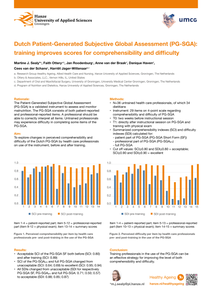
Rationale: The Patient-Generated Subjective Global Assessment (PG-SGA) is a validated instrument to assess and monitor malnutrition, which consists of both patient-reported and professional-reported items. A professional should be able to correctly interpret all items. Untrained professionals may experience difficulty in completing some items of the PG-SGA. We aimed to explore the change in perceived comprehensibility and difficulty of the Dutch PG-SGA by health care professionals on the use of the instrument, before and after training.Methods: A sample of 36 untrained health care professionals, of which 34 dietitians, completed a set of 29 items on a four point scale regarding comprehensibility and difficulty of the PG-SGA on two separate occasions: T0) two weeks before and T1) directly after an instructional session on the PG-SGA and training with the physical exam. Summarized comprehensibility indexes (SCI) and difficulty indexes (SDI) were calculated for the patient part of the PG-SGA (aka PG-SGA Short Form; PG-SGA SF), the professional part of the PG-SGA (PG-SGApro) and the full PG-SGA, to quantify the level of perceived comprehensibility and difficulty. SCI≥0.80 and SDI≥0.80 were considered acceptable, SCI≥0.90 and SDI≥0.90 were considered excellent.Results: SCI of the PG-SGA SF was acceptable both before (SCI: 0.80) and after training (SCI: 0.89). SCI of the PG-SGApro and full PG-SGA changed from unacceptable (SCI: 0.64; 0.69) to excellent (SCI: 0.95; 0.94). All SDIs changed from unacceptable (SDI for respectively PG-SGA SF, PG-SGApro and full PG-SGA: 0.71; 0.50; 0.57) to acceptable (SDI: 0.88; 0.85; 0.87).Conclusion: Training professionals in the use of the PG-SGA can be an effective strategy for improving the level of both comprehensibility and difficulty.
DOCUMENT
Background: The Patient-Generated Subjective Global Assessment (PG-SGA) is an instrument to assess malnutrition and its risk factors. Some items of the PG-SGA may be perceived as hard to comprehend or difficult by healthcare professionals. The objective was to evaluate if and how dietitians’ perceptions of comprehensibility and difficulty of the PG-SGA change after a single training in PG-SGA use. Methods: In this prospective evaluation study, Dutch PG-SGA-naïve dietitians completed a questionnaire regarding perceived comprehensibility and difficulty of the PG-SGA before (T0) and after (T1) receiving a single training in instrument use. Perceived comprehensibility and difficulty were operationalized by calculating item and scale indices for comprehensibility (I-CI, S-CI) and difficulty (I-DI, S-DI) at T0 and T1. An item index of 0.78 was considered acceptable, a scale index of 0.80 was considered acceptable, and a scale index of 0.90 was considered excellent. Results: A total of 35 participants completed the questionnaire both at T0 and T1. All item indices related to comprehensibility and difficulty improved, although I-DI for the items regarding food intake and physical exam remained below 0.78. Scale indices for difficulty and comprehensibility of the PG-SGA significantly changed (p<0.001) from not acceptable at T0 (S-CI=0.69; S-DI=0.57), to excellent for comprehensibility (S-CI=0.95) and acceptable for difficulty (S-DI=0.86) at T1. Conclusions: The findings of this study suggest that significant improvement in PG-SGA-naïve dietitians’ perception of comprehensibility and difficulty of the PG-SGA can be achieved quickly by providing a one day training in the use of the PG-SGA.
LINK
Analyzing historical decision-related data can help support actual operational decision-making processes. Decision mining can be employed for such analysis. This paper proposes the Decision Discovery Framework (DDF) designed to develop, adapt, or select a decision discovery algorithm by outlining specific guidelines for input data usage, classifier handling, and decision model representation. This framework incorporates the use of Decision Model and Notation (DMN) for enhanced comprehensibility and normalization to simplify decision tables. The framework’s efficacy was tested by adapting the C4.5 algorithm to the DM45 algorithm. The proposed adaptations include (1) the utilization of a decision log, (2) ensure an unpruned decision tree, (3) the generation DMN, and (4) normalize decision table. Future research can focus on supporting on practitioners in modeling decisions, ensuring their decision-making is compliant, and suggesting improvements to the modeled decisions. Another future research direction is to explore the ability to process unstructured data as input for the discovery of decisions.
MULTIFILE

Communication between healthcare professionals and deaf patients has been particularly challenging during the COVID-19 pandemic. We have explored the possibility to automatically translate phrases that are frequently used in the diagnosis and treatment of hospital patients, in particular phrases related to COVID-19, from Dutch or English to Dutch Sign Language (NGT). The prototype system we developed displays translations either by means of pre-recorded videos featuring a deaf human signer (for a limited number of sentences) or by means of animations featuring a computer-generated signing avatar (for a larger, though still restricted number of sentences). We evaluated the comprehensibility of the signing avatar, as compared to the human signer. We found that, while individual signs are recognized correctly when signed by the avatar almost as frequently as when signed by a human, sentence comprehension rates and clarity scores for the avatar are substantially lower than for the human signer. We identify a number of concrete limitations of the JASigning avatar engine that underlies our system. Namely, the engine currently does not offer sufficient control over mouth shapes, the relative speed and intensity of signs in a sentence (prosody), and transitions between signs. These limitations need to be overcome in future work for the engine to become usable in practice.
DOCUMENT

Background: The aging population is increasingly faced with daily life limitations, threatening their Functional Independence (FI). These limitations extend different life domains and require a broad range of community-care professionals to be addressed. The Decision Support Tool for Functional Independence (DST-FI) facilitates community-care professionals in providing uncontradictory recommendations regarding the maintenance of FI in community-dwelling older people. The current study aims to determine the validity and reliability of the DST-FI. Methods: Sixty community-care professionals completed a twofold assessment. To assess construct validity, participants were asked to assign predefined recommendations to fifty cases of older people to maintain their level of FI. Hypotheses were tested regarding the expected recommendations per case. Content validity was assessed by questions on relevance, comprehensiveness, and comprehensibility of the current set of recommendations. Twelve participants repeated the assessment after two weeks to enable both within- and between rater reliability properties, expressed by an Intraclass Correlation Coefficient. Results: Seven out of eight predefined hypotheses confirmed expectations, indicating high construct validity. As the recommendations were indicated 'relevant' and 'complete', content validity was high as well. Agreement between raters was poor to moderate while agreement within raters was moderate to excellent, resulting in moderate overall reliability. Conclusion: The DST-FI suggests high validity and moderate reliability properties when used in a population of community-dwelling older people. The tool could facilitate community-care professionals in their task to preserve FI in older people. Future research should focus on psychometric properties like feasibility, acceptability, and developing and piloting strategies for implementation in community-care.
LINK
LINK
Purpose: The Scored Patient-Generated Subjective Global Assessment (PG-SGA©) is a globally recognized and used nutritional screening, assessment, monitoring, and triaging tool. The aim of this study was to translate and culturally adapt the original English PG-SGA for the Japanese speaking populations and to assess its linguistic validity (i.e., comprehensibility, difficulty) and content validity, as perceived by Japanese patients and healthcare professionals. Methods: In accordance with methodology used in previous Dutch, Thai, German, and Norwegian PG-SGA studies, we followed the ten steps of the International Society for Pharmacoeconomics and Outcomes Research (ISPOR) Principles of Good Practice for Translation and Cultural Adaptation for Patient-Reported Outcome Measures. The study enrolled 50 patients and 50 healthcare professionals (HCPs) to evaluate the comprehensibility and difficulty of the translated and culturally adapted PG-SGA. The HCPs also evaluated the content validity of the translation. We evaluated each item and quantified scale indices for content validity (item content validity index (I-CVI), scale content validity index (S-CVI)), comprehensibility (item comprehensibility index (I-CI), scale comprehensibility index (S-CI)), and difficulty (item difficulty index (I-DI), scale difficulty index (S-DI)). Results: Patients evaluated the comprehensibility and difficulty of the patient component as excellent (S-CI = 0.97, S-DI = 0.96). The professionals rated the Japanese version of both components of the PG-SGA as very relevant (S-CVI = 0.94). The professionals evaluated the comprehensibility of the professional component as being acceptable (S-CI = 0.88) but difficult (S-DI = 0.69), based predominantly on items related to physical examination (I-DI = 0.33–0.67). Conclusion: The PG-SGA was systematically translated and culturally adapted for the Japanese setting according to the ISPOR process. The Japanese version of the PG-SGA was perceived as comprehensive, easy to use, and relevant. Perceived difficulty in professional components, specifically in the context of metabolic demand and physical examination, will require appropriate training for professionals in order to optimize implementation.
DOCUMENT
Background and aims: Patients with cancer frequently present with disease-related malnutrition and functional decline. The scored Patient-Generated Subjective Global Assessment (PG-SGA©) is a malnutrition screening and assessment tool commonly used in patients with cancer. The aim of the current study was to translate and culturally adapt the original English PG-SGA for the Greek setting, including assessment of comprehensibility, difficulty and content validity in patients and healthcare professionals. Methods: Our study was conducted according to the ten steps of the International Society for Pharmacoeconomics and Outcomes Research (ISPOR) Principles of Good Practice for Translation and Cultural Adaptation. Comprehensibility and difficulty of the Greek translation were assessed in 100 patients and 100 healthcare professionals (HCPs) from Greece. Content validity of the translation was assessed among HCPs. Item and scale indices were calculated for comprehensibility (I–CI; S–CI), difficulty (I-DI; S-DI), and content validity (I-CVI; S-CVI). Results: Patient perceived comprehensibility and difficulty of the PG-SGA were considered to be excellent (S–CI = 0.97, S-DI = 0.97). HCPs perceived content validity for the patient component was also excellent (S-CVI = 0.95). The perceived content validity, comprehensibility and difficulty for the professional component of the PG-SGA, as perceived by the HCPs, was excellent (S-CVI = 0.94, S–CI = 0.94, S-DI = 0.90), with the physical exam being perceived as most difficult (I-DI = 0.78–0.92). Conclusions: Our study resulted in the successful translation and cross-cultural adaptation of the original English PG-SGA for the Greek setting. The Greek language version of the PG-SGA is characterized by high comprehensibility, low difficulty, and is considered relevant for use in Greece.
DOCUMENT
Posterpresentatie ORD 2014 Deze studie is onderdeel van het promotieonderzoek aan de Universiteit Utrecht onder de naam "Grip krijgen op moreel auteurschap van beginnende leraren in het primair onderwijs". De metafoor “moreel auteurschap” wordt gebruikt om vanuit een narratief perspectief het intentioneel moreel leren door de beginnende leraar te kunnen beschrijven en te kunnen onderzoeken. Deze deelstudie is een verkennende studie naar de morele oriëntatie van de beginnende leraar in het primair onderwijs.
DOCUMENT

Lecture in PhD Programme Life Science Education Research UMCU. Course Methods of Life Science Education Research. Utrecht, The Netherlands. abstract Audit trail procedures are applied as a way to check the validity of qualitative research designs, qualitative analyses, and the claims that are made. Audit trail procedures can be conducted based on the three criteria of visibility, comprehensibility, and acceptability (Akkerman et al., 2008). During an audit trail procedure, all documents and materials resulting from the data gathering and the data analysis are assessed by an auditor. In this presentation, we presented a summative audit trail procedure (Agricola, Prins, Van der Schaaf & Van Tartwijk, 2021), whereas in a second study we used a formative one (Agricola, Van der Schaaf, Prins & Van Tartwijk, 2022). For both studies, two different auditors were chosen. For the study presented in Agricola et al. (2021) the auditor was one of the PhD supervisors, while in that presented Agricola et al. (2022) was a junior researcher not involved in the project. The first auditor had a high level of expertise in the study’s topic and methodology. As a result, he was able to provide a professional and critical assessment report. Although the second auditor might be considered to be more objective than the first, as she was not involved in the project, more meetings were needed to explain the aim of the study and the aim of the audit trail procedure. There are many ideas about the criteria that qualitative studies should meet (De Kleijn en Van Leeuwen, 2018). I argue that procedures of checking for interrater agreement and understanding, the triangulation, and audit trail procedures can increase the internal validity of qualitative studies. Agricola, B. T., Prins, F. J., van der Schaaf, M. F., & van Tartwijk, J. (2021). Supervisor and Student Perspectives on Undergraduate Thesis Supervision in Higher Education. Scandinavian Journal of Educational Research, 65(5), 877-897. doi: https://doi.org/10.1080/00313831.2020.1775115 Agricola, B. T., van der Schaaf, M. F., Prins, F. J., & van Tartwijk, J. (2022). The development of research supervisors’ pedagogical content knowledge in a lesson study project. Educational Action Research. doi: https://doi.org/10.1080/09650792.2020.1832551 de Kleijn, R. A. M., & Van Leeuwen, A. (2018). Reflections and review on the audit procedure: Guidelines for more transparency. International Journal of Qualitative Methods, 17(1), 1-8. doi: https://doi.org/10.1177/1609406918763214 Akkerman, S., Admiraal, W., Brekelmans, M., & Oost, H. (2008). Auditing quality of research in social sciences. Quality & Quantity, 42(2), 257-274. doi: https://doi.org/10.1007/s11135-006-9044-4
DOCUMENT




