Older people are often over-represented in morbidity and mortality statistics associated with hot and cold weather, despite remaining mostly indoors. The study “Improving thermal environment of housing for older Australians” focused on assessing the relationships between the indoor environment, building characteristics, thermal comfort and perceived health/wellbeing of older South Australians over a study period that included the warmest summer on record. Our findings showed that indoor temperatures in some of the houses reached above 35 °C. With concerns about energy costs, occupants often use adaptive behaviours to achieve thermal comfort instead of using cooling (or heating), although feeling less satisfied with the thermal environment and perceiving health/wellbeing to worsen at above 28 °C (and below 15 °C). Symptoms experienced during hot weather included tiredness, shortness of breath, sleeplessness and dizziness, with coughs and colds, painful joints, shortness of breath and influenza experienced during cold weather. To express the influence of temperature and humidity on perceived health/wellbeing, a Temperature Humidity Health Index (THHI) was developed for this cohort. A health/wellbeing perception of “very good” is achieved between an 18.4 °C and 24.3 °C indoor operative temperature and a 55% relative humidity. The evidence from this research is used to inform guidelines about maintaining home environments to be conducive to the health/wellbeing of older people. Original publication at MDPI: https://doi.org/10.3390/atmos13010096 © 2022 by the authors. Licensee MDPI.
MULTIFILE

from the article: Abstract Based on a review of recent literature, this paper addresses the question of how urban planners can steer urban environmental quality, given the fact that it is multidimensional in character, is assessed largely in subjective terms and varies across time. The paper explores three questions that are at the core of planning and designing cities: ‘quality of what?’, ‘quality for whom?’ and ‘quality at what time?’ and illustrates the dilemmas that urban planners face in answering these questions. The three questions provide a novel framework that offers urban planners perspectives for action in finding their way out of the dilemmas identified. Rather than further detailing the exact nature of urban quality, these perspectives call for an approach to urban planning that is integrated, participative and adaptive. ; ; sustainable urban development; trade-offs; quality dimensions
DOCUMENT

This chapter reports on the findings of a research project aimed at investigating the actual thermal environment of the housing of older occupants (aged 65 or over) in South Australia. The study documented their thermal preferences and behaviours during hot and cold weather and relationships to their well-being and health. Information was collected in three phases, a telephone survey, focus group discussions and detailed house environmental monitoring that employed an innovative data acquisition system to measure indoor conditions and record occupant perceptions and behaviours. The research covered three climate zones and extended over a nine-month period. The detailed monitoring involved a total of 71 participants in 57 houses. More than 10,000 comfort/well-being questionnaire responses were collected with more than 1,000,000 records of indoor environmental conditions. Analysis of the data shows the relationships between thermal sensation and self-reported well-being/health and the various adaptive strategies the occupants employ to maintain their preferred conditions. Findings from the research were used to develop targeted recommendations and design guidelines intended for older people with specific thermal comfort requirements and more broadly advice for architects, building designers and policymakers. Original publication at: Routledge Handbook of Resilient Thermal Comfort Chapter 7: https://doi.org/10.4324/9781003244929-10
MULTIFILE

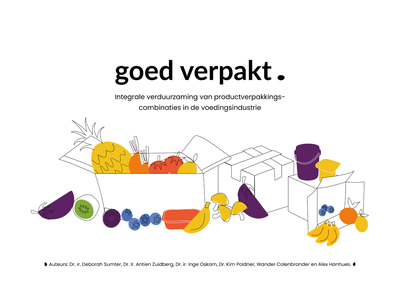
Honger is nog steeds een wereldwijd probleem, terwijl iedereen genoeg te eten zou hebben als we het beschikbare voedsel goed zouden verdelen en benutten, en het niet zouden verspillen. Maar alleen al in Nederland gooien we ruim 33 kilo voedsel per persoon per jaar weg. Dat moet anders! Door voedsel slimmer te verpakken, kunnen we voedselverspilling én onnodig verpakkingsafval voorkomen. Binnen het project Goed Verpakt hebben we verschillende partijen samengebracht om integraal aan dit onderwerp te werken. Het breed samengestelde consortium bestond uit kennisinstellingen, producenten van aardappels, groente en fruit, producenten van maaltijden en portieverpakkingen, producenten van verpakkingsmaterialen en een brancheorganisatie. Onze centrale onderzoeksvraag was: Hoe kunnen bedrijven in de voedingssector op een meer duurzame manier in de behoefte van de eindgebruiker voorzien, waarbij de gekozen totaaloplossing van de product-verpakkingscombinatie past binnen en circulaire economie en aansluit bij de vereisten van de hele keten? Samen hebben we naar slimme product-verpakkingscombinaties gezocht, waarbij we hebben geanalyseerd welke duurzaamheidsdilemma’s partijen in de keten ervaren en hoe we die kunnen oplossen of wegnemen. Daarbij hebben we ook in beeld gebracht wat de betrokken partijen zelf kunnen doen en wat zij voor elkaar kunnen krijgen door een nauwere samenwerking binnen de keten. Voor slimme product-verpakkingscombinaties is ook de overheid een onmisbare partner. Onduidelijkheid, een gebrek aan daadkracht en te eenzijdige wet- en regelgeving werken averechts en ondermijnen het streven naar meer duurzaamheid binnen de sector. Beleidsmakers onderschatten de expertise die nodig is om dit goed te regelen. Maar verduurzaming is dus vooral een kwestie van nauwer samenwerken. Met partners binnen de branche, met interessante partijen buiten de branche én met de overheid. We formuleren in dit document alvast onze negen gouden regels van integraal duurzaam verpakken. Daarnaast blijven de betrokken kennisinstellingen onderzoek doen naar dit onderwerp. Bijvoorbeeld naar consumentengedrag en – intenties en naar de inzet van de Rethink-methode voor het herontwerpen van product-verpakkingscombinaties. Zo zorgen alle betrokken partners voor een circulaire toekomst waarin voedsel steeds slimmer verpakt wordt en we met een minimum aan afval zo veel mogelijk voedsel beschikbaar maken voor iedereen.
DOCUMENT
Oncology healthcare professionals (HCPs) and cancer patients often have difficulties in navigating conversations about sexual changes and concerns due to cancer and its treatments. The present study draws on Discursive Psychology to analyze how the topic of sexuality is raised and managed in Dutch oncological consultations. Our corpus consists of 28 audio recordings. We analyzed the discursive practices used by cancer patients and oncology HCPs and to what effect. Patients, on the one hand, employ vagueness, pronouns, and ellipses, while HCPs attribute talk to others and use generalizations, and speech perturbations. Through these practices they collectively keep the topic of sexuality at a distance, thereby constructing it as a delicate topic. Moreover, we explicate the norms related to sexual behavior that cancer patients and oncology HCPs orient to in their talk. Finally, we address ways in which oncology HCPs can open the door on discussing sexual changes with their patients.
MULTIFILE

Objectives: The aim of this scoping review was threefold: 1. to identify existing definitions of oral frailty and similar terms in gerodontology literature; 2. to assess the oral frailty definitions and analyze whether these are well formulated on a conceptual level; and 3. in the absence of existing definitions meeting the criteria for good conceptual definitions, a new conceptual definition of oral frailty will be presented. Methods: A search was performed in electronic databases and internet search engines. Studies explaining or defining oral frailty or similar terms were of interest. A software-aided procedure was performed to screen titles and abstracts and identify definitions of oral frailty and similar terms. We used a guide to assess the quality of the oral frailty definitions on methodological, linguistic, and content-related criteria. Results: Of the 1,528 screened articles, 47 full-texts were reviewed. Thirteen of these contained seven definitions of oral frailty and ten definitions of similar terms. We found that all definitions of oral frailty contain the same or equivalent characteristics used to define the concepts of ’oral health’, ’deterioration of oral function’, and ’oral hypofunction’. Between the seven definitions, oral frailty is described with a different number and combination of characteristics, resulting in a lack of conceptual consistency. None of the definitions of oral frailty met all criteria. Conclusion: According to our analysis, the current definitions of oral frailty cannot be considered ’good’ conceptual definitions. Therefore, we proposed a new conceptual definition: Oral frailty is the age-related functional decline of orofacial structures.
DOCUMENT

From the article : "Based on a review of recent literature, this paper addresses the question of how urban planners can steer urban environmental quality, given the fact that it ismultidimensional in character, is assessed largely in subjective terms and varies across time. A novel perspective of urban environmental quality is proposed, simultaneously exploring three questions that are at the core of planning and designing cities: ‘quality of what?’, ‘quality for whom?’ and ‘quality at what time?’. The dilemmas that urban planners face in answering these questions are illustrated using secondary material. This approach provides perspectives for action. Rather than further detailing the exact nature of urban quality, it calls for sustainable urban environmental quality planning that is integrated, participative and adaptive" ( wileyonlinelibrary.com ) DOI: 10.1002/eet.1759 - Preprint available for free download.
DOCUMENT

In recent years, the effects of the physical environment on the healing process and well-being have proved to be increasingly relevant for patients and their families (PF) as well as for healthcare staff. The discussions focus on traditional and institutionally designed healthcare facilities (HCF) relative to the actual well-being of patients as an indicator of their health and recovery. This review investigates and structures the scientific research on an evidence-based healthcare design for PF and staff outcomes. Evidence-based design has become the theoretical concept for what are called healing environments. The results show the effects on PF and staff from the perspective of various aspects and dimensions of the physical environmental factors of HFC. A total of 798 papers were identified that fitted the inclusion criteria for this study. Of these, 65 articles were selected for review: fewer than 50% of these papers were classified with a high level of evidence, and 86% were included in the group of PF outcomes. This study demonstrates that evidence of staff outcomes is scarce and insufficiently substantiated. With the development of a more customer-oriented management approach to HCF, the implications of this review are relevant to the design and construction of HCF. Some design features to consider in future design and construction of HCF are single-patient rooms, identical rooms, and lighting. For future research, the main challenge will be to explore and specify staff needs and to integrate those needs into the built environment of HCF.
DOCUMENT




