Natural Deep Eutectic Solvents (NADES) represent a green chemistry alternative to utilization of common hazardous organic solvents. They were introduced by Abbott et al. [1], and were found to have a wide range of compositions and favorable properties. NADES are typically obtained by mixing hydrogen-bond acceptors (HBA), with hydrogen bond donors (HBD), leading to a significant depression of the melting point. The availability of components, simple preparation, biodegradability, safety, re usability and low cost are the significant advantages that call for research on their analytical applications. Three methods are most commonly used for preparing NADES: a) heating and stirring: the mixture until a clear liquid is formed; b) evaporating solvent from components solution with a rotatory evaporator; c) freeze drying of aqueous solutions.The common solvents for the extraction of anthocyanins are acidified mixtures of water with ethanol, methanol, or acetone. The anthocyanins extracts are susceptible to degradation due to high temperature, and the solvent properties (e.g. high pH) and the whole process can often be time-consuming. Extraction of anthocyanins from red cabbage by four NADES was investigated. It was demonstrated that NADES have comparable extraction efficiencies with conventional method with 0.1 M water solution of HCl. This indicates a possibility of utilization the Green chemistry extraction processes as a promising new green-extraction technology with low cost efficiency and environment friendly technology for production of safe food additives.
DOCUMENT

Standard SARS-CoV-2 testing protocols using nasopharyngeal/throat (NP/T) swabs are invasive and require trained medical staff for reliable sampling. In addition, it has been shown that PCR is more sensitive as compared to antigen-based tests. Here we describe the analytical and clinical evaluation of our in-house RNA extraction-free saliva-based molecular assay for the detection of SARS-CoV-2. Analytical sensitivity of the test was equal to the sensitivity obtained in other Dutch diagnostic laboratories that process NP/T swabs. In this study, 955 individuals participated and provided NP/T swabs for routine molecular analysis (with RNA extraction) and saliva for comparison. Our RT-qPCR resulted in a sensitivity of 82,86% and a specificity of 98,94% compared to the gold standard. A false-negative ratio of 1,9% was found. The SARS-CoV-2 detection workflow described here enables easy, economical, and reliable saliva processing, useful for repeated testing of individuals.
LINK
BACKGROUND: Sour cherry (Prunus cerasus L.) stones are the major byproduct of the cherry industry and the efficient management of this biowaste can lead to achieving the food processing sustainability aimed at by the modern food industry. Despite its significant content of lipids, the valorization of cherry stone waste as feedstock for lipid extraction appears to be limited due to the high moisture content. This study explores the primary factors that affect the yield of lipid extraction using Soxhlet, Randall and supercritical carbon dioxide (scCO2) extraction methods, with a particular emphasis on yield optimization for green extraction technologies (scCO2). RESULTS: The investigation revealed an increased lipid extraction yield for scCO2 from 7.4 for dry crushed stones to 20.6 g per 100 g dry weight when the cherry kernels are separated. The high initial moisture content affected all three extraction methods, but mostly impacted the scCO2 extraction, resulting in the co-extraction of an aqueous phase. Lipid and aqueous yield could be manipulated by time, temperature and pressure. However, no observable influence on the composition of fatty acid methyl esters was detected. CONCLUSION: Numerous approaches are shown to enhance the lipid yield from cherry stone waste, depending on the desired outcome. When dealing with wet samples, Randall extraction proves to be the most effective method. On the other hand, scCO2 extraction presents distinct advantages, such as the extraction of food-grade lipids and the co-extraction of a unique aqueous phase, which comes at the expense of a reduced lipid yield. © 2024 The Authors. Journal of Chemical Technology and Biotechnology published by John Wiley & Sons Ltd on behalf of Society of Chemical Industry (SCI).
DOCUMENT
The increasing interest in Aronia melanocarpa berries for their antioxidant properties sets the necessity to define sustainable strategies to valorize the by-products. This study investigates the use of supercritical carbon dioxide (scCO2) extraction, with and without ethanol as a co-solvent, for recovering lipophilic and phenolic compounds from aronia pomace. Extractions were performed at 20, 30, and 40 MPa and temperatures of 50, 70, and 90 °C. A yield of about 2.7 g per 100 g of dried pomace was obtained at 40 MPa and 90 °C. However, the highest total phenolic content of about 165 mg of gallic acid equivalent per 100 g of dried pomace was achieved with 5 % ethanol co-solvent at 50 °C and 30 MPa. The lipid extracts were rich in linoleic acid and the wax portion increased under low-density scCO2 conditions. A feedforward neural network was developed to model extraction kinetics and predict yield as a function of temperature, pressure, and time, demonstrating high predictive accuracy. These findings highlight scCO2 extraction as a viable route for the efficient and selective recovery of valuable bioactives from aronia pomace, contributing to a circular bioeconomy.
DOCUMENT
To study the ways in which compounds can induce adverse effects, toxicologists have been constructing Adverse Outcome Pathways (AOPs). An AOP can be considered as a pragmatic tool to capture and visualize mechanisms underlying different types of toxicity inflicted by any kind of stressor, and describes the interactions between key entities that lead to the adverse outcome on multiple biological levels of organization. The construction or optimization of an AOP is a labor intensive process, which currently depends on the manual search, collection, reviewing and synthesis of available scientific literature. This process could however be largely facilitated using Natural Language Processing (NLP) to extract information contained in scientific literature in a systematic, objective, and rapid manner that would lead to greater accuracy and reproducibility. This would support researchers to invest their expertise in the substantive assessment of the AOPs by replacing the time spent on evidence gathering by a critical review of the data extracted by NLP. As case examples, we selected two frequent adversities observed in the liver: namely, cholestasis and steatosis denoting accumulation of bile and lipid, respectively. We used deep learning language models to recognize entities of interest in text and establish causal relationships between them. We demonstrate how an NLP pipeline combining Named Entity Recognition and a simple rules-based relationship extraction model helps screen compounds related to liver adversities in the literature, but also extract mechanistic information for how such adversities develop, from the molecular to the organismal level. Finally, we provide some perspectives opened by the recent progress in Large Language Models and how these could be used in the future. We propose this work brings two main contributions: 1) a proof-of-concept that NLP can support the extraction of information from text for modern toxicology and 2) a template open-source model for recognition of toxicological entities and extraction of their relationships. All resources are openly accessible via GitHub (https://github.com/ontox-project/en-tox).
DOCUMENT

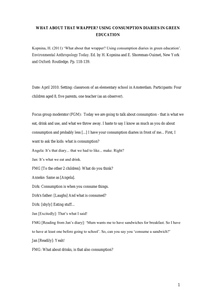
Environmental or ‘green' education is an important driving force behind the ‘greening' of society as it plays a critical role in raising environmental awareness and preparing students for green jobs. None of the existing environmental attitudes and behavior measures is focused on the evaluation of green education, especially in relation to consumption. To date, no longitudinal studies of children and students' attitudes towards consumption influenced by education exist. Also, little has been done to explore the socio-cultural context in which attitudes toward consumption are being formed and to explain the cross-cultural differences in environmental attitudes. This pilot study is designed to take the first step towards developing methods complementing existing quantitative measurements with qualitative strategies, such as consumption diaries, focus groups, and concept mapping. While this research is just a first attempt to tackle children's knowledge and attitudes consumption, preliminary results of the research on which this chapter is based and enthusiasm of the research participants encourage the author to stress the importance of consumption studies as part of green education for educational program developers. As a chapter of this volume, the author hopes that this study will add to the anthropological depository of research on the cultural variants in the perception of the environment in children. This chapter draws upon the consumption diaries collected from the upper-elementary school children in Amsterdam, The Netherlands, between September 2009 and May 2010. Consumption diaries are chronological documents recording purchase, use, and waste of materials, which can be used both as analytical tools and the means to stimulate environmental awareness. The four main methodological steps involved in this research were as follows. Children were asked to complete the consumption diary, paying specific attention to use and waste materials. Consequently, focus group meetings were held with parents and their children to discuss the diaries. Finally, interviews with the children were conducted in order to generate statements that supplement those generated by focus groups for carrying out the concept mapping analysis. The concept mapping analysis was then conducted to organize the order and analyze the ideas expressed in the focus group and interview sessions. This is an Accepted Manuscript of a book chapter published by Routledge/CRC Press in "Environmental Anthropology Today" on 8/5/11 available online: https://doi.org/10.4324/9780203806906 LinkedIn: https://www.linkedin.com/in/helenkopnina/
MULTIFILE
Closed loop or ‘circular’ production systems known as Circular Economy and Cradle to Cradle represent a unique opportunity to radically revise the currently wasteful system of production. One of the challenges of such systems is that circular products need to be both produced locally with minimum environmental footprint and simultaneously satisfy demand of global consumers. This article presents a literature review that describes the application of circular methodologies to education for sustainability, which has been slow to adopt circular systems to the curriculum. This article discusses how Bachelor and Master-level students apply their understanding of these frameworks to corporate case studies. Two assignment-related case studies are summarized, both of which analyze products that claim to be 'circular'. The students' research shows that the first case, which describes the impact of a hybrid material soda bottle, does not meet circularity criteria. The second case study, which describes products and applications of a mushroom-based material, is more sustainable. However, the students' research shows that the manufacturers have omitted transport from the environmental impact assessment and therefore the mushroom materials may not be as sustainable as the manufacturers claim. As these particular examples showed students how green advertising can be misleading, applying “ideal” circularity principles as part of experiential learning could strengthen the curriculum. Additionally, this article recommends that sustainable business curriculum should also focus on de-growth and steady-state economy, with these radical alternatives to production becoming a central focus of education of responsible citizens. https://doi.org/10.1016/j.jclepro.2019.02.005 LinkedIn: https://www.linkedin.com/in/helenkopnina/
MULTIFILE

This article will explore the Cradle to Cradle (C2C) framework for urban environments, focusing on the perception, utilization and maintenance of parks. The case study explores the perception of urban flora and the value of greenery in everyday life in The Netherlands. The reflection section addresses the difference between conventional and C2C approaches to greenery on the one hand and current green management policies and public opinion on the other hand. The author reflects on how urban planning policies can be better geared towards public awareness of C2C, and towards the implementation of ecologically benign management of urban flora. It is proposed that an implementation of urban green management consistent with C2C is feasible and desirable. It is feasible given the favorable shifts in public opinion in relation to urban sustainability, and it is desirable due to the basic cost-benefit analysis and increased need for urban sustainability. This is a post-peer-review, pre-copyedit version of an article published in Urban Ecosystems. The final authenticated version is available online at: https://doi.org/10.1007/s11252-015-0468-2 https://www.linkedin.com/in/helenkopnina/
MULTIFILE

This chapter will introduce the circular economy (CE) and Cradle to Cradle (C2C) models of sustainable production. It will reflect on the key blockages to a meaningful sustainable production and how these could be overcome, particularly in the context of business education. The case study of the course for bachelor’s students within International Business Management Studies (IBMS), and at University College in The Netherlands will be discussed. These case studies will illustrate the opportunities as well as potential pitfalls of the closed loop production models. The results of case studies’ analysis show that there was a mismatch between expectations of the sponsor companies and those of students on the one hand and a mismatch between theory and practice on the other hand. Helpful directions for future research and teaching practice are outlined. https://www.springer.com/gp/book/9783319713113#aboutBook https://www.linkedin.com/in/helenkopnina/
MULTIFILE





