The Netherlands is aiming for the roll-out of more solar PV. However like many densely populated countries, the country is running into issues of lack of space. Opportunities around infrastructural works like highways provide space without compromising the landscape. Examples of this double use are already developed and demonstrated, like for instance sound barriers and solar roads. New is the combination of solar PV with traffic barriers. This has a big potential since the Dutch main road network had 7.500 km of guiderail and the construction to put PV on is already there. In the MESH (Modular E cover for Solar Highways) project a consortium of knowledge institutes, a province and companies developed a prototype and tested it in a pilot. The consortium consists of TNO, Solliance (in which TNO is a partner, a high-end research institute for flexible thin film solar cells such as CIGS and Perovskite), Heijmans Infra (focusing mainly on the construction, improvement and maintenance of road infrastructure, including guiderails), DC Current (applying innovations with regard to power optimizers for the linear PV application), the Province of Noord-Holland (which acts as a leading customer) and the Amsterdam University of Applied Sciences (AUAS) as a knowledge institution that links education and research. In this project the theme Sustainable Energy Systems of AUAS is involved with both lecturers and student groups. In the project, Solliance investigated and developed the flexible thin film PV technology to be applied with a focus on shape and reliability. TNO and Heijmans developed a modular casing concept and a fastening system that allows quick installation on site. DC Current worked on the DC management with regard to voltage, electrical safety and minimizing failure in case of collision. At the end of the project, the partners in the consortium have validated knowledge about how to integrate PV into the guiderail and can start with the scaling up of the technology for commercial applications. In order to meet the various requirements for traffic safety on the one hand and generating electricity on the other hand, the Systems Engineering methodology was leading during the project. In the project we first built a small, but full scale prototype and invited safety experts to evaluate the design. With this feedback we made a redesign for the pilot. This pilot is placed on the highway as safety barrier and tested for a year. In a presentation at EU PVSEC18 [1] K.Sewalt reported on the design phase. This time we want to present the results of our test phase and give answers on our research questions.
DOCUMENT

PV systems are used more and more. Not always is it possible to install them in the optimal direction for maximum energy output over the year. At the Johan Cruijff ArenA the PV panels are placed all around the roof in all possible directions. Panels oriented to the north will have a lower energy gain than those oriented to the south. The 42 panel groups are connected to 8 electricity meters. Of these 8 energy meters monthly kWh produced are available. The first assignment is to calculate the energy gains of the 42 panel groups, and connect these in the correct way with the 8 energy meter readings, so simulated data is in accordance with measured data.Of the year 2017 there are also main electricity meter readings available for every quarter of an hour. A problem with these readings is that only absolute values are given. When electricity is taken of the grid this is a positive reading, but when there is a surplus of solar energy and electricity is delivered to the grid, this is also a positive reading. To see the effect on the electricity demand of future energy measures, and to use the Seev4-City detailed CO2 savings calculation with the electricity mix of the grid, it is necessary to know the real electricity demand of the building.The second assignment is to use the calculations of the first assignment to separate the 15 minute electricity meter readings in that for real building demand and for PV production.This document first gives information for teachers (learning goals, possible activities, time needed, further reading), followed by the assignment for students.
DOCUMENT
New technologies or approaches are being widely developed and proposed to be deployed in real energy systems to improve desired objectives; however, supporting decision making processes to select best solutions in terms of performance and efficiently following cost-benefit analysis require some sort of scientific evidence based tools. These tools should be reliable, robust, and capable of demonstrating the behaviour and impact of newly developed devices or algorithms in different pre- defined scenarios. Therefore, new approaches and technologies need to be tested and verified using a safe laboratory test environment.This report is about the development and realisation of some major tools and reliable methods to calculate risks and opportunities for integrating of new energy resources into the European electricity grid. Hanze University Groningen and Politecnico di Torino worked together within the STORE&GO project sharing laboratories, knowledge, hardware facilities and researchers for the realisation of the characterisation and mathematical modelling of renewable resources. Needed to realize a stable and reliable environment for remote physical hardware in the loop simulations.For this realisation we started with the local characterisation of a PV-Field and a PEM electrolyser at Entrance Groningen by logging and measuring the electric behaviour and specific device parameters to integrate and convert these into working mathematical models of a PV-Field and electrolyser prosumer. After testing and evaluating these models by comparing the results with the real-time measurements, these test and modelling is also realised from the remote laboratory in Torino. To achieve dynamical physical hardware we also realised dynamic mathematical model(s) with real-time functionality to interact directly with the remote electrolyser. To connect both the laboratories with full duplex communication functionalities between physical hardware and models we have also realized a network which is able to share network resources on both local and remote sites.
DOCUMENT

In order to improve the social acceptance of photovoltaic modules, the choice in panel color and size should be enlarged. Although various approaches have been reported to change the appearance of PV modules, it often adds complexity to the manufacturing process. Here an approach is presented in which a design module can be manufactured on standard module lines, by adding a print interlayer to the module. First results are shown on small PV panels, including performance and stability tests. Also full size panels are shown with an aluminum back panel including mounting structures for easy mounting on roofs and facades. The results show that although there is a drop in conversion efficiency by applying a print, the overall drop is lower than expected based on the print coverage. The stability tests show promising results after thermal cycling, damp heat, UV degradation and outdoor exposure.
MULTIFILE
In this charging plaze energy exchange will be done by a DC microgrid between PV, V2G electric cars and lighting. Control is done autonomous with Droop Rate Control.
DOCUMENT

Grootschalige toepassing van zonnecellen (photovoltaic cells, PV) in de gebouwde omgeving is gelimiteerd, mede omdat dakoppervlakken niet volledig benut kunnen worden ten gevolge van de ligging en de aanwezigheid van verstorende elementen als schoorstenen, dakkapellen, daklichten, etc. Het wegennet in Nederland biedt aanknopingspunten voor integratie van PV waarmee nog meer zonlicht omgezet kan worden in elektriciteit. Een terugkerend element in de infrastructuur is de geleiderail (vangrail); alleen al in Nederland staat er 7400 km geleiderail, met een potentie van 700 MWp aan geïntegreerde PV. Op die manier wordt dubbel ruimtegebruik gerealiseerd. In dit project is dunne film PV toegepast op geleiderails langs de provinciale weg in een modulaire ‘E-cover’. De opgewekte stroom is geleverd aan het elektriciteitsnet. De verwachting is dat in de toekomst steeds meer infrastructuur voor verkeersmanagement toegepast wordt in het kader van de transitie naar “smart highways”. Dit zal een drijfveer zijn voor toepassing van het modulaire E-cover concept voor de smart highway, met lokale energieopwekking.
LINK
Dynamic energy contracts, offering hourly varying day-ahead prices for electricity, create opportunities for a residential Battery Energy Storage System (BESS) to not just optimize the self-consumption of solar energy but also capitalize on price differences. This work examines the financial potential and impact on the self-consumption of a residential BESS that is controlled based on these dynamic energy prices for PV-equipped households in the Netherlands, where this novel type of contract is available. Currently, due to the Dutch Net Metering arrangement (NM) for PV panels, there is no financial incentive to increase self-consumption, but policy shifts are debated, affecting the potential profitability of a BESS. In the current situation, the recently proposed NM phase-out and the general case without NM are studied using linear programming to derive optimal control strategies for these scenarios. These are used to assess BESS profitability in the latter cases combined with 15 min smart meter data of 225 Dutch households to study variations in profitability between households. It follows that these variations are linked to annual electricity demand and feed-in pre-BESS-installation. A residential BESS that is controlled based on day-ahead prices is currently not generally profitable under any of these circumstances: Under NM, the maximum possible annual yield for a 5 kWh/3.68 kW BESS with day-ahead prices as in 2023 is EUR 190, while in the absence of NM, the annual yield per household ranges from EUR 93 to EUR 300. The proposed NM phase-out limits the BESS’s profitability compared to the removal of NM.
DOCUMENT
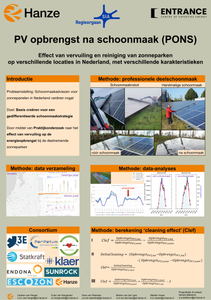
Wat is de opbrengst van het schoonmaken van zonneparken?
DOCUMENT
Installing photovoltaic panels (PV) on household rooftops can significantly contribute to mitigating anthropogenic climate change. The mitigation potential will be much higher when households would use PVs in a sustainable way, that is, if they match their electricity demand to their PVs electricity production, as to avoid using electricity from the grid. Whilst some have argued that owning PVs motivate households to use their PV in a sustainable way, others have argued that owning a PV does not result in load shifting, or that PV owners may even use more energy when their PV production is low. This paper addresses this critical issue, by examining to what extent PV owners are likely to shift their electricity demand to reduce the use of electricity from the grid. Extending previous studies, we analyse actual high frequency electricity use from the grid using smart meter data of households with and without PVs. Specifically, we employ generalized additive models to examine whether hourly net electricity use (i.e., the difference between electricity consumed from the grid and supplied back to the grid) of households with PVs is not only lower during times when PV production is high, but also when PV production low, compared to households without PVs. Results indicate that during times when PV production is high, net electricity use of households with PV is negative, suggesting they sent back excess electricity to the power grid. However, we found no difference in net electricity use during times when PV production is low. This suggests that installing PV does not promote sustainable PV use, and that the mitigation potential of PV installment can be enhanced by encouraging sustainable PV use
LINK
Volgens investeerders is een sluitende business case voor offshore windparken onmogelijk. “Ze willen weer subsidie. Evenzo willen investeerders in wind op land en zon-PV voortzetting van de SDE, terwijl in Klimaatakkoord was afgesproken daarmee in 2026 te stoppen. De ontwikkeling van zon-PV op woningdaken is ingestort na het einde van de salderingsregeling. Eigenaren van gascentrales willen een capaciteitsmarkt, waarbij zij een vergoeding krijgen, noem het subsidie, bovenop de opbrengst van verkochte stroom. Kommer en kwel dus in elektriciteitsproductieland. De baten wegen niet op tegen de kosten.”
LINK



