From June 28 to July 7 the National Arts Festival took place in Grahamstown, South Africa. For the 20th time Cue, a daily print newspaper about the Festival, was produced by Rhodes University journalism students. It was the first time that the newspaper was printed in full color. Cue is at the core of journalistic production during the Festival. But nowadays, what is a newspaper without pictures or without an online edition? Cue Pix, run by the photo department at the School of Journalism and Media Studies in the AMM (African Media Matrix) provides the pictures. Cue Online is run by the NML (New Media Lab) in the same building and is mostly shoveling print content online. Cue Radio and Cue TV take care of the audio and video, and broadcast during the Festival. Up to 2000 copies of Cue newspaper were printed daily with the number of sold copies around 1600. The newspaper was sold in the Grahamstown streets for 3 Rand. The number of pages of Cue ranges from 16 to 20, including advertisements. Cue is produced by students and lecturers of the School of Journalism and consists of about 50 student-reporters, 10 sub-editors, and 2 editors (who are generally University staff). The productions layout is taken care of by a group of design students. Twenty students from the photo department take care of the pictures and rework them with Adobes Photoshop. Cue TV and Cue Radio (with a total of about 10 students) brought their reporting skills to the Festival as well. Reporting about the Festival by Cue is a major happening that has been growing over the years. From print to TV, to radio and online. This is fantastic, but also reflects equal problems in the media industry: each media platform runs their own show. Print, TV, radio and photography: they all have their own targets, content production, and some coordination. In order to take full advantage of the different possibilities of all the media platforms, convergence is the keyword.
DOCUMENT

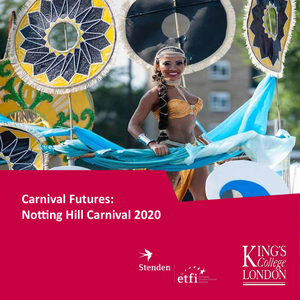
Carnival Futures: Notting Hill Carnival 2020 is a King’s Cultural Institute project led by Nicole Ferdinand (Culture, Media and Creative Industries at King’s College London) which sought to engage cultural organisations and other stakeholders in planning for the future of the Notting Hill Carnival. The content of this report is intended as a contribution to current research and to identifying future directions for the development of the Notting Hill Carnival. The material and views expressed are produced by various stakeholders in a series of workshops.
DOCUMENT
In het Utrechts Archief is er een zaal waarin een film wordt vertoond van het straatleven aan het begin van de vorige eeuw. Als bezoeker word je bij binnenkomst gescand en vervolgens geprojecteerd in de filmbeelden. In het fotomuseum kunnen bezoekers middels fysieke hendels de selectie manipuleren van de 80.000 digitale fotos uit de collectie. Het Rijksmuseum biedt via een zogenaamde widget de mogelijkheid iedere dag een ander kunstwerk op je desktop te hebben. In TwentseWelle is een digitaal panorama gebouwd waar je als bezoeker middenin staat, kijkend naar een landschap vanuit het perspectief van opgejaagd wild. Stuk voor stuk zijn dit voorbeelden waarin nieuwe technologie en nieuwe media worden ingezet om het publiek te bedienen in hun interesse voor cultuur en kennis. In die zin zijn ze exemplarisch voor de ontwikkeling waarin technologie en nieuwe media door cultureel erfgoed instellingen worden ingezet om een belangrijke taakstelling in te vullen, namelijk die van cultuur- en kennisoverdracht naar het publiek.
DOCUMENT

In deze adviestekst heeft het Algemeen Secretariaat van de Taalunie de uitdagingen in kaart gebracht die gepaard gaan met de doorstroom van nieuwkomersleerlingen naar het vervolgonderwijs. Er worden zes aanbevelingen gedaan voor een kwalitatieve doorstroom en verdere begeleiding van nieuwkomersleerlingen. De tekst kwam tot stand in samenwerking met een groep van Vlaamse en Nederlandse experts en werd gevoed door ervaringen uit diverse schoolbezoeken en interviews in Nederland en Vlaanderen.
DOCUMENT

Learning by Design (LBD) is a project-based inquiry approach for interdisciplinary teaching that uses design contexts to learn skills and conceptual knowledge. Research around the year 2000 showed that LBD students achieved high skill performances but disappointing conceptual learning gains. A series of exploratory studies, previous to the study in this paper, indicated how to enhance concept learning. Small-scale tested modifications, based on explicit teaching and scaffolding, were promising and revealed improved conceptual learning gains. The pretest-posttest design study discussed in this paper confirms this improvement quantitatively by comparing the conceptual learning gains for students exposed to the modified approach (n = 110) and traditional approach (n = 77). Further modifications, which resulted in a remodified approach tested with 127 students, show a further improvement through reduced fragmentation of the task and addressed science. Overall, the remodified approach (FITS model: Focus - Investigation - Technological design - Synergy) enriches technology education by stimulating an empirical and conceptual way of creating design solutions.
DOCUMENT
This feasibility report aims to create a solid background for Savings Groups programming in Italy, Spain, Germany, Poland and the Netherlands where partner organisations of the LETS SAVEE1 project are based. This Erasmus+ funded project aims at exploring the potential of saving groups in the European countries’ context, by improving entrepreneurial skills and access to financial services and social networks of diverse target groups. This particular report provides the partner organisation as well as other interested implementing organisations with a better understanding of how the different contexts influences the setting up and/or scale up of saving groups. This report is set up as follows: The market potential is based on literature of societal developments and how they can be linked to the emergence of saving groups in the respective countries and what kind of target groups have potential for benefitting the services offered by savings groups. By mapping partner organisations, the feasibility study identifies present and potential partners and stakeholders which could play an essential role reaching out to target groups. Then, the study will inform partner organisations and other implementers about the legal framework in each country that allows them to set up Savings Groups accordingly and identify issues that might need advocacy actions. Finally, this report provides a mapping of risk factors and ways to mitigate risks for savings groups members that were applicable for all partner organizations.
DOCUMENT

This paper presents a mixed methods study in which 21 first-year student teachers took part that investigated learning outcomes of a modified learning by design task. The study is part of a series of studies that aims to improve student learning, teaching skills and teacher training. Design-based science challenges are reasonably successful project-based approaches for breaking down the boundaries between traditional school subjects. Previous learning outcomes of the extensively studied Learning by Design (LBD) approach demonstrated a strong positive effect on students’ skills. However, compared to traditional classroom settings, LBD provided little or no profit on (scientific) concept learning. For this, according to two preliminary studies, a lack of explicit teaching and scaffolding strategies, both strongly teacher-dependent, bears a share of responsibility. The results of this third study indicate that more emphasis on these strategies indeed strengthens concept learning without reducing positive effects on skill performance.
DOCUMENT

Het gedachtegoed van het project ‘Naar Verantwoorde Rebellie’ vormt het fundament voor de bevindingen in dit whitepaper. Daarbij gaat het om inspiratie, tips en concepten die leiden tot rebelse initiatieven in de ouderenhuisvesting. Dat is geen overbodigheid, want er is een toenemende behoefte aan collectieve woonvormen voor ouderen die tussen zelfstandig wonen en verpleegzorg in zitten. Vooral voor ouderen met een laag en middeninkomen zijn de mogelijkheden beperkt. Het aanbod van geschikte tussenwoningen is simpelweg te summier (1). Dat vraagt dus om nieuwe initiatieven! Daarnaast hebben jongeren en starters het al geruime tijd erg lastig op de woningmarkt. De problematiek is bekend: het is haast een mission impossible om een betaalbare woning te kopen, en het meest deprimerende is dat de piek volgens de berekening van het Ministerie van Binnenlandse Zaken en Koninkrijksrelaties pas in 2024 wordt bereikt (2). Het is een urgent probleem, maar in de praktijk komt dat onvoldoende tot uiting. Deze groep heeft behoefte aan een helpende hand, en daarom wordt in dit whitepaper gekeken of de initiatieven voor ouderen ook voor jongeren en starters van waarde kunnen zijn. Sterker nog, of zij onderdeel van de oplossing kunnen worden. Helaas zijn we niet in de ban van ‘slechts’ een crisis, maar van meerdere crises. De woningcrisis wordt namelijk vergezeld door de klimaat- en coronacrisis, en op het moment van schrijven daar bovenop zelfs een koopkracht- en energiecrisis (3, 4, 5). Een hoop ingrediënten voor een boel ellende als we lukraak met onsamenhangende oplossingen aan komen zetten. Het is een complexe puzzel geworden die, onder tijdsdruk vanwege de klimaatdoelstellingen en groeiende onvrede, weloverwogen oplossingen vereist. Bij de bouw van toekomstige woningen moet er derhalve rekening gehouden worden met een plethora aan vereisten, die in dit whitepaper aan bod komen. In het vervolg wordt uiteengezet waar een geschikte tussenwoning aan dient te voldoen, evenals een denkrichting die beschrijft hoe een intergenerationele collectieve woonvorm kan worden vormgegeven. De lezer wordt meegenomen in een verhaal dat eerst de huidige marktsituatie en trends beschrijft, vervolgens de problemen en uitdagingen aankaart, om ten slotte een concrete oplossing aan te dragen. Hierbij wordt rekening gehouden met een veelvoud aan belangrijke variabelen zoals de locatie, voorzieningen, activiteiten, demografische kenmerken, en vorm- en zingeving van het wooncomplex (6). Het gaat nadrukkelijk om een denkrichting die op een inclusieve manier, en met inbegrip van hedendaagse toepassingen en best practices, een originele en vooral kwalitatief hoogwaardige oplossing biedt voor het beperkte woningaanbod. Creativiteit en woongenot staat in dit whitepaper centraal; de wensen van potentiële bewoners worden geïnventariseerd en meegenomen in de uiteindelijke oplossing. Door middel van gesprekken met experts worden echter ook de technische haalbaarheid en betaalbaarheid zo goed als mogelijk geborgd. De uiteenzetting leidt ten slotte tot een virtueel ontwerp dat als inspiratiebron fungeert voor zowel toekomstige bouwers als bewoners van soortgelijke wooncomplexen. Geïnteresseerden kunnen een virtuele tour van het intergenerationele woningcomplex volgen. Via de link op pagina 29 kunt u het concept bekijken.
MULTIFILE

Het onderwerp Business Intelligence staat vanuit de praktijk bij het bedrijfsleven al geruime tijd in de belangstelling. Daarnaast zijn hierover in de afgelopen tien jaren veel publicaties verschenen. Ook op internet zijn diverse aspecten van BI op meerdere sites aan te treffen. Het hoger onderwijs in Nederland zou daarom aan dit onderwerp meer aandacht moeten schenken door een studieboek te ontwikkelen en een daarop afgestemd vak in te richten dat in het hogere informatica onderwijs in het hbo en wo een essentieel onderdeel vormt. Ook voor andere studierichtingen is het een relevant (keuze)vak. Een internationaal BI-kenniscentrum in samenwerking met het bedrijfsleven en Amerikaanse onderwijsinstellingen biedt hiervoor het benodigde wetenschappelijke fundament.
DOCUMENT





