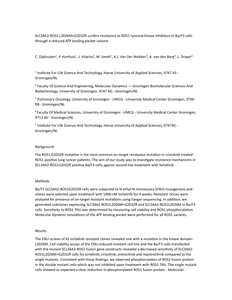
BackgroundThe ROS1 G2032R mutation is the most common on-target resistance mutation in crizotinib treated ROS1-positive lung cancer patients. The aim of our study was to investigate resistance mechanisms in SCL34A2-ROS1G2032R positive Ba/F3 cells against second line treatment with lorlatinib.MethodsBa/F3 SLC34A2-ROS1G2032R cells were subjected to N-ethyl-N-nitrosourea (ENU) mutagenesis and clones were selected upon treatment with 1000 nM lorlatinib for 4 weeks. Resistant clones were analyzed for presence of on-target resistant mutations using Sanger sequencing. In addition, we generated subclones expressing SLC34A2-ROS1L2026M+G2032R and SLC34A2-ROS1L2026M in Ba/F3 cells. Sensitivity to ROS1 TKIs was determined by measuring cell viability and ROS1 phosphorylation. Molecular Dynamic simulations of the ATP binding pocket were performed for all ROS1 variants.ResultsThe ENU-screen of 41 lorlatinib resistant clones revealed one with a mutation in the kinase domain: L2026M. Cell viability assays of the ENU-induced resistant cell line and the Ba/F3 cells transfected with the mutant SCL34A2-ROS1 fusion gene constructs revealed a decreased sensitivity of SLC34A2-ROS1L2026M+G2032R cells for lorlatinib, crizotinib, entrectinib and repotrectinib compared to the single mutants. Consistent with these findings, we observed phosphorylation of ROS1 fusion protein in the double mutant cells which was not inhibited upon treatment with ROS1 TKIs. The single mutant cells showed as expected a clear reduction in phosphorylated ROS1 fusion protein . Molecular modeling to unravel the effect of the mutations demonstrated that the volume of the ATP-binding pocket was reduced in single and double mutants compared to wild type. The double L2026M+G2032R mutant displayed the smallest pocket.ConclusionsWe identified a novel on-target mutation after inducing lorlatinib resistance in SLC34A2-ROS1G2032R Ba/F3 cells. This SLC34A2-ROS1L2026M+G2032R cell line was also resistant to crizotinib, entrectinib and repotrectinib. The resistance can be explained by a smaller ATP binding pocket in the mutated ROS1 fusion protein preventing effective binding of the investigated TKIs.
DOCUMENT
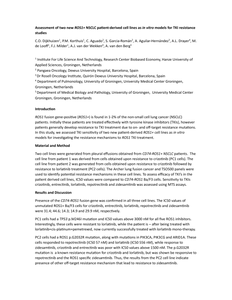
Clinical outcomes in ROS1-fusion positive (ROS1+) non-small cell lung cancer (NSCLC) by fusion partner and resistance mechanisms are limited. This cohort study included 56 ROS1+ patients (FISH or NGS confirmed); fusion partners were identified in 27 cases, including CD74 (n = 10), EZR (n = 7), and SDC4 (n = 7). Clinical data were available for 50 patients (median age 62; 51% female; 32% never-smokers). Forty patients received tyrosine kinase inhibitors (TKIs), mostly crizotinib (n = 38). Crizotinib showed a 55% objective response rate (ORR) and a median progression-free survival (mPFS) of 5.3 months. Brain metastases (HR 2.65, 95% CI 1.06–6.60, P = 0.037) and prior chemotherapy (HR 3.17, 95% CI 1.35–7.45, P = 0.008) had a higher risk of progression. Sixteen patients received subsequent lorlatinib, with an ORR of 28% and mPFS of 3.7 months. G2032R and L2026M resistance mutations were identified in four lorlatinib non-responders, and in vitro studies confirmed resistance to lorlatinib. Fusion partners did not affect crizotinib outcomes. Lorlatinib was ineffective against on-target resistance. Real-world data showed lower TKI efficacy than clinical trials, highlighting the role of clinical and molecular factors in treatment response.
DOCUMENT
DOCUMENT
Protein kinases function as pivotal regulators in biological events, governing essential cellular processes through the transfer of phosphate groups from ATP molecules to substrates. Dysregulation of kinase activity is frequently associated with cancer, ocasionally arising from chromosomal translocation events that relocate genes encoding kinases. Fusion proteins resulting from such events, particularly those involving the proto-oncogene tyrosine-protein kinase ROS (ROS1), manifest as constitutively active kinases, emphasizing their role in oncogenesis. Notably, the chromosomal reallocation of the ros1 gene leads to fusion of proteins with the ROS1 kinase domain, implicated in various cancer types. Despite their prevalence, targeted inhibition of these fusion proteins relies on repurposed kinase inhibitors. This review comprehensively surveys experimentally determined ROS1 structures, emphasizing the pivotal role of X-ray crystallography in providing high-quality insights. We delve into the intricate interactions between ROS1 and kinase inhibitors, shedding light on the structural basis for inhibition. Additionally, we explore point mutations identified in patients, employing molecular modeling to elucidate their structural impact on the ROS1 kinase domain. By integrating structural insights with in vitro and in silico data, this review advances our understanding of ROS1 kinase in cancer, offering potential avenues for targeted therapeutic strategies.
DOCUMENT
DOCUMENT
DOCUMENT
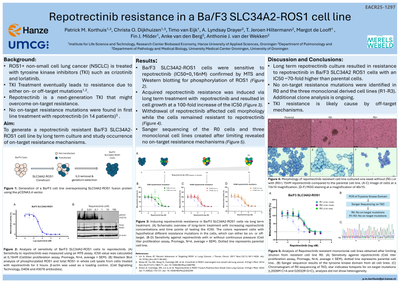
Longtumoren waaraan een ROS1 genherschikking ten grondslag ligt worden op dit moment behandeld met ROS1-specifieke tyrosine kinase remmers (TKIs). Hoewel TKI-therapie zeer succesvol is en weinig bijwerkingen geeft ten opzichte van chemotherapie, wordt uiteindelijk in alle patiënten ziekteprogressie waargenomen door therapie-resistentie van het tumorweefsel. Moleculaire veranderingen in de tumor liggen ten grondslag aan deze resistentie. Welk effect een specifieke mutatie heeft op de gevoeligheid van de tumor voor andere TKIs is grotendeels onbekend. In dit project zullen wij ROS1-tumorcelmodellen ontwikkelen met gerichte resistentie-mutaties tegen de TKIs Lorlatinib en Repotrectinib. Deze cellijnen zullen gebruikt worden om de effectiviteit van de klinische beschikbare TKIs te bestuderen. De kennis over de gevoeligheid van cellijnen met specifieke resistentiemutaties voor de beschikbare TKIs zal de diagnostiek rondom TKI-resistentie en de gepersonaliseerde behandeling van ROS1-positieve longkankerpatiënten verbeteren. Dit project is een samenwerking tussen de Hanzehogeschool, het Universitair Medisch Centrum Groningen en de nationale en internationale patiëntenorganisaties ‘Stichting Merels Wereld’ en de ‘ROS1ders’ respectievelijk. Het project is ingebed in de onderzoekslijn Bioactivity and Health binnen het Kenniscentrum Biobased Economy en het Instituut voor Life Science & Technology van de Hanzehogeschool en past uitstekend binnen de ambities van het kenniscentrum om zich op het Thema ‘(Positive) Health’ verder te ontwikkelen.