Wereldwijd onderzoek: Hoe gebruiken nieuwsmedia social media? Jongeren lezen geen krant meer, ze kijken op hun smartphone die ze altijd bij de hand hebben. Binnen het lectoraat social media en reputatiemanagement van NHL hogeschool te Leeuwarden heeft een groep internationale studenten in 12 landen onderzoek gedaan. Hierbij hebben ze meer dan 150 social media sites bestudeerd van nieuws media. De resultaten maken deel uit van een internationaal onderzoek van NHL Hogeschool en Haaga Helia University. De onderzoeksvraag was: Wat speelt zich af in de nieuwsmedia? Persbureaus kunnen het overzicht gebruiken om hun social media te optimaliseren. En voor ieder die journalistiek een warm hart toedraagt is het interessante informatie over de nieuwsmedia in een overgangssituatie (2nd edition)
DOCUMENT

The moment of casting is a crucial one in any media production. Casting the ‘right’ person shapes the narrative as much as the way in which the final product might be received by critics and audiences. For this article, casting—as the moment in which gender is hypervisible in its complex intersectional entanglement with class, race and sexuality—will be our gateway to exploring the dynamics of discussion of gender conventions and how we, as feminist scholars, might manoeuvre. To do so, we will test and triangulate three different forms of ethnographically inspired inquiry: 1) ‘collaborative autoethnography,’ to discuss male-to-female gender-bending comedies from the 1980s and 1990s, 2) ‘netnography’ of online discussions about the (potential) recasting of gendered legacy roles from Doctor Who to Mary Poppins, and 3) textual media analysis of content focusing on the casting of cisgender actors for transgender roles. Exploring the affordances and challenges of these three methods underlines the duty of care that is essential to feminist audience research. Moving across personal and anonymous, ‘real’ and ‘virtual,’ popular and professional discussion highlights how gender has been used and continues to be instrumentalised in lived audience experience and in audience research.
DOCUMENT

On the internet we see a continuously growing generation of web applications enabling anyone to create and publish online content in a simple way, to link content and to share it with others: wellknown instances include MySpace, Facebook, YouTube, Flickr, Wikipedia and Google Earth. The internet has become a social software platform sailing under the Web 2.0 flag, creating revolutionary changes along the way: the individual, the end-user, comes first and can benefit optimally from an environment which has the following keywords: radically user-oriented, decentralized, collective and massive. ‘An environment in which each participant not only listens, but can also make his own voice heard’: the Social Web. This document describes a brief exploration of this Social Web and intends to gain insight in possible fundamental changes this phenomenon is causing or might cause in our society. Particular attention will be paid to the impact of the Social Web on learning and education. For how do two apparently contrary developments touch and overlap? On the one side we have the rapid growth of technologies bringing individuals together to communicate, collaborate, have fun and acquire knowledge (social software). And on the other hand we have the just conviction within the world of education that young people should not only acquire knowledge and information, but should also have all kinds of skills and experience in order to meet social and technological changes deliberately, and prepare for a life long of learning.
DOCUMENT

Het tweejarige onderzoeksprogramma The Network is the Message richt zich op de effectiviteit van sociale media: wanneer zijn ze effectief, wat bepaalt die effectiviteit en hoe kunnen we dit meten? Startpunt in deze management summary fase 2B is het inzicht dat inhakers belangrijke dragers van brand content zijn, maar dat er ook nog een wereld te winnen is. Dit is nu niet direct een oproep aan alle merken om meteen met inhakers aan de slag te gaan; ‘inhaakmoeheid’ ligt op de loer. In deze management summary wordt beschreven wat goede inhakers zijn, wat een inhaker nou eigenlijk effectief maakt. We beschrijven de vier stappen die een rol spelen bij het ontwikkelen van kwalitatief goede inhakers.
DOCUMENT

This is the introduction to the special issue of World Review of Entrepreneurship, Management and Sustainable Development (WREMSD) dedicated to workplace innovation and social innovation related to work and organisation. As technological and business model innovations alone are not sufficient to enhance opportunities for businesses and employment, awareness is rising that better use should be made of human talents and new ways of organising and managing. In order to make working environments more receptive for innovation, and to enable people in organisations to take up an entrepreneurial role as intrapreneurs, a shift towards workplace innovation can be observed. Workplace innovation is complementary to technological and business model innovation, and a necessary ingredient for successful renewal, in that it addresses a type of management that seeks collaboration with employees through dialogue and employee engagement.
DOCUMENT

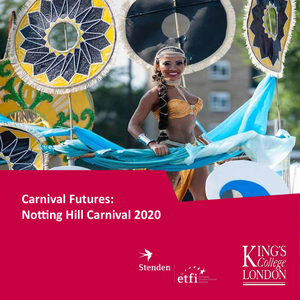
Carnival Futures: Notting Hill Carnival 2020 is a King’s Cultural Institute project led by Nicole Ferdinand (Culture, Media and Creative Industries at King’s College London) which sought to engage cultural organisations and other stakeholders in planning for the future of the Notting Hill Carnival. The content of this report is intended as a contribution to current research and to identifying future directions for the development of the Notting Hill Carnival. The material and views expressed are produced by various stakeholders in a series of workshops.
DOCUMENT
Social scientists of conservation typically address sources of legitimacy of conservation policies in relation to local communities’ or indigenous land rights, highlighting social inequality and environmental injustice. This chapter reflects on the underlying ethics of environmental justice in order to differentiate between various motivations of conservation and its critique. Conservation is discussed against the backdrop of two main ethical standpoints: preservation of natural resources for human use, and protection of nature for its own sake. These motivations will be examined highlighting mainstream conservation and alternative deep ecology environmentalism. Based on this examination, this chapter untangles concerns with social and ecological justice in order to determine how environmental and human values overlap, conflict, and where the opportunity for reconciliation lies, building bridges between supporters of social justice and conservation. https://www.springer.com/gp/book/9783319713113#aboutBook LinkedIn: https://www.linkedin.com/in/helenkopnina/
MULTIFILE

The article engages with the recent studies on multilevel regulation. The starting point for the argument is that contemporary multilevel regulation—as most other studies of (postnational) rulemaking—is limited in its analysis. The limitation concerns its monocentric approach that, in turn, deepens the social illegitimacy of contemporary multilevel regulation. The monocentric approach means that the study of multilevel regulation originates in the discussions on the foundation of modern States instead of returning to the origins of rules before the nation State was even created, which is where the actual social capital underlying (contemporary) rules can be found, or so I wish to argue. My aim in this article is to reframe the debate. I argue that we have an enormous reservoir of history, practices, and ideas ready to help us think through contemporary (social) legitimacy problems in multilevel regulation: namely all those practices which preceded the capture of law by the modern State system, such as historical alternative dispute resolution (ADR) practices.
DOCUMENT

Between 1 March 2021 and 30 April 2023, a consortium (consisting of in the Netherlands: the National Library of the Netherlands (Koninklijke Bibliotheek -KB), The Hague University of Applied Sciences, the Netherlands Institute for Sound and Vision in Hilversum; in Belgium: Media & Learning Association in Leuven and Public Libraries 2030 in Brussels; and in Spain: Fundación Platoniq in Barcelona) carried out an Erasmus+-funded research project on news media literacy among young people. It involved Dutch, Belgian and Spanish young people aged 12-15. The acronym SMILES, which stands for 'innovative methodS for Media & Information Literacy Education involving schools and librarieS', was chosen for the project title. The main goals of the SMILES project are: • Forming pairs between librarians and secondary school teachers in the three European countries, who were empowered through train-the-trainer workshops to teach secondary school students about news media literacy in relation to disinformation; • Helping students use digital technologies more safely and responsibly with a focus on recognising reliable and authentic information versus becoming more resilient to disinformation; • Developing five building blocks serving as teaching materials for Dutch, Belgian and Spanish pupils aged 12-15 with the aim of making them recognise disinformation and making them more resilient against it; • A scientific evaluation of the effectiveness of the implemented lessons through impact measurement using 'pre-knowledge tests' and 'post-knowledge tests'; • A strengthening of existing collaborations and creation of new collaborations between schools and libraries in the three partner countries. The SMILES project was implemented through three work packages. In the first work package, five so-called 'Baseline studies', or literature reviews, were conducted. The focus was on what the different educational approaches in Spain, Belgium and the Netherlands are with regard to disinformation and how these approaches can be linked. Based on these studies, the five building blocks were developed in the second work package. In addition, the teaching pairs were offered the training programme developed by SMILES through a 'train-the-trainer methodology' to safely and responsibly deploy the use of digital media tools during lessons with students. Also, based on the disinformation literature, the knowledge tests were designed to conduct an impact measurement of the train-the-trainer workshops and lessons among the trainers (teaching pairs) and students, respectively. These knowledge tests contained statements on disinformation that were answered correctly or incorrectly by respondents. The number of correctly answered statements prior to the lessons was compared with the number of correctly answered statements after the lessons. In this way, an attempt was made to prove a positive learning effect of the deployed lessons. In the third work package, the results from the pre-knowledge tests and the post-knowledge tests were analysed. In addition to these quantitative analyses, qualitative results were also used to analyse and look at the extent to which the training provided to trainers (teaching pairs) and the lessons with the five building blocks for students proved effective in teaching, recognising and becoming more resilient to disinformation, respectively. In doing so, we also reflect on whether the methodology tested has been effective in the three countries: what are the best practices and where do we see areas for improvement?
DOCUMENT




