DOCUMENT
Digital Twins of the Ocean (DTOs) are increasingly used in Maritime Spatial Planning (MSP), yet most remain limited to 2D representations and offer minimal stakeholder interactivity. These limitations reduce their effectiveness in capturing complex socio-ecological-technical dynamics and supporting exploratory what-if scenario planning in a 3D or 4D ocean space. This paper presents Immersive Ocean, a novel Virtual Twin platform developed within EU-ILIAD DTO initiative. Built with game engine and VR technologies, it supports procedural 3D world generation and interactive exploration in both desktop and immersive VR modes. Systematic performance validation demonstrated stable frame rates across both PC and VR platforms. Initial user evaluations (n=22) report high usability and engagement but also suggest areas for improvement in UI clarity and ecological model representation. These initial findings position Immersive Ocean as a promising Virtual Twin solution for an immersive, interactive, and data-integrated approach to MSP and ocean governance. Immersive Ocean is now being piloted with stakeholders in real-world MSP scenarios, including offshore wind farm planning.
DOCUMENT
In this chapter it is argued that self-direction is currently well above the head of the majority of youngsters and even of many adults. Evidence for this conclusion stems from developmental and brain research. However, for various reasons it is important that people develop the competences that are necessary for self-direction. To what degree is it possible to develop these competences? Are they 'learnable'? What can education contribute?
DOCUMENT

Based on the theory of embodied cognition we developed NOOT, at tangible tool that allows marking audio-moments during creative sessions. A detailed analysis of using NOOT in practice lead to a reconceptualization of NOOT within processes of external scaffolding. It also spurred a new design project focused on reflection during group sessions
DOCUMENT

The security of online assessments is a major concern due to widespread cheating. One common form of cheating is impersonation, where students invite unauthorized persons to take assessments on their behalf. Several techniques exist to handle impersonation. Some researchers recommend use of integrity policy, but communicating the policy effectively to the students is a challenge. Others propose authentication methods like, password and fingerprint; they offer initial authentication but are vulnerable thereafter. Face recognition offers post-login authentication but necessitates additional hardware. Keystroke Dynamics (KD) has been used to provide post-login authentication without any additional hardware, but its use is limited to subjective assessment. In this work, we address impersonation in assessments with Multiple Choice Questions (MCQ). Our approach combines two key strategies: reinforcement of integrity policy for prevention, and keystroke-based random authentication for detection of impersonation. To the best of our knowledge, it is the first attempt to use keystroke dynamics for post-login authentication in the context of MCQ. We improve an online quiz tool for the data collection suited to our needs and use feature engineering to address the challenge of high-dimensional keystroke datasets. Using machine learning classifiers, we identify the best-performing model for authenticating the students. The results indicate that the highest accuracy (83%) is achieved by the Isolation Forest classifier. Furthermore, to validate the results, the approach is applied to Carnegie Mellon University (CMU) benchmark dataset, thereby achieving an improved accuracy of 94%. Though we also used mouse dynamics for authentication, but its subpar performance leads us to not consider it for our approach.
DOCUMENT

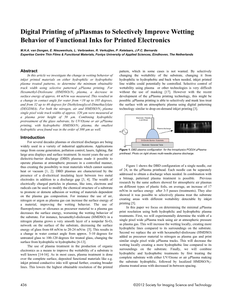
In this article we investigate the change in wetting behavior of inkjet printed materials on either hydrophilic or hydrophobic plasma treated patterns, to determine the minimum obtainable track width using selective patterned μPlasma printing. For Hexamethyl-Disiloxane (HMDSO)/N2 plasma, a decrease in surface energy of approx. 44 mN/m was measured. This resulted in a change in contact angle for water from <10 up to 105 degrees, and from 32 up to 46 degrees for Diethyleneglycol-Dimethaclylate (DEGDMA). For both the nitrogen, air and HMDSO/N2 plasma single pixel wide track widths of approx. 320 μm were measured at a plasma print height of 50 μm. Combining hydrophilic pretreatment of the glass substrate, by UV/Ozone or air μPlasma printing, with hydrophobic HMDSO/N2 plasma, the smallest hydrophilic area found was in the order of 300 μm as well.
DOCUMENT
The purpose of this literature study was to obtain an overview of previous civic literacy projects and their characteristics as primarily described in educational science literature. Eighteen academic articles on civic literacy projects in higher education were studied in detail and coded using the qualitative data analysis instrument, Atlas.ti. The codes and quotations compiled were then divided in various categories and represented in a two-axis model. The definitions of ‘civic literacy’ found in the literature varied from an interest in social issues and a critical attitude to a more activist attitude (axis number 1). The analysis of the literature showed that, especially in more recent years, more students than citizens have benefited from civic literacy projects in higher education (axis number 2). The visualization of the findings in the two-axis model helps to place civic literacy projects in a broader frame. The final authenticated version is available online at https://doi.org/10.1007/978-3-030-13472-3_9
MULTIFILE

Description of a new hand/palm-held computerized 3D force measuring system. The system is built for interface (direct) measurement of 3D manual contact force with real-time data presentation. Static calibration was performed of the 3D force sensor with variable preloads to study their effect as well of the prototype system adapted for clinical manual examination and treatment. The new system enables, for the first time, recording and presenting of 3D manual contact forces at the patient-practitioner interface. 3D direct manual contact force measures have the potential to give a more complete and differentiated characterization of patient and practitioner forces than 1D forces. Clinical validity of the prototype system will have to be investigated, and for studying specific clinical manual handling techniques, obvious limitations require further development.
DOCUMENT

This case study describes a special edition of the European Project Semester at the course Sustainable Packaging Design and Innovation at the Faculty of Industrial Design Engineering at The Hague University of Applied Sciences (Fall Semester 2017). In this special edition, unique cooperation took place between 12 parties. The parties were three research institutes, six universities, and three companies. Some parties have developed an educational module focused upon sustainable and circular packaging design, including the use of a dedicated tool for life cycle assessment. This module was embedded in the regular EPS. At The Hague University of Applied Sciences, an international class of 16 students worked in four teams on a real-life design assignment. They were offered a wide range of lectures, workshops, pitches, and presentations. The chapter concludes with a review of the followed processes and organizational, managerial, and practical concerns. Although run as a unique edition, all parties discuss to continue this cooperation.
DOCUMENT

Study objective: The three-dimensional shape of the ultrasound beam produces a thicker scan plane than most users assume. Viewed longitudinally, a needle placed lateral to a vessel just outside the central scanning plane can be displayed incorrectly in the ultrasound image as if placed intravascularly. This phenomenon is called the beam width artefact, also known as the elevation or slice thickness artefact. The goal of this study was to demonstrate the potential negative effect of the beam width artefact on the performance of in-plane ultrasound- guided vascular access procedures, and to provide a solution. Design: Randomized, double-blinded study Setting: Department of anaesthesiology and intensive care of a teaching hospital Participants: 31 experienced (anesthesiologists and intensivists) and 36 inexperienced (anesthetic nurses) ultrasound users Interventions: We developed an acoustic lens that narrows the scan plane to reduce the beam width artefact. The lens was tested in a simulated vascular access study. Measurements: The primary endpoint was first pass success. Secondary endpoints were the number of punctures and needle withdrawals, procedure time, needle visibility and operator satisfaction. Main results: First pass success was highly enhanced using the acoustic lens, with a success rate of 92.5% versus 68.7% without the lens (difference 23.8, 95% confidence interval 11.0–35.3, p <0.001). The total number of punctures needed to obtain intravenous access was also reduced using the lens (1.10 versus 1.38, difference 0.27, 95% CI 0.11–0.43, p =0.002). Procedure time, needle withdrawals, needle visibility and satisfaction were similar. Both inexperienced and experienced users benefited from the acoustic lens. Conclusions: The beam width artefact has a significant effect on the performance of ultrasound-guided needle- based procedures. The efficacy of in-plane superficial vascular access procedures can be enhanced by narrowing the imaging plane using an acoustic lens.
MULTIFILE



