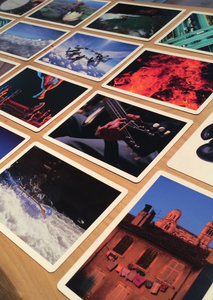
This paper introduces a creative approach aimed at empowering desk-bound occupational groups to address the issue of physical inactivity at workplaces. The approach involves a gamified toolkit called Workplace Vitality Mapping (WVM) (see Figure 1) designed to encourage self-reflection in sedentary contexts and foster the envision of physical vitality scenarios. This hybrid toolkit comprises two main components: A Card Game (on-site) for context reflection and a Co-design Canvas (Online) for co-designing vitality solutions. Through the card games, participants reflect on key sedentary contexts, contemplating their preferable physical vitality scenarios with relevant requirements. The co-design canvas facilitates the collaborative construction and discussion of vitality scenarios’ development. The perceptions and interactions of the proposed toolkit from the target group were studied and observed through a hybrid workshop, which demonstrated promising results in terms of promoting participants’ engagement experience in contextual reflections and deepening their systemic understanding to tackle the physical inactivity issue. As physical inactivity becomes an increasingly pressing concern, this approach offers a promising participatory way for gaining empathetic insights toward community-level solutions.
DOCUMENT

Over the last decade, sport and physical activity have become increasingly recognised and implemented as tools to foster social cohesion in neighbourhoods, cities and communities around Europe. As a result, numerous programmes have emerged that attempt to enhance social cohesion through a variety of sport-based approaches (Moustakas, Sanders, Schlenker, & Robrade, 2021; Svensson & Woods, 2017). However, despite this boom in sport and social cohesion, current definitions and understandings of social cohesion rarely take into account the needs, expectations or views of practitioners, stakeholders and, especially, participants on the ground (Raw, Sherry, & Rowe, 2021). Yet, to truly foster broad social outcomes like social cohesion, there is increasing recognition that programmes must move beyond interventions that only focus on the individual level, and instead find ways to work with and engage a wide array of stakeholders and organisations (Hartmann & Kwauk, 2011; Moustakas, 2022). In turn, this allows programmes to respond to community needs, foster engagement, deliver more sustainable outcomes, and work at both the individual and institutional levels. The Living Lab concept - which is distinguished by multi-stakeholder involvement, user engagement, innovation and co-creation within a real-life setting - provides an innovative approach to help achieve these goals. More formally, Living Labs have been defined as “user-centred, open innovation ecosystems based on a systematic user co-creation approach, integrating research and innovation processes in real-life communities and settings” (European Network of Living Labs, 2021). Thus, this can be a powerful approach to engage a wide array of stakeholders, and create interventions that are responsive to community needs. As such, the Sport for Social Cohesion Lab (SSCL) project was conceived to implement a Living Lab approach within five sport for social cohesion programmes in four different European countries. This approach was chosen to help programmes directly engage programme participants, generate understanding of the elements that promote social cohesion in a sport setting and to co-create activities and tools to explore, support and understand social cohesion within these communities. The following toolkit reflects our multi-national experiences designing and implementing Living Labs across these various contexts. Our partners represent a variety of settings, from schools to community-based organisations, and together these experiences can provide valuable insights to other sport (and non-sport) organisations wishing to implement a Living Lab approach within their contexts and programmes. Thus, practitioners and implementers of community-based programmes should be understood as the immediate target group of this toolkit, though the insights and reflections included here can be of relevance for any individual or organisation seeking to use more participatory approaches within their work. In particular, in the coming sections, this toolkit will define the Living Lab concept more precisely, suggest some steps to launch a Living Lab, and offer insights on how to implement the different components of a Living Lab.
DOCUMENT

Student driven CRISPR/Cas9 mutagenesis in Petunia
DOCUMENT

The context of a societal challenge provides insight into the complexity of the (eco-)system surrounding the current problematic situation: the environment, the stakeholders (including nature), the highlights and frustrations, the conflicts and dilemmas, and the opportunities for change. Why is this co-design session arranged? What problematic situation is encountered? Who (individual or group) took the initiative to act? Is there a specific reason to collaboratively start taking up this societal challenge? Does everyone in this session recognise the problematic situation? Why or why not?
MULTIFILE

Jo-An Kamp is a lecturer and researcher at Fontys University of Applied Sciences in the Netherlands. She coaches ICT students in the fields of UX, research, (interactive) media, communication, (interaction) design, ethics and innovation. She does research on the impact of technology on humans and society. Jo-An is co-creator of the Technology Impact Cycle Toolkit (www.tict.io), a toolkit designed to make people think and make better decisions about (the implementation of) technology and is a member of the Moral Design Strategy research group.
YOUTUBE

Blended learning is not a flash in the pan, it’s here to stay. At The Hague University of Applied Sciences (THUAS) the implementation of blended learning is not yet in an adult stage, but in a newly introduced educational framework (The Hague University of Applied Sciences, 2017) blended learning plays a vital role. The intention is for teams to come to a shared approach when it comes to blended learning. In his blog, Leonard Geluk, (Geluk, 2016) the Chairman of the Executive Board of the University notes that ‘the development is slow to get off the ground’ and ‘there is still work to be done before we can fully embed ICT in education.’ The toolkit of teachers has been supplemented with many digital tools in recent decades (Geluk, 2014), but what makes lecturers actually use these new possibilities? What causes them to pick up the toolkit or leave it? Jacobs (2013) indicates that people’s ability to exploit the benefits of technology, in particular digital technology, is not obvious and can be a big challenge, especially for teachers. The central question to this study is: What brings lecturers in motion around blended learning? In my opinion, gaining more understanding in the lecturers’ perspective is an important part of the ‘work’ that Leonard Geluk describes above. This is the main goal of this research.
DOCUMENT
Few people I know act likea magnet in the way Laura does. If you hear her speak, see her move, enjoy her smile - you can't help but want to be a part of what makes her heart beat faster. She radiates passion for her dream topic biomimicry and before you know it you're caught in that dream. From the day I met her, I was captivated by her enthusiasm and knowledge about this topic. In fact, meeting Laura made me decide to join the university as I thought: if people like Laura work at THUAS, I want to be a part of this organization'. Over the years I have seen her finish the Msc in biomimicry at Arizona State University followed by a PhD at TUDelft. And all that next to her full time job as a teacher. It's only a miracle that she still found the time to go outdoors and be in Nature. But luckily, she did as this is what nourishes her - and that nourishment is brought into the classroom affecting generations of students. I am very proud of how she builds her tribe just like Nature does; grassroots from the bottom up, not supported but also not inhibited by formal structures. In that way she truly acts as a bridge helping others to tap into Nature's wisdom. This morning I harvested the remaining vegetables from my garden and turned them into lunch. It's the second year I grow vegetables and it feels like I am only at the beginning of learning to collaborate with Nature. In Spring and Summer, Ihave witnessed in awe how seeds become seedlings which then grow into mature plants carrying fruit. The sheer wonder of Nature never ceases to amaze me, and my garden is only an attempt to be more aware of seasonal rhythms. It's Autumn right now, a time of year that invites us to go inside, reflect and let go of old baggage that no longer serves us. We'll be approaching the stage of wintering soon in which our inner journey will benefit from the darkness of wintertime introspection, along with the space to process the old, integrate learnings, and then germinate the new. Over the course of her career, Laura has gone through these seasonal cycles - reinventing herself in the past decade as a teacher, researcher and regenerative leader. One of Laura's many qualities is that she embodies three leadership characteristics derived from Nature. First, she acknowledges the importance of interconnection. Many times, we think of Nature as being separate from us, but in reality we humans are Nature. Connection with Nature enables us to think within systems and understand that we can't direct the system, but instead we're all part of multiple systems. Second, sensing the system and our part in it builds resilience. Even if things don't go as we expected or imagined, rather than reacting, we can step back and engage with more insight. Laura's adaptability to a system's needs while spotting opportunities to crack it open, is admirable. As the system is always in evolution, so is she - remarkably receptive to change even in the final stages of her career. Third, Laura creates space for people to develop and thrive, acting as multipliers of her vision and love for the natural world. In her leadership she embodies the ideal elder while being able to perceive the world through the eyes of a child - with continuous wonder for how life unfolds. This book is a bricolage of Laura's post-doc research conducted the past two years. In it you will find an array of fascinating reads and tools that help you deepen your practice as a biomimicry professional. The book is a community effort integrating tools Laura has co-created with her ecosystem as well as more in-depth readings written by some of the talents she has nourished over time. I wish for you to enjoy this careful curation of both practical as well as more conceptual contributions. May it inspire your own thriving in bringing Nature based wisdom to the core of our daily lives.
DOCUMENT

In order to empower more people to become more selfreliant in society, interactive products and services should better match the skills and values of diverse user groups. In inclusive design, relevant end-user groups are involved early on and throughout the design and development process, leading to a better user experience. However, for IT businesses not operating in the academic domain, getting access to appropriate user research methods is difficult. This paper describes the design and prototype development of the Include Toolbox, in close cooperation with practitioners of small to medium sized enterprises (SMEs) in IT. It consists of an interactive app paired with a book. The app helps to find suitable research methods for diverse user groups such as older people, people with low literacy, and children. The book offers background information on the advantages of inclusive design, information on different user groups, and best practices shared by other companies.
DOCUMENT

Large groups in society lack the necessary skills to be sufficiently self-reliant and are in need of personal assistance. These groups could be supported by information and information technology (ICT), but only if this technology is designed to fit their (cognitive) abilities. Inclusive design theory and methods have already been developed in research contexts, but there is still a gap between theory and practice. There is a need for a practical aid, that helps to create awareness of inclusive design among ICT developers, and offers easy-to-use information and tools to actually apply the methods for diverse target groups. This paper describes the first steps taken towards an inclusive design toolbox for developing ICT applications that offer cognitive support for selfreliance. Dutch ICT companies were interviewed and participated in a co-design workshop, leading to a number of initial needs, user requirements, and an on-line community, that form input for further development of the toolbox.
DOCUMENT

Kennis uit onderzoek is van cruciaal belang om het onderwijs te verbeteren en te innoveren. Dit vraagt om een nauwe verbinding tussen onderwijsonderzoek en de dagelijkse onderwijspraktijk. De roep om een meer lerende cultuur in het onderwijs en de ambitie om onderwijsonderzoek meer te benutten voor het verbeteren van de onderwijspraktijk is niet nieuw: in het onderwijswerkveld zijn steeds meer scholen bezig met kennisbenutting, en het vraagstuk staat al langere tijd op de politieke agenda. Tegelijkertijd blijkt uit verschillende studies dat dit nog geen vanzelfsprekendheid is en dat het versterken van een kennisinfrastructuur een bijzonder complexe opgave is. In opdracht van de onderwijsraad heeft het lectoraat Public Governance een internationale vergelijking uitgevoerd naar de kennisinfrastructuur in andere – met Nederland vergelijkbare – landen. Deze ‘best practices’ zijn beschreven vanuit de vraag: wat kan Nederland van deze andere landen leren?
DOCUMENT




