Environmental advocacy has a difficult position within environmental education (EE) and education for sustainable development (ESD). Proponents of pluralistic approaches to education see advocacy as a form of indoctrination. However, pluralistic education itself can be seen as a form of indoctrination. Its normative assumptions are based on the neo-liberal capitalist values that tend to view environmentalism as a threat to the established norms. In this paper I will argue that environmental advocacy is in fact essential for educating critical citizens capable of addressing sustainability challenges. This argument will be supported by the written reports on the documentary film about the radical environmental movement presented to the students of International Business Management Studies (IBMS) of The Hague University of Applied Science (HHS). This case study will provide an example of how environmental advocacy and the objective of pluralistic education can be reconciled and explore the advantages of combining business education with education for deep ecology. https://doi.org/10.1504/IJISD.2014.066621 https://www.linkedin.com/in/helenkopnina/
MULTIFILE

This article will discuss the role of environmentalism in environmental education (EE) and education for sustainable development (ESD) in the context of ecopedagogy. Ecopedagogy calls for the remaking of capitalist practices and seeks to re-engage democracy to include multispecies interests in the face of our current global ecological crisis. In this article, the written reports by international business students on the documentary film If a Tree Falls about a radical environmental movement will be discussed. The aim of this article is to reflect upon the question of whether confrontational questions posed by radical environmentalism can move students to re-examine certain central assumptions within their own society and education. The analysis of students’ individual writing assignments after viewing the film is placed in the context of the discussion about the aims of education in relation to environmental advocacy. This case study seeks to provide an example of how environmental advocacy and the objective of pluralistic education can be combined as mutually supportive means of achieving both democratic learning and learning for environmental sustainability. https://doi.org/10.1177/0973408215569119 https://www.linkedin.com/in/helenkopnina/
MULTIFILE

This paper examines the network governance approach of the Dutch Urban Envoy in the context of multilevel governance in the European Union. This paper aims to answer the research question on how the scope of network governance can explore the performance of the Dutch Urban Envoy. By analyzing network characteristics, such as legitimacy, actor-level properties, and network-level properties, this paper seeks to provide a nuanced understanding of the performance of the Dutch Urban Envoy. Drawing on previous research, this paper identifies the applicability and limitations of assessing network characteristics in understanding advocacy processes. The paper successfully visualizes the networks of the Dutch Urban Envoy and explores their roles and mandates, contributing to determining the added value of their position. However, the network governance approach has limitations in explaining the tangible successes and challenges of the Dutch Urban Envoy that cannot be directly attributed to their overall performance.
MULTIFILE

This chapter offers a working definition of social accountability as any citizen-led action beyond elections that aims to enhance the accountability of state actors. We view social accountability as a broad array of predominantly bottom-up initiatives, aimed at improving the quality of governance (especially oversight and responsiveness) through active citizen participation. We also trace the evolution of SA as a concept in the literature over the past decades and, then, discuss some influential theoretic approaches to SAIs, pointing out strengths and weaknesses of each model. Finally, we suggest organising Arab SAIs into one of three categories: (1) transparency; (2) advocacy; or (3) participatory governance and we review each of these existing action formats by discussing their main strengths and flaws.
MULTIFILE
Human rights groups are increasingly calling for the protection of their right to privacy in relation to the bulk surveillance and interception of their personal communications. Some are advocating through strategic litigation. This advocacy tool is often chosen when there is weak political or public support for an issue. Nonetheless, as a strategy it remains a question if a lawsuit is strategic in the context of establishing accountability for indiscriminate bulk data interception. The chapter concludes that from a legal perspective the effect of the decision to litigate on the basis of the claim that a collective right to group privacy was violated has not (yet) resulted in significant change. Yet the case study, the British case of human rights groups versus the intelligence agencies, does seem to suggest that they have been able to create more public awareness about mass surveillance and interception programs and its side-effects
LINK
Rationale, aims and objectives: The aims of this study are as follows: (a) to establish whether a relationship exists between the importance that healthcare professionals attach to ethics in care and their likelihood to report reprehensible conduct committed by colleagues, and (b) to assess whether this relationship is moderated by behavioural control targeted at preventing harm. Method: In this cross-sectional study, which was based on a convenience sample (n = 155) of nurse practitioners (NPs) and physician assistants (PAs) in the Netherlands, we measured ethics advocacy (EA) as a motivating factor (reflecting the importance that healthcare professionals attach to ethics and care) and “behavioral control targeted at preventing harm” (BCPH) as a facilitating factor. “Reporting reprehensible conduct” (RRC) was measured as a context-specific indicator of whistleblowing intentions, consisting of two vignettes describing morally questionable behaviour committed by colleagues. Results: The propensity to report reprehensible conduct was a function of the interaction between EA and BCPH. The only group for which EA predicted RRC consisted of individuals with above-average levels of perceived BCPH. Conclusion: The results suggest that the importance that healthcare professionals attach to ethical aspects in care is not sufficient to ensure that they will report reprehensible conduct. Such importance does not induce reporting behaviour unless the professionals also perceive themselves as having a high level of BCPH. We suggest that these insights could be helpful in training healthcare providers to cope with ethical dilemmas that they are likely to encounter in their work.
DOCUMENT

Indigenous rights’ relationship to ecological justice in Amazonia has not been explicitly explored in the literature. As social scientists rarely talk about violence against non-humans, this case study of conservation in Amazonia will explore this new area of concern. Ethical inquiries in conservation also engage with the manifold ways through which human and nonhuman lives are entangled and emplaced within wider ecological relationships, converging in the notion of environmental justice, which often fails to account for overt violence or exploitation of non-humans. Reflecting on this omission, this chapter discusses the applicability of engaged social science and conservation to habitat destruction in Amazonia, and broader contexts involving violence against non-humans. The questions addressed in this chapter are: is the idea of ecological justice sufficiently supported in conservation debate, and more practical Amazonian contexts? Can advocacy of inherent rights be applied to the case of non-humans? Can indigenous communities still be considered 'traditional' considering population growth and increased consumptive practices? Concluding that the existing forms of justice are inadequate in dealing with the massive scale of non-human abuse, this chapter provides directions for conservation that engage with deep ecology and ecological justice in the Amazonian context. doi: 10.1007/978-3-030-29153-2 LinkedIn: https://www.linkedin.com/in/helenkopnina/
MULTIFILE

This feasibility report aims to create a solid background for Savings Groups programming in Italy, Spain, Germany, Poland and the Netherlands where partner organisations of the LETS SAVEE1 project are based. This Erasmus+ funded project aims at exploring the potential of saving groups in the European countries’ context, by improving entrepreneurial skills and access to financial services and social networks of diverse target groups. This particular report provides the partner organisation as well as other interested implementing organisations with a better understanding of how the different contexts influences the setting up and/or scale up of saving groups. This report is set up as follows: The market potential is based on literature of societal developments and how they can be linked to the emergence of saving groups in the respective countries and what kind of target groups have potential for benefitting the services offered by savings groups. By mapping partner organisations, the feasibility study identifies present and potential partners and stakeholders which could play an essential role reaching out to target groups. Then, the study will inform partner organisations and other implementers about the legal framework in each country that allows them to set up Savings Groups accordingly and identify issues that might need advocacy actions. Finally, this report provides a mapping of risk factors and ways to mitigate risks for savings groups members that were applicable for all partner organizations.
DOCUMENT

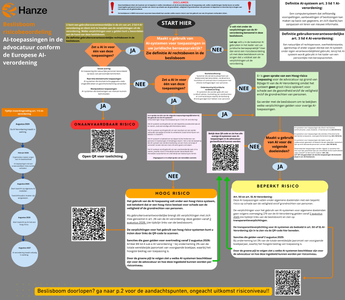
Wat betekent de AI act voor advocatenkantoren? Hoe kunnen zij AI verantwoord inzetten? In dit onderzoek heeft een student dat uitgewerkt in een uitgebreid beroepsproduct, bestaande uit een beslisboom om te beoordelen in welke risicocategorie een AI systeem voor de advocatuur valt en welke verplichten er per risicosysteem zijn. Disclaimer:De afstudeeropdracht wordt uitgevoerd door een vierdejaarsstudent in het kader van zijn/haar afstuderen bij het Instituut voor Rechtenstudies. De student levert een juridisch beroepsproduct op en doet daartoe onderzoek. De student wordt tijdens de uitvoering van zijn/haar afstudeeropdracht begeleid door een afstudeercoach. De inspanningen van de student en de afstudeercoach zijn erop gericht om een zo goed mogelijk beroepsproduct op te leveren. Dit moet opgevat worden als een product van een (vierdejaars)student en niet van een juridische professional. Mocht ondanks de geleverde inspanningen de informatie of de inhoud van het beroepsproduct onvolledig en/of onjuist zijn, dan kunnen de Hanzehogeschool Groningen, het Instituut voor Rechtenstudies, individuele medewerkers en de student daarvoor geen aansprakelijkheid aanvaarden.
MULTIFILE
This publication gives a different take on energy and energy transition. Energy goes beyond technology. Energy systems are about people: embedded in political orders and cultural institutions, shaped by social consumers and advocacy coalitions, and interconnected with changing parameters and new local and global markets. An overview and explanation of the three end states have been extracted from the original publication and appear in the first chapter. The second chapter consists of an analysis exploring key drivers of change until 2050, giving special attention to the role of international politics, social dynamics and high-impact ideas. The third chapter explores a case study of Power to Gas to illustrate how the development of new technologies could be shaped by regulatory systems, advocacy coalitions and other functions identified in the ‘technology innovation systems’ model. The fourth chapter explores the case of Energy Valley to understand how local or regional energy systems respond to drivers of change, based on their contextual factors and systems dynamics.
DOCUMENT




