Energy Valley cluster and internationalisation.There is a need for more dynamic approaches to strategy development for clusters due to the complex internal and external environments that are part of clusters. The research introduced complex adaptive systems (CAS) approach to cluster theory where contextual analysis of clusters are an essential part of understanding cluster development. In-depth analyses of cluster dynamics and drivers of change in the context of the cluster would provide deeper understanding of cluster developments that will then feed into strategy development processes.
DOCUMENT
What drivers of change and cluster dynamics, in particular for energy clusters, are significant to cluster development and what revision might be needed for cluster theory?
DOCUMENT

Clusters are the magic answer to regional economic development. Firms in clusters are more innovative; cluster policy dominates EU policy; ‘top-sectors’ and excellence are the choice of national policy makers; clusters are ‘in’. But, clusters are complex, clusters are ‘messy’; there is no clear logic and no one agrees to how it can be successful.
DOCUMENT

Clusters are the magic answer to regional economic development. Firms in clusters are more innovative; cluster policy dominates EU policy; ‘top-sectors’ and excellence are the choice of national policy makers; clusters are ‘in’. But, clusters are complex, clusters are ‘messy’; there is no clear logic and no one agrees to how it can be successful.
DOCUMENT

Survey data are often used to map cultural diversity by aggregating scores of attitude and value items across countries. However, this procedure only makes sense if the same concept is measured in all countries. In this study we argue that when (co)variances among sets of items are similar across countries, these countries share a common way of assigning meaning to the items. Clusters of cultures can then be observed by doing a cluster analysis on the (co)variance matrices of sets of related items. This study focuses on family values and gender role attitudes. We find four clusters of cultures that assign a distinct meaning to these items, especially in the case of gender roles. Some of these differences reflect response style behavior in the form of acquiescence. Adjusting for this style effect impacts on country comparisons hence demonstrating the usefulness of investigating the patterns of meaning given to sets of items prior to aggregating scores into cultural characteristics.
LINK
This title was first published in 2001. Analyzing and comparing several growth clusters in nine European cities, this compelling volume examines the critical success factors that determine the economic development of urban regions.
DOCUMENT
Clusters development takes place in an increasingly changing and complex context where global and local developments are interconnected. Various regional and innovation studies recognize the need for place-based studies to include the larger context in which clusters and regions are found. Interest and discourse on the value of complexity approaches to cluster studies is increasing, with the aim to gain deeper understanding of processes taking place in complex cluster development. This discourse was initiated by Martin & Sunley (2003) and explored extensively by Cooke (2012) in his study of ‘complex adaptive innovation systems’. Work in this area of research is limited and empirical study could add to understanding the complexity of cluster development.
DOCUMENT
Business landscapes are changing at global, regional and sectoral levels as well as the social and ecological contexts. In order to understand what these changes are and how clusters are dealing with these, the research explores drivers of change and cluster dynamics using a Complex Adaptive Systems (CAS) approach. The research uses Energy Valley as its main case study to gain insights into these changes. The research has developed a conceptual framework for cluster development. One of the main reasons for this research is the signicance of clusters in the European Union’s competitiveness strategy, Innovation Union (EC, 2010).
DOCUMENT

The emotional experience of a visit to a concentration camp memorial is high in intensity and wide in diversity. Clustering of this emotional experience has led to a better understanding of the valence of emotions. It is not known how these emotion clusters affect the meaning derived from the experience and how this affects visit intention. This study addressed this gap in research and explored the potential relations between emotion clusters and meaning in the context of an expected visit to a concentration camp memorial. This study finds that the emotion cluster Sympathy is the only cluster to have a significant and large positive direct effect on Meaning and a significant, but small, positive indirect effect on Visit Intention. The Misery cluster is the only cluster that has a significant but small negative direct effect on Visit Intention. The Positivity cluster has no effects on Meaning and Visit Intention. In the discussion, we address the role of empathy, and theoretical implications are framed in Terror Management Theory. Managerial implications include a discussion on the use of promotion to trigger empathy.
LINK
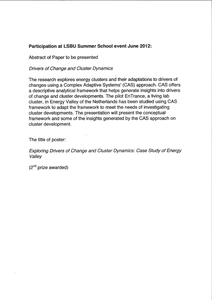
The research explores energy clusters and their adaptations to drivers of changes using a Complex Adaptive Systems (CAS) approach. CAS offers a descriptive analytical framework that helps generate insights into drivers of change and cluster developments. The pilot EnTranCE, a living lab cluster, in Energy Valley of the Netherlands has been studied using CAS framework to adapt the framework to meet the needs of investigating cluster developments. The presentation will present the conceptual framework and some of the insights genetated by the CAS approach on cluster development.
DOCUMENT