The video gives an impression of the next business models quadruple helix partners are developing in de city of Groningen and the region Westerkwartier in order to develop areas in the city of Groningen.
VIDEO
The European Manifesto for Inclusive Learning is an initiative of the University of Florence to promote adult education for migrants and refugees. The program seeks to provide “a concrete tool for adult educators to promote adult learning in their local context”. In order to achieve this goal, eight European Union partners in different EU countries collaborated intensively for 1 ½ year to exchange experiences, expand opportunities and to seek to promote a more coordinated and integrated approach. Each partner collected case studies of good practices using a common tool for collecting data. The results of the Dutch partner, The Hague University of Applied Sciences are presented here. Seven cases have been studied with very different, mainly informal ways of mutual learning in the Netherlands. First the Manifesto is described in more detail. This is followed by a sketch of refugee flows to the Netherlands and the Dutch asylum system. After these chapters, the different cases are presented, followed by a conclusion and recommendations based on the Dutch good practices.
DOCUMENT

Het rapport LLO is uitgewerkt voor MBO Terra in opdracht van Groenpact ten behoeve van een conferentie in januari. Het rapport geeft inzicht in het proces van de afgelopen jaren waarin Terra heeft gezocht naar een nieuw model voor LLO; hierbij zijn systeeminnovaties vormgegeven zoals de kenniswerkplaats en de gebiedscoöperatie.
DOCUMENT
Currently the advances in the field of 3D printing are causing a revolution in the (bio-)medical field. With applications ranging from patient-specific anatomical models for surgical preparation to prosthetic limbs and even scaffolds for tissue engineering, the possibilities seem endless. Today, the most widely used method is FDM printing. However, there is still a limited range of biodegradable and biocompatible materials available. Moreover, printed implants like for instance cardiovascular stents require higher resolution than is possible to reach with FDM. High resolution is crucial to avoid e.g. bacterial growth and aid to mechanical strength of the implant. For this reason, it would be interesting to consider stereolithography as alternative to FDM for applications in the (bio-) medical field. Stereolithography uses photopolymerizable resins to make high resolution prints. Because the amount of commercially available resins is limited and hardly biocompatible, here we investigate the possibility of using acrylates and vinylesters in an effort to expand the existing arsenal of biocompatible resins. Mechanical properties are tailorable by varying the crosslink density and by varying the spacer length. To facilitate rapid production of high-resolution prints we use masked SLA (mSLA) as an alternative to conventional SLA. mSLA cures an entire layer at a time and therefore uses less time to complete a print than conventional SLA. Additionally, with mSLA it takes the same time to make 10 prints as it would to make only one. Several formulations were prepared and tested for printability and mechanical strength.
MULTIFILE
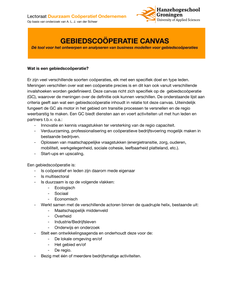
Een gebruiksaanwijzing bij de ontwikkelde tool de 'Gebiedscoöperatie Canvas'.
DOCUMENT
Aan de rand van het Groningse dorp Ten Boer ligt Woldwijk. Een nieuw buurtje met kleurrijke tiny houses, duurzame lemen buurthuizen en een biodiverse omgeving. Het is een voorbeeld van anders wonen in het buitengebied, maar wel met een onzekere toekomst.
DOCUMENT