De afdeling Inholland Communicatie beheert een aantal social media platformen waarmee op corporate niveau wordt gecommuniceerd. Verder zijn veel 'eigen' - vaak onderwijs gerelateerde - platformen ontstaan en actief. Samen met het lectoraat Digital World is een project gestart om te onderzoeken of het mogelijk is een collectief gedeeld communitygevoel uit te dragen en online op te bouwen. Welke keuzes maak je, hoe communiceer je, wat stel je voorop: marketing of onderwijs?
LINK
Rapid changes in the urban environment due to growth puts the urban water cycle out of balance, hence, affecting other surface and subsurface processes, such as subsidence and surface water management. Subsidence of the ground is causing risk and hazard.
IMAGE
Online supplements to Smit, E., Tuithof, H., Savelsbergh, E., & Béneker, T. (2023). Geography teachers’ pedagogical content knowledge: A systematic review. Journal of Geography. https://doi.org/10.1080/00221341.2023.2173796 Supplement 1: Extended information on selected studies Supplement 2: Full references of studies used in the review Supplement 3: Codebook Abstract: Pedagogical Content Knowledge (PCK) is the knowledge teachers use to teach a specific subject to a specific audience. The importance of PCK to quality teaching is widely recognized. However, an overview of research about geography teachers’ PCK is missing. To fill this gap, we conducted a systematic review. We analyzed 43 empirical studies, but only 9 used PCK as a framework. Most studies addressed instructional strategies or teaching orientations. The studies were too diverse to draw conclusions on geography teachers’ PCK in general. But portraits of 16 geography teachers emphasized the necessity of geographical knowledge and teaching experience for PCK-quality.
MULTIFILE

Objective: The aim of this study was to obtain insight in specific elements influencing the use, non-use, satisfaction, and dissatisfaction of ankle foot orthoses (AFOs) and the presence of underexposed problems with respect to AFOs. Methods: A questionnaire was composed to obtain information from AFO users to investigate the variables associated with satisfaction and the relation between these variables. A specific feature of this study was the systematic analysis of the remarks made by the respondents about their AFO. Quantitative data analyses were used for analysing the satisfaction and qualitative analyses were used analysing the remarks of the respondents. A total of 211 users completed the questionnaire. Results: Our survey showed that 1 out of 15 AFOs were not used at all. About three quarters of the AFO users were satisfied and about one quarter was dissatisfied. Females and users living alone reported relatively high levels of dissatisfaction, especially in the field of dimensions, comfort, weight, safety and effectiveness. Dissatisfaction with respect to off-the-shelf AFOs for the item durability was higher than that for custom-made AFOs. In the delivery and maintenance process the items ‘maintenance’, ‘professionalism’ and ‘delivery follow-up’ were judged to be unsatisfactory. A large number of comments were made by the respondents to improve the device or process, mainly by the satisfied AFO users. These comments show that even satisfied users experience many problems and that a lot of problems of AFO users are ‘underexposed’. Conclusion: To improve user satisfaction, the user practice has to be identified as an important sub-process of the whole orthopaedic chain especially in the diagnosis and prescription, delivery tuning and maintenance, and evaluation phase.
LINK
Ecocentrism is the broadest term for worldviews that recognize intrinsic value in all lifeforms and ecosystems themselves, including their abiotic components. Anthropocentrism, in contrast, values other lifeforms and ecosystems insofar as they are valuable for human well-being, preferences and interests. Herein, the authors examine the roots of ecocentrism and discuss its mixed history of international recognition. They argue that non-human nature has intrinsic value irrespective of human preferences or valuation, and they refute the claim that ecocentrism is misanthropic. They then summarize four key examples from the academic literature in which anthropocentrism fails to provide an ethic adequate for respecting and protecting planet Earth and its inhabitants. The authors conclude that ecocentrism is essential for solving our unprecedented environmental crisis, arguing its importance from four perspectives: ethical, evolutionary, spiritual and ecological. They contend that a social transformation towards ecocentrism is not only an ethical but a practical imperative, and they urge support for ecocentric understanding and practices. https://www.ecologicalcitizen.net/article.php?t=why-ecocentrism-key-pathway-sustainability https://www.linkedin.com/in/helenkopnina/
MULTIFILE

At the age of a failing economic system and undeniable evidence of the effects humankind has had over the planet, it is necessary to look for alternatives to the way we live locally. This article explores the use of designing narratives and metanarratives to co-create imaginaries serving as the needed alternatives. This research starts by considering the historical factors to understand how industrialisation and the loss of traditional practices created a culture of disconnection from Nature in the Girona area, but also looks at why people start now reconnecting with it. The analysis is the foundation for speculative design practices to co-create a new local narrative of connection and regeneration. The project adopted the Integrative Worldviews Framework and used paradoxes to create possible future worldviews based on historical factors and literature. Citizens participated in conversational future-visioning workshops to develop and evaluate their local imagery of the previously created worldviews. This conversation-based exercise evidenced the potential of paradoxes in destructive futures to create imaginaries of regeneration. These imaginaries merge and form future stories. From the future narratives, the practice created cultural artefacts embodying a new culture of connection based on storytelling, traditional jobs, and a mythological understanding of Nature. Finally, as observed at the end of the project, these artefacts allow citizens to adopt them as their culture and expand their current worldview.
DOCUMENT

In this paper we position sustainable tourism of the Wadden. The aim is to clarify the complex issues at stake and therewith provide a framework for future actions and policies.
DOCUMENT

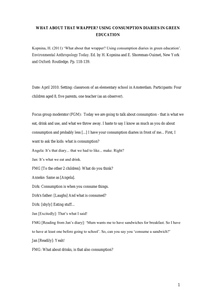
Environmental or ‘green' education is an important driving force behind the ‘greening' of society as it plays a critical role in raising environmental awareness and preparing students for green jobs. None of the existing environmental attitudes and behavior measures is focused on the evaluation of green education, especially in relation to consumption. To date, no longitudinal studies of children and students' attitudes towards consumption influenced by education exist. Also, little has been done to explore the socio-cultural context in which attitudes toward consumption are being formed and to explain the cross-cultural differences in environmental attitudes. This pilot study is designed to take the first step towards developing methods complementing existing quantitative measurements with qualitative strategies, such as consumption diaries, focus groups, and concept mapping. While this research is just a first attempt to tackle children's knowledge and attitudes consumption, preliminary results of the research on which this chapter is based and enthusiasm of the research participants encourage the author to stress the importance of consumption studies as part of green education for educational program developers. As a chapter of this volume, the author hopes that this study will add to the anthropological depository of research on the cultural variants in the perception of the environment in children. This chapter draws upon the consumption diaries collected from the upper-elementary school children in Amsterdam, The Netherlands, between September 2009 and May 2010. Consumption diaries are chronological documents recording purchase, use, and waste of materials, which can be used both as analytical tools and the means to stimulate environmental awareness. The four main methodological steps involved in this research were as follows. Children were asked to complete the consumption diary, paying specific attention to use and waste materials. Consequently, focus group meetings were held with parents and their children to discuss the diaries. Finally, interviews with the children were conducted in order to generate statements that supplement those generated by focus groups for carrying out the concept mapping analysis. The concept mapping analysis was then conducted to organize the order and analyze the ideas expressed in the focus group and interview sessions. This is an Accepted Manuscript of a book chapter published by Routledge/CRC Press in "Environmental Anthropology Today" on 8/5/11 available online: https://doi.org/10.4324/9780203806906 LinkedIn: https://www.linkedin.com/in/helenkopnina/
MULTIFILE
In this article, we elaborate on the role of dialogical learning in identity formation in the context of environmental education. First, we distinguish this kind of learning from conditioning and reproductive learning. We also show that identity learning is not self-evident and we point out the role of emotions. Using Dialogical Self Theory, we then suggest that individuals do not have an “identity hierarchy” but a dialogical self that attaches meaning to experiences in both conscious and unconscious ways. We describe the learning process that enables the dialogical self to develop itself, and we elaborate on the characteristics of a good dialogue. We conclude with some remarks expanding room for a dialogue that would foster identity learning. https://doi.org/10.3390/resources5010011 https://www.linkedin.com/in/helenkopnina/
MULTIFILE

The first part of this paper provides a series of conceptual critiques to illustrate how the recent move to inaugurate a “post-nature” world works to vindicate anthropocentric perspectives and a techno-managerial approach to the environmental crisis. We contend with this premise and suggest that troubling nature has profound implications for education. In the second part, we provide case studies from nature-based programs in The Netherlands and Canada to demonstrate how anthropocentric thinking can be reinscribed even as we work towards “sustainability”. Despite the tenacity of human hubris and the advent of the Anthropocene, we suggest these troubled times are also rich with emerging “post-anthropocentric” perspectives and practices. As such we offer “rewilding” as a means to think about education that moves beyond the romantic vestiges of “Nature” without lapsing into delusions of human exceptionalism. http://dx.doi.org/10.13135/2384-8677/2334 https://www.linkedin.com/in/helenkopnina/
MULTIFILE




