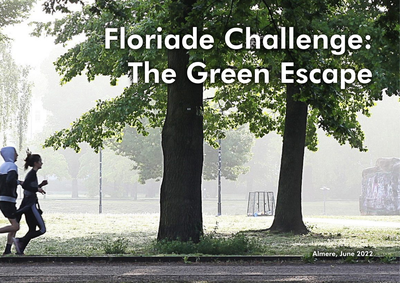
Almere is a green city where the greenery extends into the centre through a framework of nature, forests, parks and canals. With this green environment, Almere fulfils an important condition for a liveable city, where it is pleasant to live and work. An important goal for the municipality is to challenge its residents to develop a healthy lifestyle by using that green framework.But what really motivates Almeerders to go outside to exercise, enjoy the surroundings and meet each other? Are there sufficient green meeting or sports facilities nearby? Could the routes that connect the living and working environment with the larger parks or forests be better designed? And can those routes simultaneously contribute to climate adaptation?With the Green Escape Challenge, we invited students and young professionals to work on these assignments together.
DOCUMENT
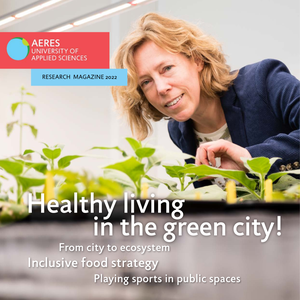
With the beautiful new building of Aeres University of Applied Sciences Almere in the Floriade park, we have materialized our wish to lead the way in the green transition and its challenges. We want to be green changemakers and have the ambition to take on the challenges that we are faced with in agriculture, food and healthy living environments. We bring this about with our study programmes and increasingly with our Practice-Based Research Team. In 10 years’ time, this team has grown from our first professorship into a mature team of 20 people, of whom 7 are research professors.In this edition, three of our new professors will be introduced to you.
DOCUMENT
Organizing entrepreneurial collaboration in small, self-directed teams is gaining popularity. The underlying co-creation processes of developing a shared team vision were analyzed with a core focus on three underlying processes that originate from the shared mental models framework. These processes are: 1) the emergence of individual visions and vision integration, 2) conflict solving, and 3) redesigning the emerging knowledge structure. Key in the analysis is the impact of these three processes on two outcome variables: 1)the perceived strength of the co-creation process, 2) the final team vision. The influence of business expertise and the relationship between personality traits and intellectual synergy was also studied. The impact of the three quality shared mental model (SMM) variables proves to be significant and strong, but indirect. To be effective, individual visions need to be debated during a second conflict phase. Subsequently, redesigning the shared knowledge structure resulting from the conflict solving phase is a key process in a third elaboration phase. This sequence positively influences the experienced strength of the co-creation process, the latter directly enhancing the quality of the final team vision. The indirect effect reveals that in order to be effective, the three SMM processes need to be combined, and that the influence follows a specific path. Furthermore, higher averages as well as a diversity of business expertise enhance the quality of the final team vision. Significant relationships between personality and an intellectual synergy were found. The results offer applicable insights for team learning and group dynamics in developing an entrepreneurial team vision. LinkedIn: https://www.linkedin.com/in/rainer-hensel-phd-8ba44a43/ https://www.linkedin.com/in/ronald-visser-4591034/
DOCUMENT

Green data centres are the talk of the day. But who in fact is involved in developing green data centres? What is their contribution? And what does this contribution constitute in practical terms? This article states which stakeholders are involved in green data centres in the Netherlands, what their involvement is and what effect their involvement has. The article starts by giving the definitions for sustainability and by determining the stakeholders and their possibilities in this field. Next, we examine the actual impact of each stakeholder for arriving at greener data centres. This leads to a number of conclusions for achieving a larger degree of sustainability.
DOCUMENT
This paper describes a project to explore the possibilities of virtual worlds in educating Green IT. In the project a virtual world has been created with various assignments which are meant to create awareness on sustainability aspects of IT. The world (and the assignments) will be incorporated in a course for first-year IT students. In order to measure the effects of the course, a questionnaire has been developed which can be used before and after the course to measure the attitude towards green IT.
DOCUMENT

This paper aims to show how current insights on place branding are used to organize “green” entrepreneurship in the Dutch Utrechtse Heuvelrug region. The role of place is explored in establishing a differentiated meaning for green entrepreneurship and providing an inspirational source for innovations, resulting in a green economic value proposition designed and communicated through branding. Design/methodology/approach: From the literature, different perspectives on the role and function of the place were derived, which lead to the choice of an identity-based entrepreneurial brand. To define the regional identity, qualitative and quantitative research were conducted. In addition, co-creation sessions were organized to further develop the brand. Findings: Taking place branding as the starting point, a framework has been developed, introducing the regional identity as an open space, linking locally based sub-brands to enhance power. To deliver economical and social value in an area with no leading business to sustainability and well-developed business skills, cluster development has been introduced as a way to create new economic activity and sustainable impact. Practical implications: The strategy of separating stakeholders and position them as locally based brands enables place planners and marketers to manage place brand complexity, which generally delays the process, often limiting place branding to “logos and slogans”. Originality/value: This paper provides a case study, which offers new perspectives on the issue of managing complexity, which is inevitable in organizing a place brand.
LINK
Students of the Minor 'Robotic Production and Circular Materials' designed and created a modular outdoor structure suitable for the Green Mile Initiative. The structure fills in one parking lot, along the streetside of the Stadhouderskade.In 2022, this street is one of the most polluted and dangerous street in Amsterdam. It is mainly a lot of asphalt, not beautiful, with little space for nature and mainly focused on moving traffic. We think this can be done differently.The ambition is to turn Stadhouderskade into 'The Green Mile'; a green, sustainable, safe, vital and future-proof street for people, animals and nature. A meaningful public space that invites you to walk, meet, play sports and experience nature.InitiatorsBecause users of the Stadhouderskade can only realize this 'ambition' by joining forces, a movement is being established. The Municipality of Amsterdam, Rijksmuseum, Heineken, De Nederlandsche Bank, Amsterdam University of Applied Sciences, Blendingbricks and UNStudio are taking the initiative for this movement.As part of the Minor 'Robotic Production and Circular Materials, a team of students and teachers designed and built a piece of street furniture, the size of one parking space, a conversation piece towards the greening of the Green Mile.
IMAGE

The presentation covers recent and current procurement management team research activities at Hanze university, notably SME procurement, sustainable procurement, and innovation procurement.
DOCUMENT

Evenementen en Festivals zijn voor steden tegenwoordig serious business. Ze zijn bepalend voor het imago van de organiserende stad en ze trekken honderdduizenden bezoekers, voor wie het soms een eerste kennismaking met de stad betekent. Zo ook voor de gemeente Den Haag die haar evenementen prominent inzet als stedelijk marketinginstrument. Daarnaast zorgen evenementen jaarlijks voor enkele miljoenen euro's aan omzet en dus ook voor werkgelegenheid in de stad. De gemeente Den Haag wil weten of haar evenementen milieubewuster kunnen en is op zoek naar praktische mogelijkheden. Tegelijkertijd staat het behoud en de stimulering van evenementen hoog in het vaandel. Daarom heeft wethouder Duurzaamheid, de heer R. Smits aan de Haagse Hogeschool gevraagd een 'Roadmap' voor Green Events op te stellen. Dit in het kader van het 'Partnership Duurzame Transitie Den Haag' De Haagse Hogeschool heeft, ter aanvulling van de eigen expertise, advies- en ingenieursbureau DHV ingeschakeld om de vraag van de gemeente Den Haag te beantwoorden. Een 'Green Event' is een evenement met een uitgekiend milieuplan. Daarbij gaat het om mogelijke maatregelen op het gebied van watergebruik, energie, mobiliteit (hoe komen en gaan de bezoekers) en afval. De Kernvraag van het onderzoek is: Hoe kan op efficiënte en evenementvriendelijke manier een 'vergroening' van de Haagse evenementen worden doorgevoerd?
DOCUMENT





