Over the past decade, journalists have created in-depth interactive narratives to provide an alternative to the relentless 24-hour news cycle. Combining different media forms, such as text, audio, video, and data visualisation with the interactive possibilities of digital media, these narratives involve users in the narrative in new ways. In journalism studies, the convergence of different media forms in this manner has gained significant attention. However, interactivity as part of this form has been left underappreciated. In this study, we scrutinise how navigational structure, expressed as navigational cues, shapes user agency in their individual explorations of the narrative. By approaching interactive narratives as story spaces with unique interactive architectures, in this article, we reconstruct the architecture of five Dutch interactive narratives using the walkthrough method. We find that the extensiveness of the interactive architectures can be described on a continuum between closed and open navigational structures that predetermine and thus shape users’ trajectories in diverse ways.
DOCUMENT

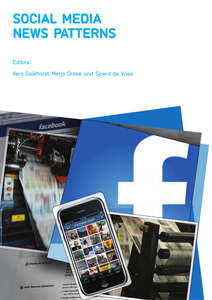
Wereldwijd onderzoek: Hoe gebruiken nieuwsmedia social media? Jongeren lezen geen krant meer, ze kijken op hun smartphone die ze altijd bij de hand hebben. Binnen het lectoraat social media en reputatiemanagement van NHL hogeschool te Leeuwarden heeft een groep internationale studenten in 12 landen onderzoek gedaan. Hierbij hebben ze meer dan 150 social media sites bestudeerd van nieuws media. De resultaten maken deel uit van een internationaal onderzoek van NHL Hogeschool en Haaga Helia University. De onderzoeksvraag was: Wat speelt zich af in de nieuwsmedia? Persbureaus kunnen het overzicht gebruiken om hun social media te optimaliseren. En voor ieder die journalistiek een warm hart toedraagt is het interessante informatie over de nieuwsmedia in een overgangssituatie (2nd edition)
DOCUMENT
In dit whitepaper vindt u de resultaten van onze jaarlijkse social media MKB-monitor. Met deze monitor doen we onderzoek naar het gebruik van sociale media in het MKB. In dit whitepaper vindt u de resultaten van de monitor en kansen voor de toekomst
DOCUMENT

The growing availability of data offers plenty of opportunities for data driven innovation of business models for SMEs like interactive media companies. However, SMEs lack the knowledge and processes to translate data into attractive propositions and design viable data-driven business models. In this paper we develop and evaluate a practical method for designing data driven business models (DDBM) in the context of interactive media companies. The development follows a design science research approach. The main result is a step-by-step approach for designing DDBM, supported by pattern cards and game boards. Steps consider required data sources and data activities, actors and value network, revenue model and implementation aspects. Preliminary evaluation shows that the method works as a discussion tool to uncover assumptions and make assessments to create a substantiated data driven business model.
MULTIFILE

In this paper we discuss the general approach and choices we made in developing a prototype of a social media monitor. The main goal of the museum monitor is to offer museum professionals and researchers better insight in the effects of their own social media usage and compare this with other actors in the cultural heritage sector. It gives researchers the opportunity to consider communication within the sector as whole. In the research project “Museum Compass” we have developed a prototype of a social media monitor, which contains data of current and historic online activities on Facebook, Twitter, YouTube, Foursquare and Flickr of all registered Dutch museums. We discuss – mostly in a practical sense – our approach for developing the monitor and give a few examples as a result of its usage.
DOCUMENT

The art interactive installation 'Scanlines' was realised at the conference 'Doing Experimental Media Archaeology: Practice & Theory Conference'.
LINK

Together with ten Dutch museums and four design agencies, the Amsterdam University of Applied Sciences led the practice-based research called The Exhi- bition Designer of the 21st Century (2017-2019), which was funded by Regieor- gaan SIA. Researching the effect of intentionally designed museum experiences, the project focused on how four design strategies (participatory practices, sto- rytelling techniques, atmosphere and interactive media) affected visitors’ level of inspiration, the degree they were emotionally touched and to what extent they felt they had learned valuable information. In this article, the case study of one Dutch museum will be discussed to 1) address the methodology used in our pro- ject to research the effect of designers’ intentions and 2) present results from our research concerning six interactive media installations used in two exhibitions at this museum. The goal of the project is to develop an instrument that will allow museums to research their own expectations when developing new exhibitions.
DOCUMENT

Een van de belangrijkste ontwikkelingen in het onderwijs is het gebruik van nieuwe kennismedia: media voor het genereren, begrijpen en delen van kennis. Denk aan social media, serious gaming, apps, tablets en smartphones. De grote vraag is: hoe ga je als school om met deze mediaontwikkelingen? In dit whitepaper presenteren we de roadmap van ons onderzoek naar de educatieve implementatie van de iPad (Engelstalig document)
DOCUMENT

The goal of this study was (1) to determine whether and how nursing home residents with dementia respond to the interactive art installation in general and (2) to identify whether responses change when the content type and, therefore, the nature of the interaction with the artwork changes. The interactive art installation ‘VENSTER’ evokes responses in nursing home residents with dementia, illustrating the potential of interactive artworks in the nursing home environment. Frequently observed responses were naming, recognizing or asking questions about depicted content and how the installation worked, physically gesturing towards or tapping on the screen and tapping or singing along to the music. It seemed content matters a lot. When VENSTER is to be used in routine care, the choice of a type of content is critical to the intended experience/usage in practice. In this study, recognition seemed to trigger memory and (in most cases) a verbal reaction, while indistinctness led to asking for more information. When (initially) coached by a care provider, residents actively engaged physically with the screen. Responses differed between content types, which makes it important to further explore different types of content and content as an interface to provide meaningful experiences for nursing home residents. •Implications for rehabilitation •VENSTER can facilitate different types of responses ranging from verbal reactions to active physical engagement. The choice of a type of content is critical to the intended experience/usage in practice. •Activating content seems suitable for use as a meaningful experience during the spare time in between existing activities or therapy. •Sessions with interactive content are short (avg. 30 mins) and intense and can therefore potentially be used as an activating therapy, activity or exercise. •In order to actively engage residents with dementia, the role of the care provider seems very important.
MULTIFILE

This paper reports the responses of nursing home residents who live in a psychogeriatric ward to the abstract interactive art installation ‘Morgendauw’, which was specifically designed for this study. All stakeholders were involved in designing and implementing Morgendauw. The artwork seems able to evoke responses in both the residents and their caregivers, but the amount and duration of the responses observed during the study were limited. 15 interactions over the course of 14 h were noted and almost all of them were initiated by the nursing home staff, physiotherapy students or visitors (n = 12). Interactions lasted for about 3 min on average. Although the nursing home residents initially did not seem to notice the artwork, the threshold of acknowledging and approaching the artwork was quickly overcome when staff nudged or directed the residents’ attention towards the artwork. Beyond this point, nursing home residents generally needed little explanation of the interface to interact with the artwork. The location in which Morgendauw was placed during the study or the characteristics of the installation seemed to create a threshold. Further research should focus on the importance and the effects of context when designing and implementing an interactive art installation in a nursing home environment.
DOCUMENT




