Een Duits verzorgingstehuis nodigde recent aangekomen vluchtelingen uit die geïnteresseerd waren in werken in de ouderenzorg. Het doel van deze studie was om inzicht te krijgen in hoe gevestigde zorgverleners en eerstegeneratie immigranten nieuwkomers sleutelden aan waarden om de zorg voor mensen met dementie vorm te geven. Deze etnografische studie omvatte 200 uur observatie, 24 diepte-interviews en twee focusgroepinterviews met zes immigranten van de eerste generatie en zes gevestigde personeelsleden. De gevestigde zorgverleners en immigranten van de eerste generatie toonden zich bereid en in staat om te sleutelen aan situaties waarin verschillende waarden een rol speelden. Wanneer de werklast echter te zwaar wordt, kunnen medewerkers uit beide groepen gevoelens van machteloosheid, onverschilligheid en demotivatie ervaren. Institutionele beperkingen hebben een negatieve invloed op de interactie tussen gevestigde zorgverleners en immigranten van de eerste generatie die nieuwkomers zijn en beïnvloeden hun uitvoering van de zorg voor geriatrische bewoners met dementie. In dergelijke situaties wordt het cruciaal voor het personeel om een ondersteunende supervisor te hebben die hen kan helpen om te gaan met de dagelijkse stressfactoren van hun praktijk.
MULTIFILE

In the social sciences, especially in social psychology and sociology, fear of the unknown and the tendency to favour the group one belongs to are recognised phenomena. This chapter will look at elements of these scientific theories and establish a link between these elements and the initial findings of a study of Syrian refugees on the Dutch labour market. First, this study is described, after which a glimpse into the world of social psychology is provided. This chapter concludes by taking a wide perspective on Dutch society and by discussing some lessons that can be learned for a diverse future. Research and education can support society in highlighting the importance of diversity and in training people to recognise the added value of diversity. Everyone will need to put considerable effort into ensuring people are judged for their personal qualities. Lecturers and professionals will need to examine their own judgements and biases first, before they can help to shape the perceptions of students. Together with students, lecturers can promote the benefits of the contact hypothesis and the concept of interactional diversity.
DOCUMENT

Whilst until the late 1980s most migration issues developed in a parallel manner but with national specifics, important differences showed up during the 1990s and at the beginning of this decade. Since the middle of the 1990s, there has been an obvious change in policy towards migrants and foreigners in the Netherlands, and those changes have been more or less “exported” to our neighbouring countries and even to the level of the EU. Integration into society with the maintenance of the immigrant’s own culture has been replaced by integration into the Dutch society after passing an integration examination. The focus of this article is to investigate those changes and to compare the implementation of those policies in the Netherlands/Limburg and Germany/NRW, where the official understanding of not being an immigration country was dominant until the end of the 1990s, and where integration has only recently become an important political issue. Both countries are now facing similar challenges for better integration into the society, especially into the educational system. Firstly, the autors describe migration definitions, types, the numbers of migrants and the backgrounds of migrant policies in Germany and the Netherlands up until the middle of the 1990s. Secondly they discuss the integration policies thereafter: the pathway to a new policy and the Action Plan Integration in Germany, and the central ideas of the Civic Integration of Newcomers Act (WIN) in the Netherlands. Integration policy in the Netherlands is highly centralised with little differentiation on the local governmental level when compared to South Limburg. Thirdly, the autors investigate the cross-border cooperation between professional organisations and educational institutions in the Euregio Meuse-Rhine, and the involvement of social work institutions and social workers in their process of integration into the local society and the exchange of each others’ experiences (the ECSW and RECES projects).
DOCUMENT

At its core, raving has existed in opposition to normativity, and so has electronic music. If newcomers enticed by hard trance remixes of 2000’s Top 40 hits embrace this opposition, it is often done in ways removed from history. As Loren Granic AKA Goddollars, co-founder and resident of A Club Called Rhonda in Los Angeles, stated: “Many of the newcomers are straight/white kids who are very far removed from the LGBT community, despite fist-pumping by the millions to a music that was born from gay people of colour sweating their asses off at 5 AM in a Chicago warehouse.” If the role marginalized people have played in the creation and pioneering of their favourite music is ignored, how would people react when told that their fun might also harm marginalized groups? The ethics of lockdown raves have always been fraught, as their repercussions reverberate beyond the people who choose to attend them; meanwhile, data shows that people of colour were more likely to be targeted for attending raves during the lockdown.
LINK
This post will deal with The Inclusive City Game Talk Show held on the 23rd of November 2016 at Wijk & Co. in Utrecht Overvecht. Like the preceding event in Amsterdam, the talk show was moderated by Utrecht University’s Michiel de Lange and it brought together local and national experts (such as municipal workers or representatives of local initiatives) and game designers. Unlike the previous event, the focus was on localizing the more general background of creating city games for newcomers in the environment of Overvecht. The talk show took place during the game jam of Games for Cities as well, thus the evening functioned as a dialogue with local experts, an initial presentation of game ideas and a chance to comment on their design. Sketching the general background were Michelle Provoost and Nina Hälker. Finally, Ekim Tan was present to discuss the game jam game design process. Due to the more specific localization of a neighborhood (instead of the whole of Amsterdam) the focus of this talk show was on how games can be used to approach an influx of newcomers in a specific neighborhood.
DOCUMENT
In January 2022 the new Dutch Civic Integration programme was launched together with promises of improvements it would bring in facilitating the ‘integration’ of newcomers to the Netherlands. This study presents a critical discourse analysis of texts intended for municipalities to take on their new coordinating role in this programme. The analysis aims to understand the discourse in the texts, which actors are mobilized by them, and the role these texts and these actors play in processes of governmental racialization. The analysis demonstrates shifting complex assemblages are brought into cascades of governance in which all actors are disciplined to accept the problem of integration as a problem of cultural difference and distance, and then furthermore disciplined to adopt new practices deemed necessary to identify and even ‘objectively’ measure the inherent traits contributing to this problematic. Lastly, the analysis displays that all actors are disciplined to accept the solution of ‘spontaneous compliance’; a series of practices and knowledges, which move the civic integration programme beyond an aim of responsibilization, into a programme of internalization, wherein newcomers are expected to own and address their problematic ‘nature’, making ‘modern’ values their own.
DOCUMENT

Europe’s urban economies do not look the same as ten years ago. And in ten years from now,they will again be different. The digital revolution is particularly disruptive: entire sectors are being transformed, old playersare losing out, newcomers are taking over, and competition is fiercer than ever. At the same time, citizens are not just workers in companies, but many become independent entrepreneurs, and active producers.Innovation is becoming open, involving interaction between companies, universities and users. Working, living and recreation become intertwined in place and time.
MULTIFILE

When it comes to shopping and spending time in the city, much of the traditional offering has made place for something new, usually more expensive: coffee bars like Starbucks with a wide range of cafés and lattes; bakery stores with a big choice of luxury croissants, sourdough, gluten free or spelt bread; concept stores with a mix of special brands, vintage stores and again good coffee or glass of prosecco at 17.00. But a crafts shop, a furniture upholstery or a good butcher? Hard to find. One of the main reasons for this change is that newcomers generally bring more money to an area but also different lifestyles and tastes, going with the flow of the latest trends and ready to pay for special brands and exceptional or innovative concepts. In the meantime, prices are booming. The term we often use for this phenomenon is gentrification: in my view, it describes a process whereby the renovation of a particular city area attracts newcomers with a higher socio-economic status who in turn make the area more popular. The effect of this popularity is an increase in housing prices as well as leisure offerings, meaning (recreative) shops, bars and sport or cultural activities, which tend to push out the original residents of their own neighbourhood. In this article you can read about gentrification and its visible effects on three shopping areas that feature market places and leisure activities – Van der Pek street, Zonneplein and Purmerplein situated in Amsterdam North, a previously traditional area. I will share with you the outcomes of our research into the liveability of these shopping areas, and our placemaking suggestions, based on the key indicators of the placemaking movement (Madden, 2018).
DOCUMENT
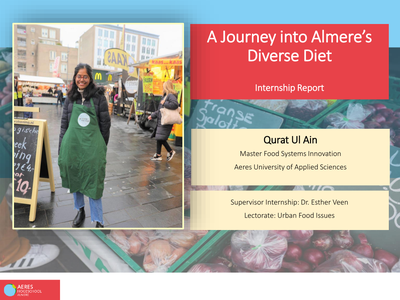
There is a strong relation between food and identity. Especially when people move to another country, traditional food (or simply food from their country of origin), symbolizes a link with culture, communityand ethnic identity. As people move around the globe they introduce new foods in the places they land. Almere is becoming one of the largest majority minority cities of the Netherlands. Walking around thecity, the diversity of food ingredients and eating cultures as shown in shops and restaurants is immediately clear. The aim of this project was to get an insight into the diets of the residents of Almere so as to learn about eating patterns in a multicultural city and how multiculturality affects the diets of both newcomers and people who have been living here for generations.
DOCUMENT
A welcome policy can be embedded in a municipal authority organisation in a number of different ways. Each has its own strengths and weaknesses. To be effective, the local policy makers must be clear on how they hope to make use of the welcome policy and how this will benefit or suffer from different organisational structures. No one ‘ideal’ structure will ‘fit’ all municipal situations in Europe. However, to be aware of the strengths and weaknesses of the organisational structure that most closely resembles the local situation can increase the chances of successful policy implementation.
DOCUMENT




