BackgroundICU patients lose muscle mass rapidly and maintenance of muscle mass may contribute to improved survival rates and quality of life. Protein provision may be beneficial for preservation of muscle mass and other clinical outcomes, including survival. Current protein recommendations are expert-based and range from 1.2 to 2.0 g/kg. Thus, we performed a systematic review and meta-analysis on protein provision and all clinically relevant outcomes recorded in the available literature.MethodsWe conducted a systematic review and meta-analyses, including studies of all designs except case control and case studies, with patients aged ≥18 years with an ICU stay of ≥2 days and a mean protein provision group of ≥1.2 g/kg as compared to <1.2 g/kg with a difference of ≥0.2 g/kg between protein provision groups. All clinically relevant outcomes were studied. Meta-analyses were performed for all clinically relevant outcomes that were recorded in ≥3 included studies.ResultsA total of 29 studies published between 2012 and 2022 were included. Outcomes reported in the included studies were ICU, hospital, 28-day, 30-day, 42-day, 60-day, 90-day and 6-month mortality, ICU and hospital length of stay, duration of mechanical ventilation, vomiting, diarrhea, gastric residual volume, pneumonia, overall infections, nitrogen balance, changes in muscle mass, destination at hospital discharge, physical performance and psychological status. Meta-analyses showed differences between groups in favour of high protein provision for 60-day mortality, nitrogen balance and changes in muscle mass.ConclusionHigh protein provision of more than 1.2 g/kg in critically ill patients seemed to improve nitrogen balance and changes in muscle mass on the short-term and likely 60-day mortality. Data on long-term effects on quality of life are urgently needed.
MULTIFILE

In this article we investigate the change in wetting behavior of inkjet printed materials on either hydrophilic or hydrophobic plasma treated patterns, to determine the minimum obtainable track width using selective patterned μPlasma printing. For Hexamethyl-Disiloxane (HMDSO)/N2 plasma, a decrease in surface energy of approx. 44 mN/m was measured. This resulted in a change in contact angle for water from <10 up to 105 degrees, and from 32 up to 46 degrees for Diethyleneglycol-Dimethaclylate (DEGDMA). For both the nitrogen, air and HMDSO/N2 plasma single pixel wide track widths of approx. 320 μm were measured at a plasma print height of 50 μm. Combining hydrophilic pretreatment of the glass substrate, by UV/Ozone or air μPlasma printing, with hydrophobic HMDSO/N2 plasma, the smallest hydrophilic area found was in the order of 300 μm as well.
DOCUMENT
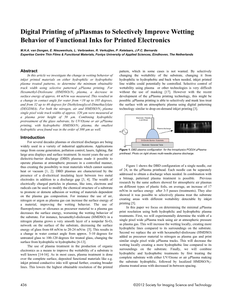
Inkjet printing is a rapidly growing technology for depositing functional materials in the production of organic electronics. Challenges lie among others in the printing of high resolution patterns with high aspect ratio of functional materials to obtain the needed functionality like e.g. conductivity. μPlasma printing is a technology which combines atmospheric plasma treatment with the versatility of digital on demand printing technology to selectively change the wetting behaviour of materials. In earlier research it was shown that with μPlasma printing it is possible to selectively improve the wetting behaviour of functional inks on polymer substrates using atmospheric air plasma. In this investigation we show it is possible to selectively change the substrate wetting behaviour using combinations of different plasmas and patterned printing. For air and nitrogen plasmas, increased wetting of printed materials could be achieved on both polycarbonate and glass substrates. A minimal track width of 320 μm for a 200 μm wide plasma needle was achieved. A combination of N2 with HMDSO plasma increases the contact angle for water up from <100 to 1050 and from 320 to 460 for DEGDMA making the substrate more hydrophobic. Furthermore using N2-plasma in combination with a N2/HMDSO plasma, hydrophobic tracks could be printed with similar minimal track width. Combining both N2 -plasma and N2/HMDSO plasma treatments show promising results to further decrease the track width to even smaller values.
DOCUMENT

Growth conditions have been frequently studied in optimizing polyhydroxybutyrate (PHB) production, while few studies were performed to unravel the dynamic mixed microbial consortia (MMCs) in the process. In this study, the relationship between growth conditions (C/N ratios and pH) and the corresponding key-microbes were identified and monitored during PHB accumulation. The highest PHB level (70 wt% of dry cell mass) was obtained at pH 9, C/N 40, and acetic acid 10 g/L. Linking the dominant genera with the highest point of PHB accumulation, Thauera was the most prevalent species in all MMCs of pH 9, except when a C/N ratio of 1 was applied. Notably, dominant bacteria shifted at pH 7 (C/N 10) from Thauera (0 h) to Paracoccus, and subsequently to Alcaligenes following the process of PHB accumulation and consumption. Further understanding of the relationship between the structure of the microbial community and the performance will be beneficial for regulating and obtaining high PHB accumulation within an MMC. Our study illustrates the impact of C/N ratios and pH on microbial prevalence and PHB production levels using a mixed microbial starter culture. This knowledge will broaden industrial perspectives for regulating high PHB production and timely harvesting.
LINK
Ammonia is heavily used in agriculture as a fertilizer and in industry as a raw material for the production of various organic nitrogen compounds. Its high hydrogen content and its established infrastructure for both storage and distribution makes ammonia a prominent candidate for storing fluctuating renewable energy. The Haber-Bosch heterogenous reaction of hydrogen and nitrogen on an iron-based catalyst is used today at large scale ammonia production sites. The current industrial hydrogen production is dominated by fossil energy sources. The traditional Haber-Bosch process can become green and carbon-free if renewable electricity is used for hydrogen generation. However, a continuous operation of power to ammonia can be challenging with a fluctuating renewable energy source. Techno-economic models show that electrolysis and the hydrogen supply chain is the main dominating cost factor of power to ammonia.
LINK
This century, greenhouse gas emissions such as carbon dioxide, methane and nitrogen oxides must be significantly reduced. Greenhouse gases absorb and emit infrared radiation that contributes to global warming, which can lead to irreversible negative consequences for humans and the environment. Greenhouse gases are caused by the burning of fossil fuels such as crude oil, coal, and natural gas, but livestock farming, and agriculture are also to blame. In addition, deforestation contributes to more greenhouse gases. Of the natural greenhouse gases, water vapor is the main cause of the greenhouse effect, accounting for 90%. The remaining 10% is caused from high to low by carbon dioxide, methane, nitrogen oxides, chlorofluorocarbons, and ozone. In addition, there are industrial greenhouse gases such as fluorinated hydrocarbons, sulphurhexafluoride and nitrogen trifluoride that contribute to the greenhouse effect too. Greenhouse gases are a major cause of climate change, with far-reaching consequences for the welfare of humans and animals. In some regions, extreme weather events like rainfall are more common, while others are associated with more extreme heat waves and droughts. Sea level rise caused by melting ice and an increase in forest fires are undesirable effects of climate change. Countries in low lying areas fear that sea level rise will force their populations to move to the higher lying areas. Climate change is affecting the entire world. An estimated 30-40% o f the carbon dioxide released by the combustion of fossil fuels dissolves into the surface water resulting in an increased concentration of hydrogen ions. This causes the seawater to become more acidic, resulting in a decreasing of carbonate ions. Carbonate ions are an important building block for forming and maintaining calcium carbonate structures of organisms such as oysters, mussels, sea urchins, shallow water corals, deep sea corals and calcareous plankton.
MULTIFILE
De toekomst van de zeevaart ziet er volgens Martien Visser zonnig uit. “We hebben weliswaar de ambitie minder afhankelijk te worden van landen van buiten Europa, maar in de praktijk komt daar niets van terecht. We willen zelfs geen datacenters. Extra belangrijk dus te werken aan een CO2-vrije internationale scheepvaart”, stelt hij.
LINK
Bisphosphonates (BPs) are widely used in the treatment of osteolytic bone disease associated with multiple myeloma, and have been demonstrated to exert antitumor effects both in vitro and in vivo. However, the precise molecular mechanisms involved in the direct antitumor effects of BPs in vitro are not known. Nitrogen-containing BPs, such as risedronate (RIS), act by inhibiting protein prenylation. A phosphonocarboxylate analogue of RIS, 3-PEHPC, has previously been shown in osteoclasts and macrophages to specifically inhibit prenylation of Rab GTPases. The aim of this study was to identify the molecular targets of RIS and 3-PEHPC in human myeloma cells and to determine the cellular effects of selective inhibition of Rab prenylation by 3-PEHPC as compared to nonspecific inhibition of protein prenylation by RIS in human myeloma cells. RIS dose-dependently inhibited prenylation of both Rap1A and Rab6, whereas 3-PEHPC only inhibited Rab6 prenylation. Both RIS and 3-PEHPC dose-dependently increased apoptosis in human myeloma cells. RIS induced an accumulation of cells in the S-phase of the cell cycle, associated with inhibition of DNA replication. In contrast, 3-PEHPC did not cause cell-cycle arrest. Furthermore, geranylgeraniol could prevent inhibition of prenylation, induction of apoptosis, and cell-cycle arrest in response to RIS, but not inhibition of Rab prenylation and apoptosis induced by 3-PEHPC, consistent with specific inhibition of Rab geranylgeranyl transferase by 3-PEHPC. In conclusion, our studies demonstrate that selective inhibition of Rab prenylation induces apoptosis, but not S-phase arrest, thus identifying distinct molecular pathways that mediate the antimyeloma effect of nitrogen-containing BPs. © 2006 Wiley-Liss, Inc.
DOCUMENT
In manufacturing of organic electronics, inkjet printing as an alternative technique for depositing materials is becoming increasingly important. Aside to the ink formulations challenges, improving the resolution of the printed patterns is a major goal. In this study we will discuss a newly developed technique to selectively modify the substrate surface energy using plasma treatment as a means to achieve this goal. First, we look at the effects of the μPlasma treatment on the surface energy for a selection of plastic films. Second, we investigated the effects of the μPlasma treatment on the wetting behaviour of inkjet printed droplets to determine the resolution of the μPlasma printing technique. We found that the surface energy for all tested films increased significantly reaching a maximum after 3-5 repetitions. Subsequently the surface energy decreased in the following 8-10 days after treatment, finally stabilizing at a surface energy roughly halfway between the surface energy of the untreated film and the maximum obtained surface energy. When μPlasma printing lines, an improved wetting abillity of inkjet printed materials on the plasma treated areas was found. The minimal achieved μPlasma printed line was found to be 1 mm wide. For future application it is important to increase the resolution of the plasma print process. This is crucial for combining plasma treatment with inkjet print technology as a means to obtain higher print resolutions.
DOCUMENT

Global society is confronted with various challenges: climate change should be mitigated, and society should adapt to the impacts of climate change, resources will become scarcer and hence resources should be used more efficiently and recovered after use, the growing world population and its growing wealth create unprecedented emissions of pollutants, threatening public health, wildlife and biodiversity. This paper provides an overview of the challenges and risks for sewage systems, next to some opportunities and chances that these developments pose. Some of the challenges are emerging from climate change and resource scarcity, others come from the challenges emerging from stricter regulation of emissions. It also presents risks and threats from within the system, next to external influences which may affect the surroundings of the sewage systems. It finally reflects on barriers to respond to these challenges. http://dx.doi.org/10.13044/j.sdewes.d6.0231 LinkedIn: https://www.linkedin.com/in/sabineeijlander/ https://www.linkedin.com/in/karel-mulder-163aa96/
MULTIFILE




