In a growing number of economic branches, citizens are becoming more active, as part-time producers, service providers, suppliers or even entrepreneurs. They compete with traditional companies, but often operate through new business models.
MULTIFILE

De Digitale Universiteit (DU) performed a quickscan to determine the usability of the IMS Question and TestInteroperability (QTI) specification as a format to store questions and tests developed for and by the consortium. The original report is available in Dutch from the website of De Digitale Universiteit and an unofficial English translation of that report can be downloaded. In October 2003, Canvas Learning Ltd., developers of the Canvas Canvas Learning Author and Canvas Learning Player responded to the Quickscan by sending their Canvas Flash player which could also render the test questions developed for the Quickscan. The Canvas Learning Player hadn't been tested as part of the original Quickscan because none of the partners within De Digitale Universiteit was using the application at that time. This addendum contains a short overview of the results of the tests for the Flash player as it was provided by Canvas Learning Ltd. All tests have been conducted by the author of the quickscan using the original test set. The set and the player used can be downloaded as a SCORM compliant package.
DOCUMENT

De afgelopen jaren heeft betaald deeltijdwerk in de bijstand onder beleidsmakers meer aandacht gekregen, mede door de beperkte mogelijkheden voor veel bijstandsgerechtigden om volledig uit te stromen. Maar er is weinig onderzoek gedaan naar de beweegredenen van bijstandsgerechtigden om in deeltijd betaald werk te verrichten en de waarden die zij daarbij afwegen. In dit artikel geven we meer inzicht in de waarden die bijstandsgerechtigden afwegen om wel of niet in deeltijd betaald werk te verrichten in de bijstand. Dat doen we op basis van 31 kwalitatieve semigestructureerde interviews met bijstandsgerechtigden. De resultaten laten zien dat bijstandsgerechtigden verschillende intrinsieke en extrinsieke waarden tegen elkaar afwegen en dat het spanningsveld tussen die waarden de stap naar deeltijdwerk of uitstroom kan bemoeilijken. Deeltijdwerk in de bijstand heeft de potentie om een waardevol alternatief te vormen voor volledige uitstroom en bijstandsgerechtigden te helpen op weg naar uitstroom. Maar die potentie wordt nu niet volledig benut door de beperkte aandacht voor inkomenszekerheid en zinvolle werkinhoud in het beleidsdebat.
DOCUMENT

It has become a topic at Dutch educational institutes to feel not only responsible for improvement of theoretical and practical skills, but also of 'competences' in a broader sense. The curriculum of the Electrical and Electronic (E&E) Department has been changed enormously in the past decade. Fewer lessons and many more projects were introduced. We have choosen to let the students work on competences especially in the projects they are in. With the introduction of competences and the aid of a student portfolio we have given the tools to the students to improve their competences in a broader way. At the E &E department we introduced two different ways of working on competences. In the first years of their study students choose different roles in our projects every time. We have described all the roles and the related tasks for each specific role. While working on a role, the students indirectly work on different competences. This way of working inforces a broader educational level (a student shouldn t work on things he already knows or is able to handle) and the hitch hiking behaviour is banned out. Students now do take responsibility while contributing to the project teams. Inquiries amongst the students confirm these results. The second way is working on the specific competences in their traineeship and thesis work in the last part of their study. This will be introduced in autumn 2004 in the E&E department. In this paper we will show you how we are implementing the integration of competences, like the E&E department did, for IPD projects as well. This implementation is planned to start in autumn 2004.
DOCUMENT
A report by the Study Group On Sports Cardiology Of The European Association For Cardiovascular Prevention And Rehabilitation.
DOCUMENT
Tussenstand van het onderzoek, uitgevoerd door de HvA en UvA, naar het Amsterdams Experiment met de Bijstand (2018-2022), waarin wordt geschreven over de methode, uitkomsten en het belang van kwantitatief in combinatie met kwalitatief onderzoek.--Samenvatting (English)In the period 2018-2021 the municipality of Amsterdam conducted an experiment with beneficiaries of social assistance. Benefit recipients could voluntarily participate in the experiment. They were randomly assigned to three experimental conditions, viz. ‘extra attention’ (in which they received more frequent counseling and support), ‘self-direction’ (which offered the participants the freedom to make their own choices), and the ‘comparison group’ (the control group which received the customary treatment). Under all three conditions, participants who worked part-time could earn up to €200 a month on top of their social assistance benefit. A little over 800 participants (of the 5,000 in total) were followed closely by researchers of the Amsterdam University of Applied Science (HvA) and the University of Amsterdam (UvA). Although the participants who got ‘extra attention’ did not significantly flow out more frequently from the social assistance system than participants in the other two conditions, they did more often have a part-time job at the end of the experiment. There were no significant differences between the conditions with respect to participation in other non-paid activities, such as voluntary work and informal care. In-depth interviews with a selection of the participants showed, among other outcomes, that they considered the financial uncertainty as a main hindrance for doing (more) part-time work.
DOCUMENT
At this critical moment in time, April 2020, when we are living with the cataclysmic event of Covid-19, television – a medium declared almost dead at the beginning of this millennium – has become a vital resource for solace, daydreaming, social ritual, knowledge and storytelling. In conditions of lockdown, we turn towards television, not away from it (Ellis, 2020; Negra, 2020). We are checking news on national channels, and tuning to live broadcasting for campaigns to help the health services and communities in need, such as with the globally broadcast One World: Together At Home special. We are curling up on the sofa to engage with gripping drama, like Ozark streaming on Netflix, re-watching favourite series from the beginning, such as Buffy or Breaking Bad, and taking part in television quiz shows like Pointless, even watching repeats, to recreate a pub quiz atmosphere in the living room. On a darker note, we are also overloaded with corona news; the ritual evening news bulletin can be a source of anxiety and a cause of sleeplessness. Television infrastructure can break down, from broken satellite dishes to lost remote controls, which are tricky to fix when technicians are not so readily available to help; and television can be an economic burden. The cost of streaming Breaking Bad can push the limits of monthly contracts and data packages. Television both lightens and darkens the mood of domestic spaces and social relations in lockdown culture.
MULTIFILE

Volgens de literatuur zijn zowel fysieke synchrone als online asynchrone participatie van groot belang voor prestaties in blended leeromgevingen. De combinatie zou kunnen leiden tot meer diepgaande interactie tijdens colleges. Tot nu toe werd echter vooral gekeken naar de effecten van individuele participatie van voltijdstudenten. In deze studie onderzochten we de rol van fysieke en online participatie van 821 deeltijd en voltijdstudenten die in 32 verschillende klassen deelnamen aan dezelfde blended leeromgeving. We onderzochten hierbij niet alleen de voorspellende waarde van individuele participatie maar testen met multilevel modellen ook de invloed van gemiddelde fysieke en online participatie van de groep. Uit de analyses komt naar voren dat fysieke participatie alleen bij voltijdstudenten testuitslagen significant voorspelt. Online participatie is bij zowel voltijd- als deeltijdstudenten een significante voorspeller van het cijfer en de slaagkans. De combinatie van online en fysieke participatie leverde geen aanvullende meerwaarde op. Gemiddelde fysieke en onlineparticipatie in de klas waren, verrassend genoeg, significante negatieve voorspellers van toetsuitslagen. Studenten scoorden hoger en slaagden vaker wanneer hun klasgenoten gemiddeld minder participeerden. Vervolgonderzoek zou verder uit kunnen wijzen of studenten die vaak aanwezig zijn in klassen met lage aanwezigheid het beter doen door meer begeleiding of dat docenten participatie al dan niet bewust meewegen bij de beoordeling van studenten.
DOCUMENT
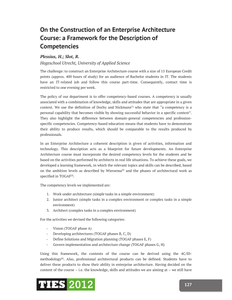
The challenge: to construct an Enterprise Architecture course with a size of 15 European Credit points (approx. 400 hours of study) for an audience of Bachelor students in IT. The students have an IT-related job and follow this course part-time. Consequently, contact time is restricted to one evening per week.
DOCUMENT
In 2005 and 2006, almost sixty Dutch National Sport Federations (NSFs) participated in a special program for creating a marketing strategy for the next four years. This program was initiated and organized by NOC*NSF (the Dutch Olympic Umbrella Sports Organization). The NSFs had to joint the project to receive funds. For most of them it was the first time they seriously analyzed the market with the aim of developing new programs. The purpose of this paper is to explore to what extent Dutch NSFs are capable to change their structures to become more market oriented and more market responsive in order to write strategic plans. The changed structures are investigated using the "institutional theory" (Tolbert & Zucker, 1996) and are explained by exogenous (market context and institutional context) and endogenous (interests, values, power dependencies, and capacity for action) dynamics from the neo-institutionalist framework (Greenwood & Hinings, 1996). In 2005 NSFs were expected to be in a pre-institutionalized stage, i.e. they were supposed to develop new organizational structures in response to specific problems (Kikulis, 2000). Now, approximately 1½ years after finishing their strategies, the question arises whether they have reached the semi-institutional stage, i.e. whether the new structures or actions are diffused across organizations, yet still subject to change and whether old structures are yet eroding (Kikulis, 2000). Methods Studying the intended structural change of NSFs requires an in-depth study of their social reality and the reactions and interpretations of involved actors, including their applied meanings to certain situations. Greenwood & Hinings (1996) plead for detailed comparative case-studies when studying institutional changes. Therefore three NSFs has been selected: The Royal Dutch Korfball Federation (KorfFed); The Royal Dutch Billiards Federation (BillFed); and the Dutch Jeu de Boules Federation (JeuFed). These three federations differ on size, amount of housed sports, number of associated clubs, sorts of intermediary decision making bodies, employed FTE's, and more. Therefore it is expected that the tempo of institutionalization of the new, market oriented, structures, will differ among them. Sugden & Tomlinson (2002) developed a multi-method style of qualitative research for making sense of the deep, inside information below the surface of everyday life. They call it the "Brighton method. Applying the Brighton method for this research implies that the three cases will be studied with respect to their history, their present marketing actions, their results and the changes in their organization. In-depth interviews, document analysis (policy plans, marketing plans and more), and where possible observations and participations are used to create a critical and investigative view of the organizations in change. Results The KorfFed used the marketing program to further develop existing programs. Although the outcomes of these programs were not new, the program has opened the eyes of the president, director and staff members. They are now conscious of the urgency of a market orientation, and a marketing orientation (a marketing position has already been introduced), and they see opportunities in attracting non-competition playing korfball players. They have, however, not yet reached the phase of semi-institutionalization of the market oriented structures. This can be concluded from the following: - The organization still has an ad-hoc character; - Some board members still make decisions based on their own insights rather than on information from the professional part of the organization; - Decisions to start programs are still grounded on subsidy possibilities rather than on market possibilities. Interest dissatisfaction and power dependencies are the main dynamics that form barriers in the planned organizational change. The BillFed is a federation that covers four disciplines, i.e. pool, snooker, carom, and billiard 3 cushions. The federation used to act upon these four disciplines. The marketing program has made clear that the BillFed should act upon target groups instead of on these disciplines. Therefore, the federation created a vision to reach youth, young adults, as also elderly people. Carrying out this new vision requires a market orientated structure (focus on target groups) instead of an internal orientated structure (focus on discipline groups). This new vision is created on an upper level (general board together with professional staff) in the organization. This federation also introduced a professional marketing position. Unfortunately, the underlying layers remain slightly passive and are not willing to work along the new structures, which mean that the new structures have not been diffused across the whole organization. Interest dissatisfaction, value commitments and power dependencies are the problematic dynamics. The JeuFed used to have a strong competition and tournament (internal) orientation, while many jeu-de-boules players play the game just for fun. The marketing program has created the insight that the just-for-fun players are also an important target group. Hence, 3 projects are developed to make club membership more attractive for all jeu-de-boules players. Since the federation never worked with projects before, they just found out that implementing projects such as these requires new structures. The JeuFed has just arrived in the pre-institutionalized phase, still far away from the semi-institutionalized chapter. Power dependencies and a lack of capacity for change are influencing dynamics in this case. Discussion Although it is already 1½ years ago that Dutch NSFs finished their marketing program, in none of the described cases the new structures have reached the semi-institutional stage. These new structures or actions are not yet diffused across the organizations, and the old structures are not eroding. In all three cases another combination of endogenous dynamics are influencing the process of organizational change. Continuing research is needed to find out whether these federations will ever reach the next stage of institutionalization and which dynamics will play an important role.
DOCUMENT



