This is a revised PAPAI (Personal Adapted Physical Activity Instructor) handbook 2020, part of the Sport Empowers Disabled Youth 2 (SEDY2) project. The original handbook of the PAPAI project, based on Finnish pilot-phase experiences, was written in 2016 by Aija Saari and Heidi Skantz. This revised (2020) PAPAI handbook contains updated materials and lessons learned by the Finnish Paralympic Committee and Inholland University during 2017-2020.
DOCUMENT

This study aimed (1) to examine the contribution of robot ZORA in achieving therapeutic and educational goals in rehabilitation and special education for children with severe physical disabilities, and (2) to discover the roles professionals attribute to robot ZORA when it is used in robot-based play interventions in rehabilitation and special education for children with severe physical disabilities. A multi-centre mixed methods study was conducted among children with severe physical disabilities in two centres for rehabilitation and one school for special education. The participating children played with robot ZORA six times during a period of 6 weeks, in individual or group sessions. Quantitative data were gathered about the contribution of ZORA in reaching individual goals for all of the participating children, using the Individually Prioritized Problem Assessment (IPPA). Playfulness was measured with a visual analogue scale (0–10) and children could indicate whether they liked the sessions using a scale consisting of smileys. Video-stimulated recall interviews were used to collect qualitative data about the different roles of ZORA. In total, 33 children and 12 professionals participated in the study. The results of the IPPA showed a significant contribution of ZORA to the achievement of (children’s) individual goals. The data gathered using the IPPA during the ZORA-based interventions showed that the largest contributions of robot ZORA lie in the domains of movement skills and communication skills. Playfulness of the sessions was 7.5 on average and 93% of the sessions were evaluated as ‘enjoyable’ by the children. Overall, ZORA could positively contribute to the achievement of individual goals for children with severe physical disabilities. According to the participating professionals the most promising roles in which robot ZORA can be used are motivator, rewarder or instructor.
DOCUMENT

The SEDY2 project is a three-year follow-up project (2020-2022) funded through the European Union (Erasmus+). The goal of the project is to encourage inclusion and equal opportunities in sport for children and youth with disabilities. This toolkit is aimed at people involved in educating students or volunteers on inclusion in sport for young people with disabilities, who are managing, working in a sports club or involved in the development of sports policy. They could be a volunteer, a coach, a club member or a policy maker. Inclusion in its simplest form is defined as the state of being included. In an inclusive club, every participant is welcomed, accepted, and feels that they belong. However, the needs of young people with disabilities are often unmet. Young people with disabilities have fewer opportunities to participate in quality sport activities. The goal of this toolkit is to support educators to facilitate and promote disability inclusion among mainstream sport providers through education, using the educational materials and sharing best practices and inclusive ideas from SEDY2 project.
DOCUMENT

Within Human Activity Recognition (HAR), there is an insurmountable gap between the range of activities performed in life and those that can be captured in an annotated sensor dataset used in training. Failure to properly handle unseen activities seriously undermines any HAR classifier's reliability. Additionally within HAR, not all classes are equally dissimilar, some significantly overlap or encompass other sub-activities. Based on these observations, we arrange activity classes into a structured hierarchy. From there, we propose Hi-OSCAR: a Hierarchical Open-set Classifier for Activity Recognition, that can identify known activities at state-of-the-art accuracy while simultaneously rejecting unknown activities. This not only enables open-set classification, but also allows for unknown classes to be localized to the nearest internal node, providing insight beyond a binary “known/unknown” classification. To facilitate this and future open-set HAR research, we collected a new dataset: NFI_FARED. NFI_FARED contains data from multiple subjects performing nineteen activities from a range of contexts, including daily living, commuting, and rapid movements, which is fully public and available for download.
MULTIFILE
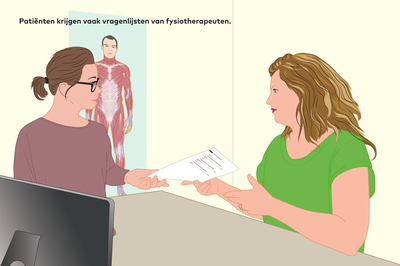
The traditional paternalistic approach in health care is increasingly developing towards a patient-centered care (PCC) approach. However, not all patients are able to take advantage of the positive effects of PCC. Inadequate health literacy (HL) is an important limiting factor in the ability of patients to take on an active role and exchange information with their health care provider effectively. A provenly effective approach to improvement of provider-patient interaction and health outcomes is the use of health-related questionnaires. The aim of the research project described within this thesis was to adapt the most frequently-used questionnaire in Dutch physical therapy practice and add information and communication technology to it. A Dutch and Turkish version of the tool called Talking Touch Screen Questionnaire (TTSQ) was developed and evaluated on both usability and validity aspects. The current prototype of the tool does not yet fully solve the problems native and minority patients with low (health) literacy have with completing the adapted questionnaire. Big challenges in future development and testing the TTSQ are the recruitment of vulnerable members of the hard-to-reach native and minority target populations and finding research methods that suit the abilities and needs of these participants. This is expected to be a very challenging, labor- and time-consuming process. On the other hand, having a usable, valid and reliable TTSQ may well save a lot of time and money in both research and clinical practice in the future.
DOCUMENT
Parents have a vital influence on the participation of their child with a physical disability. The aim of this study is to gain insight into parents’ own daily actions, challenges, and needs while supporting their child with a physical disability at home, at school, and in the community. An additional objective of this study is to refine the preliminary thematic framework previously identified in a scoping review.
DOCUMENT

De incidentie van niet aangeboren hersenletsel (NAH) bij personen in de leeftijd tot 25 jaar in Nederland is aanzienlijk, met ca. 18.000 nieuwe gevallen per jaar. Kinderen en jongeren met NAH hebben naast fysieke, cognitieve en emotionele beperkingen, een significant lager niveau van sociale participatie dan hun gezonde leeftijdgenoten. Het gebruik van de Nintendo Wii, een spelcomputer die bewegingen op natuurlijke en intuïtieve wijze uitlokt, lijkt mogelijkheden te bieden om contacten met anderen en actieve vrijetijdsbesteding bij jongeren met NAH te stimuleren. In deze studie wordt onderzocht wat het effect is van het gebruik van de Nintendo Wii bij kinderen en jongeren met NAH op fysiek, cognitief en sociaal functioneren. Om dit te onderzoeken is een multicenter, observationele pilotstudie verricht, bij 50 kinderen en jongeren met NAH in de leeftijd van 6-29 jaar die onder controle of behandeling zijn van een revalidatiearts. De interventie, van in totaal 12 weken, startte met 2 trainingssessies van 60 minuten, waarbij de toe te passen games werden gekozen passend bij zelf gekozen behandeldoelen (te verbeteren functies of activiteiten) en uitvoerbaar gezien de individuele beperkingen van de deelnemer. Vervolgens werd er minimaal 2 keer in de week gegamed. Er was wekelijks contact met een therapeut per telefoon of e-mail. De effectmetingen (vragenlijsten en een neuropsychologische test) werden verricht aan het begin en einde van de interventie en betroffen het fysiek, cognitief en sociaal functioneren. De statistische analyse bestond uit vergelijkingen van de uitkomstmaten tussen 0 en 12 weken met behulp van gepaarde t-toetsen, Wilcoxon-Signed-Rank tests en chi-kwadraat toetsen. Deze eerste pilotstudie naar de effecten van het gamen met de Nintendo Wii bij jongeren met NAH laat significante verbetering zien op het fysiek en cognitief functioneren, en niet op het sociaal functioneren. Deze resultaten zijn aanleiding om de effectiviteit van de Nintendo Wii in deze patiëntengroep in een grotere, gecontroleerde studie verder te onder ABSTRACT Aim: To explore the effects of usage of the Nintendo Wii on physical, cognitive and social functioning in patients with acquired brain injury (ABI). Methods: This multicenter, observational proof-of-concept study included children, adolescents and young adults with ABI aged 6-29 years. A standardized, yet individually tailored 12-week intervention with the Nintendo Wii was delivered by trained instructors. The treatment goals were set on an individual basis and included targets regarding physical, mental and/or social functioning. Outcome assessments were done at baseline and after 12 weeks, and included: the average number of minutes per week of recreational physical activity; the CAPE (Children's Assessment of Participation and Enjoyment); the ANT (Amsterdam Neuropsychological Tasks); the achievement of individual treatment goals (Goal Attainment Scaling); and quality of life (PedsQL; Pediatric Quality of Life Inventory). Statistical analyses included paired t-tests or Wilcoxon-Signed-Rank tests. Results: 50 patients were included, (31 boys and 19 girls; mean age 17.1 years (SD 4.4)), of whom 45 (90%) completed the study. Significant changes of the amount of physical activity, speed of information processing, attention, response inhibition and visual-motor coordination (p<0.05) were seen after 12 weeks, whereas there were no differences in CAPE or PedsQL scores. Two-thirds of the patients reported an improvement of the main treatment goal. Conclusion: This study supports the potential benefits of gaming in children and youth with ABI.
DOCUMENT

Author-supplied abstract: Developing large-scale complex systems in student projects is not common, due to various constraints like available time, student team sizes, or maximal complexity. However, we succeeded to design a project that was of high complexity and comparable to real world projects. The execution of the project and the results were both successful in terms of quality, scope, and student/teacher satisfaction. In this experience report we describe how we combined a variety of principles and properties in the project design and how these have contributed to the success of the project. This might help other educators with setting up student projects of comparable complexity which are similar to real world projects.
DOCUMENT

The Sport Empowers Disabled Youth 2 (SEDY2) project encourages inclusion and equal opportunities in sport for youth with a disability by raising their sports and exercise participation in inclusive settings. The SEDY2 Collection of Inclusion Best Practices report contains good examples of inclusion on youth with a disability in sport at the community and institutional level. This report includes a detailed description of the process of building and using the SEDY2 approach for collection international best practices in sport, the criteria and template used to collect the SEDY2 best practices and the list of SEDY2 international best practices on inclusion in sport for youth with a disability.
DOCUMENT

In the current market, the focus is more and more on building long-term relationships with clients in which value is created, communicated and delivered. This also means developing a new customer relationship focus that goes beyond the consumer orientation that has thus far dominated the practice of marketing. In a user-driven approach, the basis is no longer the product range, the world of the manufacturer or supplier, but rather the experience of the user. This has implications not only for manufacturers and service providers, but also for marketeers and market researchers. We feel that the most commonly used methods and techniques do not answer to the new demands of the market. We have therefore adapted emerging generative user research methods from the field of design as a basis for a truly user-driven market approach. As part of the Fitness in Motion project -a programme aimed at helping the health club industry develop a stronger customer orientation- we applied Contextmapping, a generative technique that has already proved its worth in the world of industrial product development and interaction design.
DOCUMENT




