The development of an integrated ethical or normative model to design housing for persons with impairments and diseases, focusing on older persons with dementia.
LINK
Purpose – Older people with dementia (OPD) have specific housing and technology-related needs, for which various design principles exist. A model for designing environments and its constituting items for people with dementia that has a firm foundation in neurology may help guide designers in making design choices. The paper aims to discuss these issues. Design/methodology/approach – A general design model is presented consisting of three principles for OPD, namely designing for ageing people; designing for a favourable state and designing for beautiful moments. The neurosciences as a whole give shape to an eminent framework explaining the behaviour of OPD. One of the objectives of this paper is to translate the design principles into design specifications and to show that these specifications can be translated in a design. Findings – Philosophical concepts are introduced which are required to understand design for OPD. Four case studies from Dutch nursing homes are presented that show how the theory of modal aspects of the philosopher Dooyeweerd can be used to map design specifications in a systematic way. Research limitations/implications – These examples of design solutions illustrate the applicability of the model developed in this article. It emphasises the importance of the environment for supporting the daily life of OPD. Originality/value – There is a need for a design model for OPD. The environment and technology should initiate positive behaviours and meaningful experiences. In this paper, a general model for the designing of environments for OPD was developed that has a firm foundation in neurology and behavioural sciences. This model consists of six distinct steps and each step can be investigated empirically. In other words, this model may lay the foundation for an evidence-based design. Original article at Emerald: https://doi.org/10.1108/JET-11-2017-0043 For this paper Joost van Hoof received the Highly Recommended Award from Emerald Publishing Ltd. in October 2019: https://www.emeraldgrouppublishing.com/authors/literati/awards.htm?year=2019
MULTIFILE

To identify ethical issues that interns encounter in their clinical education and thus build a more empirical basis for the required contents of the clinical ethics curriculum. The authors analyzed a total of 522 required case reports on ethical dilemmas experienced by interns from September 1995 to May 1999 at the medical school of Vrije Universiteit in Amsterdam. They identified four regularly described and numerous less frequently described topics. The interns addressed a wide range of ethical themes. In 45% of the cases, they mentioned disclosure or non-disclosure of information and informed consent; in 37%, medical decisions at the end of life; in 16%, medical failures; and in 9%, problems transferring patients from one caregiver to another. The interns also identified 27 themes linked to their unique position as interns and 19 themes related to specific types of patients. Based on self-reported experiences, the authors conclude that clinical ethics teachers should reflect on a multitude of dilemmas. Special expertise is required with respect to end-of-life decisions, truth telling, medical failures, and transferring patients from one caregiver to another. The clinical ethics curriculum should encourage students to voice their opinions and deal with values, responsibilities, and the uncertainty and failings of medical interventions.
DOCUMENT

The flexible deployment of drones in the public domain, is in this article assessed from a legal philosophical perspective. On the basis of theories of Dworkin and Moore the distinction between individual rights and collective security policy goals is discussed. Mobile cameras in the public domain reflect how innovative technological tools challenge public authorities in new ways to balance between privacy and security. Furthermore, the different dimensions of privacy and the distinction between the three types of the value of privacy are reviewed. On the basis of the case study of the Dutch Drones Act, the article concludes that the flexible deployment of mobile cameras in the public domain is not legitimate from a normative perspective. The legal safeguards in the Netherlands are insufficient to protect the value of privacy. Therefore, further restrictions such as prior judicial review should be considered.
LINK
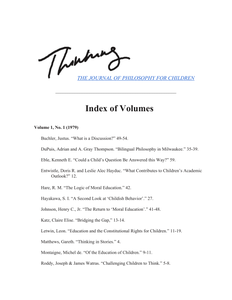
The journal was a forum for the work of both theorists and practitioners of philosophical practice with children, and published such work in all forms, including philosophical argument and reflection, classroom transcripts, curricula, empirical research, and reports from the field. The journal also maintained a tradition in publishing articles in the hermeneutics of childhood, a field of intersecting disciplines including cultural studies, social history, philosophy, art, literature and psychoanalysis.
DOCUMENT
The recent shift towards the interdisciplinary study of the human-environment relationship is largely driven by environmental justice debates. This article will distinguish four types of environmental justice and link them to questions of neoliberalism and altruism. First, environmental justice seeks to redress inequitable distribution of environmental burdens to vulnerable groups and economically disadvantaged populations. Second, environmental justice highlights the developed and developing countries’ unequal exposure to environmental risks and benefits. Third, temporal environmental justice refers to the issues associated with intergenerational justice or concern for future generations of humans. In all three cases, environmental justice entails equitable distribution of burdens and benefits to different nations or social groups. By contrast, ecological justice involves biospheric egalitarianism or justice between species. This article will focus on ecological justice since the rights of non-human species lags behind social justice debates and discuss the implications of including biospheric egalitarianism in environmental justice debates. https://doi.org/10.1186/2194-6434-1-8 https://www.linkedin.com/in/helenkopnina/
MULTIFILE

The purpose of the paper is to start a dialogue about differences between Western and Eastern cultures in the way they conceptualize knowledge and discuss the implications of these differences for a global intellectual capital (IC) theory and practice. A systematic metaphor analysis of the concept of knowledge and IC is used to identify common Western conceptualizations of knowledge in IC literature. A review of philosophical and religious literature was done to identify knowledge conceptualizations in the main streams of Asian philosophy. Fundamental differences were found in the way knowledge is conceptualized. In Western IC literature common metaphors for knowledge include knowledge as a thing and knowledge as capital. In Asian thought, knowledge is seen as unfolding truth based upon a unity of universe and human self and of knowledge and action. The research was performed on a limited sample of literature. More research is needed to identify how knowledge is conceptualized in the practice of doing business in Asia and to test the effects of introducing IC theories to Asian businessmen and managers. Moreover, it might be questionable whether different types of resources (Western management literature on IC and Asian cultural philosophies) can be put in a comparative perspective to extract conclusions out of it. This methodological starting point has its confinements, but is plausible partly as long as IC theories originating from an Asian background are still missing, partly as far as philosophical notions within Western IC publications are contrasted with Asian notions of knowledge. Despite this restriction we would like to emphasize that Western conceptualizations of knowledge, embedded in terms like intellectual capital and knowledge management, can not be transferred to Asian business without considering the local view on knowledge. Asian conceptualizations of knowledge should play an important role in the further development of a knowledge-based theory and practice of the firm. We choose deliberately to contrast Western philosophy with cultural and religious connotations in Asian philosophy, as the underlying paradigm is strongly influenced by these notions. This is clearly perceivable in revivalist and reformist tendencies in Buddhism, Hinduism and Islam. Religious notions within these traditions have a strong paradigmatic function in a cognitive and normative sense. Not only in anthropology but also in epistemology, contemporary Asian thought is dominated by a discourse deeply embedded in religious and cultural traditions, in which the dimensions of 'nature', 'subjectivity' and 'history' have well defined boundaries. Anthropologically and epistemologically, all spheres of human reality are analyzed and described within the perspective of an integral and monolithic unity, in which all dimensions and spheres of being are bound. In Western philosophy these spheres of being have been separated from religious notions because of a longstanding secularization due to which religion and culture, metaphysics and philosophy have become separate disciplines.(Boom, 1993)
DOCUMENT

Purpose To analyze differences between Western and Eastern cultures in the way they conceptualize knowledge and discuss the implications of these differences for a global intellectual capital (IC) theory and practice. Design/methodology/approach A systematic metaphor analysis of the concept of knowledge and IC is used to identify common Western conceptualizations of knowledge in IC literature. A review of philosophical and religious literature was done to identify knowledge conceptualizations in the main streams of Asian philosophy. Findings Fundamental differences were found in the way knowledge is conceptualized. In Western IC literature common metaphors for knowledge include knowledge as a thing and knowledge as capital. In Asian thought, knowledge is seen as unfolding truth based upon a unity of universe and human self and of knowledge and action. Research limitations/implications The research was performed on a limited sample of literature. More research is needed to identify how knowledge is conceptualized in the practice of doing business in Asia and to test the effects of introducing IC theories to Asian businessmen and managers. Practical implications Western conceptualizations of knowledge, embedded in terms like intellectual capital and knowledge management, can not be transferred to Asian business without considering the local view on knowledge. Asian conceptualizations of knowledge should play an important role in the further development of a knowledge-based theory and practice of the firm. Originality/value The paper is the first to explore differences in knowledge conceptualizations by analyzing the underlying metaphors that are used in Western IC literature and Asian philosophy.
DOCUMENT

In this article we focus upon a division between generalized schools of philosophical and ethical thought about culture and conservation. There is an ongoing debate playing out over conservation between those who believe conservation threatens community livelihoods and traditional practices, and those who believe conservation is essential to protect nonhuman species from the impact of human development and population growth. We argue for reconciliation between these schools of thought and a cooperative push toward the cultivation of an environmentally-focused perspective that embraces not only social and economic justice but also concern for non-human species. Our goal is to underline the ethics and tangible benefits that may result from combining the cultural data and knowledge of the social sciences with understanding of environmental science and conservation. We highlight instances in which social scientists overlook their own anthropocentric bias in relationship to ecological justice, or justice for all species, in favor of exclusive social justice among people. We focus on the polemical stances of this debate in order to emphasize the importance of a middle road of cooperation that acknowledges the rights of human and nonhuman species, alike. In conclusion, we present an alternative set of ethics and research activities for social scientists concerned with conservation and offer ideas on how to reconcile the conflicting interests of people and the environment. https://doi.org/10.1016/j.biocon.2015.01.030 https://www.linkedin.com/in/helenkopnina/
MULTIFILE

This article will discuss philosophical debates on economic growth and environmental sustainability, the role of management responsibility, and the risk of subversion to business as usual. This discussion will be framed using the concepts of Cradle to Cradle (C2C) and Circular Economy about sustainable production. The case study illustrating the danger of subversion of these progressive models discussed here is based on the assignments submitted by Masters students as part of a course related to sustainable production and consumption at Leiden University. The evaluation of the supposedly best practice cases placed on the website of the Ellen MacArthur Foundation or those awarded Cradle to Cradle certificate has led some students to conclude that these cases illustrated green-washing. Larger implications of identified cases of green-washing for the field of sustainable business and ecological management are discussed. “This is a post-peer-review, pre-copyedit version of an article published in 'Philosophy of Management'. The final authenticated version is available online at: https://doi.org/10.1007/s40926-019-00108-x LinkedIn: https://www.linkedin.com/in/helenkopnina/
MULTIFILE




