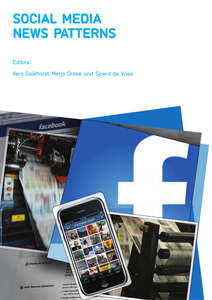
Wereldwijd onderzoek: Hoe gebruiken nieuwsmedia social media? Jongeren lezen geen krant meer, ze kijken op hun smartphone die ze altijd bij de hand hebben. Binnen het lectoraat social media en reputatiemanagement van NHL hogeschool te Leeuwarden heeft een groep internationale studenten in 12 landen onderzoek gedaan. Hierbij hebben ze meer dan 150 social media sites bestudeerd van nieuws media. De resultaten maken deel uit van een internationaal onderzoek van NHL Hogeschool en Haaga Helia University. De onderzoeksvraag was: Wat speelt zich af in de nieuwsmedia? Persbureaus kunnen het overzicht gebruiken om hun social media te optimaliseren. En voor ieder die journalistiek een warm hart toedraagt is het interessante informatie over de nieuwsmedia in een overgangssituatie (2nd edition)
DOCUMENT
Sadness is now a design problem. The highs and lows of melancholy are coded into social media platforms. After all the clicking, browsing, swiping and liking, all we are left with is the flat and empty aftermath of time lost to the app. Sad by Design offers a critical analysis of the growing social media controversies such as fake news, toxic viral memes and online addiction. The failed search for a grand design has resulted in depoliticised internet studies unable to generate either radical critique or a search for alternatives. Geert Lovink calls for us to embrace the engineered intimacy of social media, messenger apps and selfies, because boredom is the first stage of overcoming ‘platform nihilism’. Then, after the haze, we can organise to disrupt the data extraction industries at their core.
DOCUMENT
In this paper we discuss the general approach and choices we made in developing a prototype of a social media monitor. The main goal of the museum monitor is to offer museum professionals and researchers better insight in the effects of their own social media usage and compare this with other actors in the cultural heritage sector. It gives researchers the opportunity to consider communication within the sector as whole. In the research project “Museum Compass” we have developed a prototype of a social media monitor, which contains data of current and historic online activities on Facebook, Twitter, YouTube, Foursquare and Flickr of all registered Dutch museums. We discuss – mostly in a practical sense – our approach for developing the monitor and give a few examples as a result of its usage.
DOCUMENT

In dit magazine (rapport) blikken betrokken onderzoekers en professionals terug op “The Next Level” en de resultaten daarvan, die onder meer bestaan uit trainingen op het gebied van ‘crises & social media’ voor professionals. In mei 2016 is na ruim 2 jaar een einde gekomen aan onderzoeksproject "The Next Level". De lectoraten Crossmediale communicatie in het Publieke Domein en Regie van Veiligheid (Hogeschool Utrecht) werkten hierin samen met professionals uit het communicatie- en veiligheidsdomein. Centrale vraag in dit onderzoek was: hoe kan bij een crisis - beïnvloed door sociale media - effectief vorm worden gegeven aan crisiscommunicatie en crisismanagement?
DOCUMENT

Een van de belangrijkste ontwikkelingen in het onderwijs is het gebruik van nieuwe kennismedia: media voor het genereren, begrijpen en delen van kennis. Denk aan social media, serious gaming, apps, tablets en smartphones. De grote vraag is: hoe ga je als school om met deze mediaontwikkelingen? In dit whitepaper presenteren we de roadmap van ons onderzoek naar de educatieve implementatie van de iPad (Engelstalig document)
DOCUMENT

In dit whitepaper vindt u de resultaten van onze jaarlijkse social media MKB-monitor. Met deze monitor doen we onderzoek naar het gebruik van sociale media in het MKB. In dit whitepaper vindt u de resultaten van de monitor en kansen voor de toekomst
DOCUMENT

Social media zijn momenteel het gesprek van de dag. In slechts enkele jaren tijd hebben social media sites als YouTube, Facebook en LinkedIn een miljoenenpubliek aan zich gebonden. En het aantal consumenten en bedrijven dat gebruik maakt van deze online platformen groeit nog steeds sterk. Hoewel er dagelijks nieuwe cijfers verschijnen over het gebruik van social media is er vooralsnog weinig bekend over de adoptie van social media door bedrijven. Middels dit boek willen de onderzoekers van het lectoraat Online Ondernemen van de Hogeschool van Amsterdam een bijdrage leveren aan het opvullen van deze kennisleemte door het social media gebruik binnen de detailhandel in Nederland in kaart te brengen. Het boek bevat de resultaten van een onderzoek naar gebruik van de social media sites Hyves, Facebook, LinkedIn, YouTube, weblogs, Twitter en fora door (web)winkels en consumenten in Nederland. Welke social media sites worden veel en welke weinig gebruikt door (web)winkels en consumenten in Nederland? Wat zijn de kenmerken van de (web)winkels en consumenten die voorop lopen en achterblijven in het gebruik van social media platformen? In hoeverre zijn Nederlanders geïnteresseerd in het volgen van commerciële bedrijven via social media? Hoeveel volgers hebben (web)winkels op Hyves, Facebook, LinkedIn, YouTube en Twitter? Op deze en andere vragen over het gebruik van social media in de detailhandel in Nederland wordt in dit boek antwoord gegeven.
DOCUMENT

full text via link. Wat zijn de ontwikkelingen in social media research, naar wie luisteren we nu eigenlijk in social media, wie is de werkelijke innovator en wie is de werkelijke deler, en wat kunnen merken met klantervaringen? Anita Cox (Insights Director) trapt af met de vraag: Waarom zagen we social media 5 jaar geleden niet aankomen? -
LINK
This longitudinal, quantitative study contributes to the debate on technology-based professional development by examining the extent to which a learning (LinkedIn) intervention in a university setting affects an individual’s social media use for professional development, and the extent to which this relates to self-reported employability. In addition, we investigated how this relationship is moderated by an individual’s motivation to communicate through social media (LinkedIn). Based on social capital theory and the conservation of resources theory, we developed a set of hypotheses that were tested based on longitudinal data collected from university employees (N = 101) in middle- and high-level jobs. First, in line with our expectations, social media use for professional development was significantly higher after the learning intervention than before. Second, partially in line with our expectations, social media use for professional development was positively related with the employability dimension anticipation and optimization. Third, contrary to our expectations, motivation to communicate through social media (LinkedIn) did not have a moderating role in this relationship. We concluded that the learning intervention has the potential to foster social media use for professional development, and in turn, can contribute to individuals’ human capital in terms of their employability. Hence, the intervention that forms the core of this empirical research can be a sustainable and promising human resource management (HRM) practice that fits the human capital agenda.
DOCUMENT

This paper will query whether a dedicated news platform can attune to young people’s civic needs? That is to ask: can this be a space that follows a social media logic of conversation and ‘give and take’ – with producers and consumers changing roles or even losing the distinction? How could and would such a news source be of interest to urban young, arguably the group that feels most removed from citizen status and social acceptance for who they happen to be? ‘Urban youth’ for us refers to a very specific group of young people. They are Marokko.nl’s community members. As the name suggests a fair number of them will consider themselves to be Moroccan-Dutch. From our perspective it is important to understand this group as identifying with ethnic minority groups in the Netherlands, although most of them will have been born in the Netherlands and hold Dutch citizenship. More than other young people they will recognize Islam as the religion they feel closest to. They also share a sense, as will become clear below, that they are caught ‘between two worlds’ (Elias and Lemish, 2008; Singla, 2004; Gezduci and D’Haenens, 2010). Mainstream Dutch media cast preciously few actors, anchors, audience members and experts from ethnic minority groups. Not surprisingly, this is often given as a reason to distrust hegemonic media and as underlining a sense of distance and alienation from Dutch society (see also Awad and Roth, 2011: 401).
DOCUMENT



