The shortage for ICT personal in the EU is large and expected to increase. The aim of this research is to contribute to a better understanding of the roles and competences needed, so that education curricula can be better aligned to evolving market demand by answering the research question: Which competence gaps do we need to bridge in order to meet the future need for sufficiently qualified personnel in the EU Software sector? In this research, a mixed method approach was executed in twelve European countries, to map the current and future needs for competences in the EU. The analyses shows changes in demand regarding technical skills, e.g. low-code and a stronger focus on soft skills like communication and critical thinking. Besides this, the research showed educational institutes would do well to develop their curricula in a practical way by integration of real live cases and work together with organizations.
MULTIFILE

In Europe there is a deep gender imbalance in ICT professions. Only about 15% of the ICT jobs are occupied by female employees. Although the situation varies in different sectors and European countries, a gender imbalance and a professional skills shortage are common features of the ICT labour market in Europe. At a cost to both their own opportunities and society's ability to produce people with much-needed ICT skills, women continue to be underrepresented in ICT education. They represent less than 10% of the student population in ICT university programs. Although some of the barriers that women face have their foundations in cultural expectations established well before the college level, departments can take effective steps to increase recruitment and retention of women students. Several strategies have been and are being adopted in Europe and in The Netherlands to increase the number of female ICT students.
DOCUMENT
Abstract: Background: There has been a rapid increase in the population of senior citizens in many countries. The shortage of caregivers is becoming a pressing concern. Robots are being deployed in an attempt to fill this gap and reduce the workload of caregivers. This study explores how healthcare robots are perceived by trainee care professionals. Methods: A total of 2365 students at different vocational levels completed a questionnaire, rating ethical statements regarding beneficence, maleficence, justice, autonomy, utility, and use intentions with regard to three different types of robots (assistive, monitoring, and companion) along with six control variables: gender, age, school year, technical skills, interest in technology, and enjoying working with computers.
DOCUMENT

Background: The transformation in global demography and the shortage of health care workers require innovation and efficiency in the field of health care. Digital technology can help improve the efficiency of health care. The Mercury Advance SMARTcare solution is an example of digital technology. The system is connected to a hybrid mattress and is able to detect patient movement, based on which the air pump either starts automatically or sends a notification to the app. Barriers to the adoption of the system are unknown, and it is unclear if the solution will be able to support health care workers in their work. Objective: This study aims to gain insight into health care workers’ expectations of factors that could either hamper or support the adoption of the Mercury Advance SMARTcare unit connected to a Mercury Advance mattress to help prevent patients from developing pressure injuries in hospitals and long-term care facilities. Methods: We conducted a generic qualitative study from February to December 2022. Interviews were conducted, and a focus group was established using an interview guide of health care workers from both the United Kingdom and the Netherlands. Thematic analysis was performed by 2 independent researchers. Results: A total of 14 participants took part in the study: 6 (43%) participants joined the focus group, and 8 (57%) participants took part in the individual interviews. We identified 13 factors based on four themes: (1) factors specifically related to SMARTresponse, (2) vision on innovation, (3) match with health care activities, and (4) materials and resources involved. Signaling function, SMARTresponse as prevention, patient category, representatives, and implementation strategy were identified as facilitators. Perception of patient repositioning, accessibility to pressure injury aids, and connectivity were identified as barriers. Conclusions: Several conditions must be met to enhance the adoption of the Mercury Advance SMARTcare solution, including the engagement of representatives during training and a reliable wireless network. The identified factors can be used to facilitate the implementation process. JMIR Nursing 2024;7:e47992
DOCUMENT

Demand Driven Care plays a key role in the modernization of the Dutch health care system. This modernization is needed because a) clients needs for care increases quantitatively as well as in diversity, b) the financial means for collective services are inadequate, c) the accessibility of health care will depend on clients own responsibility, and d) shortage of professional care givers is foreseen. In the Netherlands, the need for professional care givers increases with an average of 2% every year. Demand Driven Care is an instrument for liberalization of public activities. The Faculty Chair Demand Driven Care focuses on those activities that will contribute to sufficient care supply. Within the program of the chair, activities are executed under the theme of Integrated Care, Substitution, Patient Centred Care, and Home Care Technology with an emphasis on gerontechnology. The Faculty Chair wants to contribute to a better integration and coherence in care. So that clients live and function independently as long as possible and are able to enhance their self management. In addition, health care professionals should be aware of demand driven processes and should have a demand driven attitude towards clients.
DOCUMENT

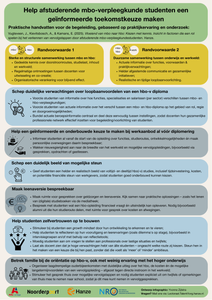
Vertaling resultaten: Vugteveen, J., Kievitsbosch, A., & Kamans, E. (2025). Vloeiend van mbo naar hbo: Kiezen met kennis. Inzicht in factoren die een rol spelen bij het verkennen van vervolgstappen door afstuderende mbo-verpleegkundestudenten.
DOCUMENT
The definition of ‘Assistive Technology’ (AT) includes both assistive products and the services or actions necessary for safe and effective provision of the assistive products to people who need them. International standards and product specifications exist for assistive products. Despite huge unmet need for effective AT provision, a variety of service delivery models across different countries, and a shortage of personnel trained in this field, nowidely useable and accepted AT service provision guidelines currently exist. Aligned with contemporary global initiatives to improve access to AT, a scoping review was commissioned to inform the development of globally useable provision guidance. The aim was to deliver a rapid scoping review of the literature regarding quality guidelines for AT service provision. Method: The rapid scoping review utilised a two-tiered approach to identifying relevant publications: 1) systematic search of academic databases; 2) consultation with assistive technology organisations. The review was conducted in March 2023 across four databases (Medline, CINAHL, SCOPUS and Google Scholar) with no date limitations. Systematic outreach to international and global AT networks was used to access expert informants. Non-English publications were included utilizing Google Translate and support from expert informants to verify content. Analysis was guided by the body of work on quality AT provision and service delivery processes in Europe, as well as the World Health Organization-GATE 5P framework for strengthening access to AT. Results: The search strategies yielded 41 publications from diverse countries, and directed at differing assistive products, personnel and provision contexts. Results are reported from the charted data through to the data extraction framework, including type of publication, study design, audience and reach. We report on the type of AT and the AT provision ecosystem elements discussed, and service delivery process or steps and quality criteria service delivery. Conclusion: This review did not find established guidelines or standards for service provision, but it did identify key service delivery steps which may form part of such guidelines, and many of the 3 publications included mentioned the need for practice guidelines. Despite different contexts such as type of assistive product, recipient of the guidance, language, location and authorship, core elements of AT provision including service delivery steps can be identified. Consideration regarding the nuances of vocabulary, of process, and of enabling flexible foci, is recommended in systematizing globally applicable guidance. This review offers a strong starting point for developing guidance for assistive technology provision to meet global need.
DOCUMENT

Background: Rising healthcare costs, an increasing general practitioner shortage and an aging population have made healthcare organization transformation a priority. To meet these challenges, traditional roles of non-medical members have been reconsidered. Within the domain of physiotherapy, there has been significant interest in Extended Scope Physiotherapy (ESP). Although studies have focused on the perceptions of different stakeholders in relation to ESP, there is a large variety in the interpretation of ESP. Aim: To identify a paradigm of ESP incorporating goals, roles and tasks, to provide a consistent approach for the implementation of ESP in primary care. Methods: An exploratory, qualitative multi-step design was used containing a scoping review, focus groups and semi-structured interviews. The study population consisted of patients, physiotherapists, general practitioners and indirect stakeholders such as lecturers, health insurers and policymakers related to primary care physiotherapy. The main topics discussed in the focus groups and semi-structured interviews were the goals, skills and roles affiliated with ESP. The ‘framework’ method, developed by Ritchie & Spencer, was used as analytical approach to refine the framework. Results: Two focus groups and twelve semi-structured interviews were conducted to explore stakeholder perspectives on ESP in Dutch primary care. A total of 11 physiotherapists, six general practitioners, five patients and four indirect stakeholders participated in the study. There was a lot of support for ‘decreasing healthcare costs’, ‘tackling increased health demand’ and ‘improving healthcare effectiveness’ as main goals of ESP. The most agreement was reached on ‘triaging’, ‘referring to specialists’ and ‘ordering diagnostic imaging’ as tasks fitting for ESP. Most stakeholders also supported ‘working in a multidisciplinary team’, ‘working as a consultant’ and ‘an ESP role separated from a physiotherapist role’ as roles of ESP. Conclusions: Based on the scoping review, focus groups and interviews with direct and indirect stakeholders, it appears that there is sufficient support for ESP in the Netherlands. This study provides a clear presentation of how ESP can be conceptualized in primary care. A pilot focused on determining the feasibility of ESP in Dutch primary care will be the next step.
DOCUMENT

The aim of this small explorative study was to get an impression of the participants’ views and understanding of the role of becoming a teacher in Swedish schools, realising the characteristic of pedagogy aimed for in the curriculum (in Lgr11 and Lgy), specifically the interaction patterns and student participation in learning processes. Main research questions addressed participants expectations of differences and challenges in the Swedish school context as compared to their experiences in Syria contexts, in specific the development of their understanding of student participation in interaction as characteristic of Swedish education and curriculum. From this, recommendations are formulated for curriculum and research for future Fast Track trajectories.
DOCUMENT

Climate change is now considered more than just an environmental issue, with far-reaching effects for society at large. While the exact implications of climate change for policing practice are still unknown, over the past two decades criminologists have anticipated that climate change will have a number of effects that will result in compromised safety and security. This article is informed by the outcome of a co-creation workshop with 16 practitioners and scholars of diverse backgrounds based in The Netherlands, who sought to conceptualize and systematize the existing knowledge on how climate change will most likely impact the professional practice of the Dutch (or any other) police. These challenges, with varying degrees of intensity, are observable at three main levels: the societal, organizational, and individual level. These levels cannot be separated neatly in practice but we use them as a structuring device, and to illustrate how dynamics on one level impact the others. This article aims to establish the precepts necessary to consider when exploring the intersection between climate change and policing. We conclude that much still needs to be done to ensure that the implications of climate change and the subject of policing are better aligned, and that climate change is recognized as an immediate challenge experienced on the ground and not treated as a distant, intangible phenomenon with possible future impacts. This starts with creating awareness about the possible ways in which it is already impacting the functioning of policing organizations, as well as their longer-term repercussions.
MULTIFILE




