DOCUMENT
DOCUMENT
In een tijd waar ontmoeting, toegang en inclusiviteit hoog op de ruimtelijke agenda staan, speelt de semi-publieke ruimte in potentie een interessante rol. Maar wat zijn eigenlijk deze semi-publieke ruimten en in hoeverre kan je deze ontwerpen of hier beleid voor maken? En hoe gaan wij, als gebruikers, om met de semi-publieke ruimte? Deze themareeks zoekt antwoorden vanuit onderzoek en praktijk, langs verschillende ruimtelijke concepten en verschijnsels en vanuit verschillende perspectieven. Dit artikel biedt een introductie op de semi-publieke ruimte en over de themareeks zelf.
DOCUMENT

In this article, we examine the relationship between important types of policies for asylum permit holders in the Netherlands and the improvement in their command of Dutch. As far as asylum policy is concerned, we find that participation in activities in the asylum seekers reception centre – and in particular, following Dutch language classes – contribute to an improvement in Syrian asylum permit holders’ command of Dutch. On the other hand, a prolonged period of stay and frequent relocations between reception centres are not favourable. Asylum permit holders who have successfully completed the civic integration programme have a better command of the language than asylum permit holders who are still undergoing the programme. An important finding is that there seems to be a sort of double deficit in the area of civic integration: not only do the elderly and lower educated make less progress in learning Dutch, but they are also the ones more likely to receive a dispensation from the civic integration requirement, which places them at a further disadvantage. Third, we find that early participation in the labour market or as a volunteer is also beneficial for language proficiency.
LINK
This article analyses four of the most prominent city discourses and introduces the lens of urban vitalism as an overarching interdisciplinary concept of cities as places of transformation and change. We demonstrate the value of using urban vitalism as a lens to conceptualize and critically discuss different notions on smart, inclusive, resilient and sustainable just cities. Urban vitalism offers a process-based lens which enables us to understand cities as places of transformation and change, with people and other living beings at its core. The aim of the article is to explore how the lens of vitalism can help us understand and connect ongoing interdisciplinary academic debates about urban development and vice versa, and how these ongoing debates inform our understanding of urban vitalism.
DOCUMENT

This project builds upon a collaboration which has been established since 15 years in the field of social work between teachers and lecturers of Zuyd University, HU University and Elte University. Another network joining this project was CARe Europe, an NGO aimed at improving community care throughout Europe. Before the start of the project already HU University, Tallinn Mental Health Centre and Kwintes were participating in this network. In the course of several international meetings (e.g. CARe Europe conference in Prague in 2005, ENSACT conferences in Dubrovnik in 2009, and Brussels in April 2011, ESN conference in Brussels in March 2011), and many local meetings, it became clear that professionals in the social sector have difficulties to change current practices. There is a great need to develop new methods, which professionals can use to create community care.
DOCUMENT
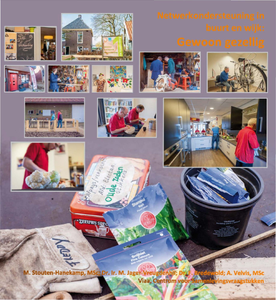
Dit rapport doet verslag van het onderzoek naar de manier waarop contact tot stand komt tussen mensen met een verstandelijke beperking of psychiatrische problematiek en andere buurtbewoners. Het betreft een onderdeel van het meerjarig onderzoek ‘Netwerkondersteuning in buurt en wijk’, waarin gedurende vier jaar (2015-2018) wordt samengewerkt met een aantal zorgorganisaties (RIBW Groep Overijssel, Frion, MEE en Dimence (De Kern)), acht gemeenten (Zwolle, Zwartewaterland, Steenwijkerland, Kampen, Hardenberg,Dalfsen, Ommen en Staphorst), Hogeschool Viaa en de Universiteit voor Humanistiek. De centrale vraag van dit onderzoek is: Wat hebben verschillende groepen mensen met een verstandelijke of psychiatrische beperking die in de buurt of wijk wonen nodig om een informeel sociaal netwerk op te bouwen of uit te breiden in hun buurt of wijk dat er aan bijdraagt dat ze naar vermogen kunnen deelnemen aan de samenleving?
DOCUMENT
Objectives: Promoting unstructured outside play is a promising vehicle to increase children’s physical activity (PA). This study investigates if factors of the social environment moderate the relationship between the perceived physical environment and outside play. Study design: 1875 parents from the KOALA Birth Cohort Study reported on their child’s outside play around age five years, and 1516 parents around age seven years. Linear mixed model analyses were performed to evaluate (moderating) relationships among factors of the social environment (parenting influences and social capital), the perceived physical environment, and outside play at age five and seven. Season was entered as a random factor in these analyses. Results: Accessibility of PA facilities, positive parental attitude towards PA and social capital were associated with more outside play, while parental concern and restriction of screen time were related with less outside play. We found two significant interactions; both involving parent perceived responsibility towards child PA participation. Conclusion: Although we found a limited number of interactions, this study demonstrated that the impact of the perceived physical environment may differ across levels of parent responsibility.
MULTIFILE




