Picture books with characters that promote healthy eating are increasingly being used to make this behavior more attractive. The first aim of this study was to investigate whether the effect of vegetable promoting picture books on toddlers' vegetable consumption differed according to the reading style and the use of a hand puppet during reading. The second aim was to investigate whether these effects were mediated by toddlers’ narrative involvement and character imitation. In a 2 (reading style: interactive vs. passive) x 2 (puppet use: with vs. without puppet) between-subjects design, 163 toddlers (2e3 years) were randomly assigned to one of the four reading conditions. The story was about a rabbit that loves to eat carrots. After the fourth reading day, the eating task was conducted in which children could eat freely from four different snacks, including carrots. The main finding was that interactive reading produced the greatest carrot consumption. The explanation for this effect was that interactive reading stimulated toddlers to imitate poses of the book characters, even more when interactive reading was supported by the use of a hand puppet. The findings underline that young children should be actively involved with health interventions in order for them to be effective.
LINK
BackgroundInterventions to prevent overweight and obesity in toddlers are needed to minimize health inequalities, especially in migration and lower socio-economic groups. Preschools are identified as important environments for interventions to prevent overweight and obesity. Early Childhood Education and Care (ECEC) teachers in preschools are potential key actors in promoting healthy eating and physical activity. This paper describes the research design of a Dutch preschool-based intervention for ECEC teachers in promoting healthy eating and physical activity in toddlers.MethodsPreSchool@HealthyWeight concerns a cluster randomized controlled trial on preschools in Amsterdam Nieuw-West, Netherlands. This city district is characterised by inhabitants with a migration background and low socio-economic status. Forty-one preschools, with 115 ECEC teachers and 249 toddlers/parents, were randomly allocated to an intervention or control group. An intervention for teachers will be carried out on intervention locations and consists of modified versions of 2 existing programs: ‘A Healthy Start’ and ‘PLAYgrounds’. In ‘A Healthy Start’, ECEC teachers learn to provide a healthy and active environment for toddlers. The ‘PLAYgrounds for Toddlers’ program, coaches ECEC teachers to stimulate physical activity in the playgrounds of preschools. PreSchool@HealthyWeight aims to evaluate the effectiveness of the intervention after 9 months. Primary outcomes are the teachers’ knowledge, attitude and practices concerning healthy eating and physical activity, and consequently the level of confidence of ECEC teachers in promoting healthy eating and physical activity in toddlers. Secondary outcomes include the Body Mass Index, body composition, dietary intake and physical activity level of teachers and toddlers. In addition, the activating role of ECEC teachers and the physical activity of toddlers on the playgrounds will be evaluated. Lastly, the knowledge, attitude and practices of parents concerning healthy eating and physical activity will be assessed.DiscussionIt is hypothesized that this preschool-based intervention for ECEC teachers improves the knowledge, attitude and practices regarding healthy eating and physical activity, and consequently the level of confidence of ECEC teachers in promoting healthy eating and physical activity of toddlers. The intervention addresses the call for early intervention to prevent overweight and obesity and to minimize health inequalities.Trial registrationNetherlands Trial Register (NTR): NL5850. Date registered: August 26, 2016.
DOCUMENT

Background and aimsThe aim of this study was to gain insight in the effect of a preschool-based intervention for Early Childhood Education and Care (ECEC) teachers on promoting healthy eating and physical activity in toddlers.MethodsIn a cluster randomized controlled trial, 37 preschools of child care organization Impuls in Amsterdam Nieuw-West, the Netherlands, were randomly allocated to an intervention or control group. In total, 115 female ECEC teachers (mean age 42 ± 9 years) participated. The intervention for ECEC teachers consisted of two existing Dutch programs: ‘A Healthy Start’ and ‘PLAYgrounds’. The practices and knowledge of ECEC teachers concerning healthy eating and physical activity and the level of confidence in promoting healthy eating and physical activity in toddlers was assessed at baseline and 9 months of follow-up. To examine the effect of the intervention linear mixed models were used.ResultsPreliminary analyses of the practices indicated that Activity-related-Teaching/Autonomy-Support was increased in the intervention group (mean difference: 0.181), but not in the control group (mean difference: -0.048; p-value group*time: 0.025). Food-related-Pressure-to-Eat was decreased in the intervention group (mean difference: -0.580), but not in the control group (mean difference: -0.158; p-value group*time: 0.014). No effect of the intervention was found on knowledge (p-value group*time: 0.24) and the level of confidence (p-value group*time: 0.98) of ECEC teachers. ConclusionsThe preschool-based intervention seems to increase Activity-related-Teaching/Autonomy-Support and to decrease Food-related-Pressure-to-Eat. No effects were seen on knowledge and level of confidence of ECEC teachers in promoting healthy eating and physical activity in toddlers.
MULTIFILE

Starting with finger foods is recommended from 7 months in typically developing children. However, information on which finger foods are appropriate and accepted for which age is largely lacking. The purpose of this exploratory study was to determine whether chewing skills, hand motor skills, and other personal and food characteristics influence the intake of finger foods in early life. Thirty children aged 12 to 18 months participated in this study. All children were offered four finger foods in a fixed order on four consecutive days at their home. Two finger foods varied mainly in texture (fresh banana vs. freeze-dried banana) and two other finger foods mainly in shape (stick vs. heart shaped cracker). The intake was measured after ten minutes of exposure to the product. Chewing skills were measured with the Mastication Observation and Evaluation instrument and fine motor skills with selected items of the Bayley-III-NL scales. The results suggest that texture but not shape was found to affect intake, as fresh banana was eaten more than freeze-dried banana and the consumed quantity of the two crackers was not significantly different. Hand motor skills affected the intake of fresh banana only and chewing skills did not affect intake of any of the finger foods. Age and experience with chewable foods were associated with an increased intake of some of the finger foods. In conclusion, the intake of the four finger foods in this study was found to be mainly affected by texture, hand motor skills, age and experience.
DOCUMENT
Characteristics of the physical childcare environment are associated with children’s sedentary behavior (SB) and physical activity (PA) levels. This study examines whether these associations are moderated by child characteristics. A total of 152 1- to 3-year-old children from 22 Dutch childcare centers participated in the study. Trained research assistants observed the physical childcare environment, using the Environment and Policy Assessment Observation (EPAO) protocol. Child characteristics (age, gender, temperament and weight status) were assessed using parental questionnaires. Child SB and PA was assessed using Actigraph GT3X+ accelerometers. Linear regression analyses including interaction terms were used to examine moderation of associations between the childcare environment and child SB and PA. Natural elements and portable outdoor equipment were associated with less SB and more PA. In addition, older children, boys and heavier children were less sedentary and more active, while more use of childcare and an anxious temperament were associated with more SB. There were various interactions between environmental factors and child characteristics. Specific physical elements (e.g., natural elements) were especially beneficial for vulnerable children (i.e., anxious, overactive, depressive/withdrawn, overweight). The current study shows the importance of the physical childcare environment in lowering SB and promoting PA in very young children in general, and vulnerable children specifically. Moderation by child characteristics shows the urgency of shaping childcare centers that promote PA in all children, increasing equity in PA promotion in childcare.
DOCUMENT

DOCUMENT

This study evaluated the Toddler Oral Health Intervention (TOHI) for preventing early childhood caries (ECC) by 48 months. TOHI, an add-on to standard care in well-baby clinics (WBCs), aims to reduce ECC incidence and severity.
MULTIFILE

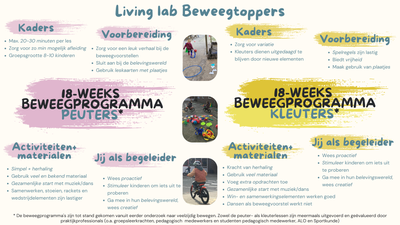
Bijeenkomst van het living lab Beweegtoppers waarin resultaten gedeeld werden met het publiek. Resultaten bestonden uit een poster met geleerde lessen (en een 18weeks beweegprogramma voor kleuters en een 18weeks beweegprogramma voor kleuters; zie andere output)
IMAGE
MULTIFILE

Abstract and poster (poster title differs).
MULTIFILE




