Myths can be part of the established narratives of tourist destinations: they offer a perspective on reality that may alter it but that makes it also more insightful by highlighting its inner contradictions and idiosyncrasies and challenging the universal values underlying it. This altered perspective on a place ensures visitors will feel touched by the myth and connected to the place, and the myth itself will be retold. In this paper, we discuss how we have connected narrative to story and story to myth to (re)tell the narratives of people and places and to enhance, in this way, the overall visitor experience in (tourist) destinations. We review two storytelling/placemaking projects that were commissioned to us by several regional, tourism organizations in Brabant, a province in the South of the Netherlands. The projects are: Becoming Vincent, a project about Vincent van Gogh; and Crossroads, a project about heritage from WWII. The aim of these projects was to draft a unique, narrative concept and design storylines that would link and upgrade the sites related to that heritage to eventually attract tourists there, and/or to stimulate visitors to visit more sites connected to the same theme. Finally, we draw lessons we learnt from these projects and highlight the insights we gained in the use of storytelling for mythmaking in tourist destinations
DOCUMENT
This research concerning the experience and future of zoos was carried out from 2011-2012 and takes regional ideas concerning Zoo Emmen as well as global visions into account. The research focuses partly on Zoo Emmen, its present attractions and visitors while also comparing and contrasting visions on the future in relationship to other international zoos in the world. In this way, remarkable experiences and ideas will be identified and in the light of them, it can serve as inspiration for stakeholders of zoos at large. The main research subject is a look at the future zoos in view of: The Zoo Experience – an international experience benchmark; The Zoo of the Future – a Scenario Planning approach towards the future; The virtual zoo - zoo’s in the internet domain.
DOCUMENT

The cultural tourism market has diversified and fragmented into many different niches. Previous attempts to segment cultural tourists have been largely unidimensional, failing to capture the complexity of cultural production and consumption. We employ multiple correspondence analysis to visualize the relationship between cultural consumers and attractions in a large data set (n = 12,905). This indicates that two dimensions describing the ranges between 'static' and 'dynamic' attractions and 'high-brow' and 'low brow' culture effectively discriminate different groups of arts and heritage tourists. The holiday structure itself seems to provide a context that influences the cultural consumption of actors. Thus higher levels of cultural capital are related to more accessible forms of culture, contrary to theoretical expectations. There is also evidence of the development of a cultural tourism 'travel career' with more dynamic cultural forms being characteristic of younger tourists and more high brow and static forms of culture being consumed in later life by those with higher levels of cultural capital.
LINK
Cultural festivals can attract cultural tourists, extend the tourist season and add vibrancy to the cultural scene. However, there is relatively little research on how festivals affect tourist experience of the destination or outcomes such as satisfaction or repeat visitation. This study used the Event Experience Scale to measure tourist experiences at three cultural festivals in Hong Kong – the Lantern Festival, Dragon Boat Festival and the Cheung Chau Bun Festival. The findings show that tourist experiences of these festivals are distinct, and they positively affect destination image and behavioural outcomes. Relative to permanent attractions and tours, festival experiences elicit stronger affective, conative and novelty responses. Festivals also convey a stronger impression of Hong Kong as a destination exhibiting Chinese and traditional culture, but less as a global city. The festival experience is associated with positive outcomes, namely greater satisfaction, intention to recommend and intention to return.
DOCUMENT

Purpose: This study aimed to determine the motivations of a select group of South Africans in terms of their potential engagement with cultural tourism; more specifically, the study set out to show whether these motivations influence the cultural activities that the tourists want to participate in and whether their interest in specific cultural activities determines their destination choices. Furthermore, the mediating role of activities in the relationship between cultural motivations and destination choice was also assessed. Design/methodology/approach: An online panel survey collected responses from 1,530 potential cultural tourists across South Africa. Hypotheses were tested, using structural equation modelling. Findings: The results show that tourists' motivations for cultural tourism influence their likelihood of participating in specific cultural activities. Cultural tourism is shown to be influenced by more than learning and includes entertainment, relaxation, novelty and escape dimensions. There also seems to be a difference in the activities engaged in by destination type. For example, tourists likely to take part in indigenous cultural tourism activities are more likely to do so at hedonic destinations. Practical implications: This paper contributes to the understanding of cultural tourism activities, aiding destinations in attracting cultural tourists. Destinations need to develop activities that match visitor motivations, increase satisfaction and encourage visitors to return. Originality/value: The paper increases the understanding of cultural tourism in South Africa and underlines the importance of communities in providing distinctive tourism activities. The study also has an important social dimension, highlighting the role of social status in cultural tourism consumption and destination selection.
MULTIFILE
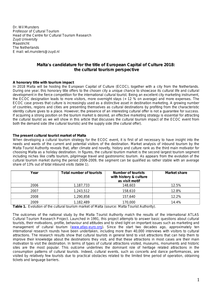
De kandidatuur van Malta als Europese Culturele hoofdstad in cultuurtoeristisch perspectief
DOCUMENT
Traveling to places associated with death is not a new phenomenon. People have long been drawn, purposefully or otherwise, towards sites, attractions, and events linked in one way or another with death, suffering, violence, or disaster. War-related attractions, though diverse, are a subset of the totality of tourist sites associated with death and suffering. This article aims to assess how "dark" tourism may play a role in leveraging tourism in Palestine, which has largely relied on pilgrimage tourism in the past. This article investigates the potential for developing this form of tourism, since Palestine has been undergoing death, suffering, violence, or disaster through political tension and instability since 1948 and arguably for a generation earlier, but has not yet developed a strategy for tourism development that considers this type of tourism.
MULTIFILE

Emotional reactions to marketing stimuli are essential to tourist destination marketing, yet difficult to validly measure. A neuromarketing experiment was peformed to establish whether brain event-related potentials (ERPs), elicited by destination photos, can be used to evaluate the effectiveness of tourist destination marketing content in movies. Two groups of participants viewed pictures from the cities of Bruges and Kyoto. Prior to viewing the pictures, one group saw an excerpt from the movie In Bruges, which positively depicts Bruges’ main tourist attractions. The other group saw a movie excerpt that did not feature Bruges (the Rum Diary). An early emotional response was osberved to the subsequently presented Bruges pictures for the In Bruges group only; no reliable between-group differences were found in ERPs to pictures from Kyoto. In conclusion, EEG-based neuromarketing is a valuable tool for evaluating the effectiveness of destination marketing, and popular movies can positively influence affective destination image.
LINK




