Het leven is continu leren. Een ‘rijke’ en veelzijdige leeromgeving draagt bij om dit ook daadwerkelijk te bewerkstelligen. Jong of oud, student of professional. Leren is van alle tijden en hiervoor dient de kennisinstelling haar onderwijs en onderzoek in te zetten ten behoeve van innovatie en vernieuwing voor bedrijfsleven en overheid. De doelstelling is een symbiose na te streven in een zgn. triple/quadruple helix setting.
DOCUMENT

Abstract: Climate change is related with weather extremes, which may cause damages to infrastructure used by freight transport services. Heavy rainfall may lead to flooding and damage to railway lines, roads and inland waterways. Extreme drought may lead to extremely low water levels, which prevent safe navigation by inland barges. Wet and dry periods may alternate, leaving little time to repair damages. In some Western and Middle-European countries, barges have a large share in freight transport. If a main waterway is out of service, then alternatives are called for. Volume- and price-wise, trucking is not a viable alternative. Could railways be that alternative? The paper was written after the unusually long dry summer period in Europe in 2022. It deals with the question: If the Rhine, a major European waterway becomes locally inaccessible, could railways (temporarily) play a larger role in freight transport? It is a continuation of our earlier research. It contains a case study, the data of which was fed into a simulation model. The model deals with technical details like service specification route length, energy consumption and emissions. The study points to interesting rail services to keep Europe’s freight on the move. Their realization may be complex especially in terms of logistics and infrastructure, but is there an alternative?
MULTIFILE

Dit eindrapport behandelt het onderzoek van CDM@Airports, gericht op Collaborative Decision Making in de logistieke processen van luchtvrachtafhandeling op Nederlandse luchthavens. Dit project, met een looptijd van ruim twee jaar, is gestart op 8 november 2021 en geëindigd op 31 december 2023. HET PROJECT CDM@AIRPORTS OMVAT DRIE WERKPAKKETTEN: 1. Projectmanagement, dit betreft de algehele aansturing van het project incl. stuurgroep, werkgroep en stakeholdermanagement. 2. Onderzoeksactiviteiten, bestaande uit a) cross-chain-samenwerking, b) duurzaamheid en c) adoptie van digitale oplossingen voor datagedreven logistiek. 3. Management van een living lab, een ‘quadruple-helix-setting’ die fysieke en digitale leeromgevingen integreert voor onderwijs en multidisciplinair toegepast onderzoek.
MULTIFILE

The main question in this PhD thesis is: How can Business Rules Management be configured and valued in organizations? A BRM problem space framework is proposed, existing of service systems, as a solution to the BRM problems. In total 94 vendor documents and approximately 32 hours of semi-structured interviews were analyzed. This analysis revealed nine individual service systems, in casu elicitation, design, verification, validation, deployment, execution, monitor, audit, and version. In the second part of this dissertation, BRM is positioned in relation to BPM (Business Process Management) by means of a literature study. An extension study was conducted: a qualitative study on a list of business rules formulated by a consulting organization based on the Committee of Sponsoring Organizations of the Treadway Commission risk framework. (from the summary of the Thesis p. 165)
DOCUMENT

Limited data is available on the size of urban goods movement and its impact on numerous aspects with respect to livability such as emissions and spatial impact. The latter becomes more important in densifying cities. This makes it challenging to implement effective measures that aim to reduce the negative impact of urban good movement and to monitor their impact. Furthermore, urban goods movement is diverse and because of this a tailored approach is required to take effective measures. Minimizing the negative impact of a heavy truck in construction logistics requires a different approach than a parcel delivery van. Partly due to a lack of accurate data, this diversity is often not considered when taking measures. This study describes an approach how to use available data on urban traffic, and how to enrich these with other sources, which is used to gain insight into the decomposition (number of trips and kilometers per segment and vehicle type). The usefulness of having this insight is shown for different applications by two case studies: one to estimate the effect of a zero-emission zone in the city of Utrecht and another to estimate the logistics requirements in a car-free area development.
MULTIFILE
It is of utmost importance to collect organic waste from households as a separate waste stream. If collected separately, it could be used optimally to produce compost and biogas, it would not pollute fractions of materials that can be recovered from residual waste streams and it would not deteriorate the quality of some materials in residual waste (e.g. paper). In rural areas with separate organic waste collection systems, large quantities of organic waste are recovered. However, in the larger cities, only a small fraction of organic waste is recovered. In general, citizens dot not have space to store organic waste without nuisances of smell and/or flies. As this has been the cause of low organic waste collection rates, collection schemes have been cut, which created a further negative impact. Hence, additional efforts are required. There are some options to improve the organic waste recovery within the current system. Collection schemes might be improved, waste containers might be adapted to better suit the needs, and additional underground organic waste containers might be installed in residential neighbourhoods. There are persistent stories that separate organic waste collection makes no sense as the collectors just mix all municipal solid waste after collection, and incinerate it. Such stories might be fuelled by the practice that batches of contaminated organic waste are indeed incinerated. Trust in the system is important. Food waste is often regarded as unrein. Users might hate to store food waste in their kitchen that could attract insects, or the household pets. Hence, there is a challenge for socio-psychological research. This might also be supported by technology, e.g. organic waste storage devices and measures to improve waste separation in apartment buildings, such as separate chutes for waste fractions. Several cities have experimented with systems that collect organic wastes by the sewage system. By using a grinder, kitchen waste can be flushed into the sewage system, which in general produces biogas by the fermentation of sewage sludge. This is only a good option if the sewage is separated from the city drainage system, otherwise it might create water pollution. Another option might be to use grinders, that store the organic waste in a tank. This tank could be emptied regularly by a collection truck. Clearly, the preferred option depends on local conditions and culture. Besides, the density of the area, the type of sewage system and its biogas production, and the facilities that are already in place for organic waste collection are important parameters. In the paper, we will discuss the costs and benefits of future organic waste options and by discussing The Hague as an example.
DOCUMENT

The present study aims at understanding how individuals engage in organized crime activities. Processes responsible for organized crime involvement are still poorly understood, particularly for those who become engaged only later in life. In-depth interviews with 16 inmates, all convicted of participation in organized crime and incarcerated in Dutch prisons, illuminate how individuals at different life stages become involved in crime in general, and in organized crime activities in particular. Most participants we interviewed turn out to have experienced an adult onset in crime. Their involvement mechanisms are analysed and compared with mechanisms applicable to offenders with an early start in crime. It was found that offenders with an early start in crime have a wealth of opportunities and criminal contacts, whereas individuals who become involved in crime later in life are exposed to crime opportunities in conventional settings.
DOCUMENT
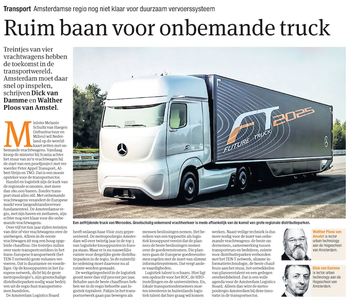
Treintjes van vier vrachtwagens hebben de toekomst in de transportwereld. Amsterdam moet daar snel op inspelen, schrijven Dick van Damme en Walther Ploos van Amstel.
IMAGE
The need to better understand how to manage the real logistics operations in Schiphol Airport, a strategic hub for the economic development of the Netherlands, created the conditions to develop a project where academia and industry partnered to build a simulation model of the Schiphol Airport Landside operations. This paper presents such a model using discrete-event simulation. Arealistic representation of the open road network of the airport as well as the (un)loading dock capacities and locations of the five ground handlers of Schiphol Airport was developed. Furthermore, to provide practitioners with applicable consolidation and truck-dispatching policies, some easy-to-implement rules are proposed and implemented in the model. Preliminary results from this model show that truck-dispatching policies have a higher impact than consolidation policies in terms of both distances travelled by cooperative logistic operators working within the airport and shipments’ average flow time. Furthermore, the approach presented in this study can be used for studying similar mega-hubs
DOCUMENT




