This research investigates to what extent lecturers at universities of applied sciences do regard differentiated rewards—intended to develop and/or display professionalism—to be fair, and to what extent, and in which form, do these stimulate their willingness to (further) professionalise and/or display professionalism. This was a case study research design, and a factorial survey measurement technique was used to collect data. We argue that lecturers believe it is fair that forms of differentiated rewards are used and applied in order to have them develop and/or display more professionalism. Especially the viewpoints/practices that relate to coordination, consultation, and consideration for personal circumstances have an influence on the justice perceived. This paper contributes to the HRM literature confirming that lecturers appreciate financial stimuli enhancing their professionalism; however, elements such as consultation, respect, coordination, and communication are appreciated even more. It appeals to HRM to design new practices which have more stimulating effect on personal and professional growth in subject-specific knowledge.
DOCUMENT

This research investigates to what extent lecturers at universities of applied sciences do regard differentiated rewards(intended to develop and/or display professionalism)to be fair, and to what extent, and in which form, do these stimulate their willingness to (further) professionalise and/or display professionalism. This was a case study research design, and a factorial survey measurement technique was used to collect data. We argue that lecturers believe it is fair that forms of differentiated rewards are used and applied in order to have them develop and/or display more professionalism. Especially the viewpoints/practices that relate to coordination, consultation, and consideration for personal circumstances have an influence on the justice perceived. This paper contributes to the HRM literature confirming that lecturers appreciate financial stimuli enhancing their professionalism; however, elements such as consultation, respect, coordination, and communication are appreciated even more. It appeals to HRM to design new practices which have more stimulating effect on personal and professional growth in subject-specific knowledge.
DOCUMENT

Legal professionals working in city and municipal government face changes in expectations about their roles within the organisation. Where in the past they mostly took on the reactive and detached role of guardians of legal quality, these days they are expected to take a more flexible, solution-oriented and cooperative stance. How do these legal professionals handle this shift? How far do they go in adapting and which factors play a role? Based on three different positions within the organisation I describe this process, focusing in particular on their perception of their professional roles, and their willingness to change. I conclude with some critical comments on the changing expectations from legal professionals.
DOCUMENT
In December of 2004 the Directorate General for Research and Technological Development (DG RTD) of the European Commission (EC) set up a High-Level Expert Group to propose a series of measures to stimulate the reporting of Intellectual Capital in research intensive Small and Medium-Sized Enterprises (SMEs). The Expert Group has focused on enterprises that either perform Research and Development (R&D), or use the results of R&D to innovate and has also considered the implications for the specialist R&D units of larger enterprises, dedicated Research & Technology Organizations and Universities. In this report the Expert Group presents its findings, leading to six recommendations to stimulate the reporting of Intellectual Capital in SMEs by raising awareness, improving reporting competencies, promoting the use of IC Reporting and facilitating standardization.
DOCUMENT

Recently, the Dutch government raised the retirement age of workers in the Netherlands. In this study we focused on the work values of low-skilled older workers, the extent to which their jobs fulfill these values, and the effect of work values on the willingness of these workers to extend their working life. This study is based on a literature review and a secondary analysis on a large database of persons aged 45 and older (STREAM). The study shows that extrinsic work values are more important for low-skilled older workers, and intrinsic work values more relevant for high-skilled older workers. The most important work values for low-skilled older workers are fulfilled slightly more often than those of high-skilled older workers. The extent to which important work values are fulfilled in the jobs of low-skilled older workers is positively correlated with job satisfaction and with their own assessment of whether or not to continue working for another 12 months. Based on this research, we formulated recommendations for HR practices on the employability of low-skilled older workers
DOCUMENT

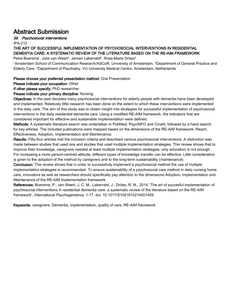
Presentatie gegeven over de review in Brussel Objectives: In the past decades many psychosocial interventions for elderly people with dementia have been developed and implemented. Relatively little research has been done on the extent to which these interventions were implemented in the daily care. The aim of this study was to obtain insight into strategies for successful implementation of psychosocial interventions in the daily residential dementia care. Using a modified RE-AIM framework, the indicators that are considered important for effective and sustainable implementation were defined.
MULTIFILE
A social media architect is an appealing new profession that entails crossovers between communication and IT & Design. There are no study programmes for this job. Important questions are how to interest secondary school pupils for such a new job, and how to prepare them for these jobs or jobs that do not even exist today? This research aims to set an example by presenting a realistic job profile of a social media architect by linking the ‘21st century skills’ to the context in which he/she operates.
DOCUMENT

Over the last two decades, institutions for higher education such as universities and colleges have rapidly expanded and as a result have experienced profound changes in processes of research and organization. However, the rapid expansion and change has fuelled concerns about issues such as educators' technology professional development. Despite the educational value of emerging technologies in schools, the introduction has not yet enjoyed much success. Effective use of information and communication technologies requires a substantial change in pedagogical practice. Traditional training and learning approaches cannot cope with the rising demand on educators to make use of innovative technologies in their teaching. As a result, educational institutions as well as the public are more and more aware of the need for adequate technology professional development. The focus of this paper is to look at action research as a qualitative research methodology for studying technology professional development in HE in order to improve teaching and learning with ICTs at the tertiary level. The data discussed in this paper have been drawn from a cross institutional setting at Fontys University of Applied Sciences, The Netherlands. The data were collected and analysed according to a qualitative approach.
DOCUMENT

Innovation is crucial for higher education to ensure high-quality curricula that address the changing needs of students, labor markets, and society as a whole. Substantial amounts of resources and enthusiasm are devoted to innovations, but often they do not yield the desired changes. This may be due to unworkable goals, too much complexity, and a lack of resources to institutionalize the innovation. In many cases, innovations end up being less sustainable than expected or hoped for. In the long term, the disappointing revenues of innovations hamper the ability of higher education to remain future proof. Against the background of this need to increase the success of educational innovations, our colleague Klaartje van Genugten has explored the literature on innovations to reveal mechanisms that contribute to the sustainability of innovations. Her findings are synthesized in this report. They are particularly meaningful for directors of education programs, curriculum committees, educational consultants, and policy makers, who are generally in charge of defining the scope and set up of innovations. Her report offers a comprehensive view and provides food for thought on how we can strive for future-proof and sustainable innovations. I therefore recommend reading this report.
DOCUMENT

In 2005 and 2006, almost sixty Dutch National Sport Federations (NSFs) participated in a special program for creating a marketing strategy for the next four years. This program was initiated and organized by NOC*NSF (the Dutch Olympic Umbrella Sports Organization). The NSFs had to joint the project to receive funds. For most of them it was the first time they seriously analyzed the market with the aim of developing new programs. The purpose of this paper is to explore to what extent Dutch NSFs are capable to change their structures to become more market oriented and more market responsive in order to write strategic plans. The changed structures are investigated using the "institutional theory" (Tolbert & Zucker, 1996) and are explained by exogenous (market context and institutional context) and endogenous (interests, values, power dependencies, and capacity for action) dynamics from the neo-institutionalist framework (Greenwood & Hinings, 1996). In 2005 NSFs were expected to be in a pre-institutionalized stage, i.e. they were supposed to develop new organizational structures in response to specific problems (Kikulis, 2000). Now, approximately 1½ years after finishing their strategies, the question arises whether they have reached the semi-institutional stage, i.e. whether the new structures or actions are diffused across organizations, yet still subject to change and whether old structures are yet eroding (Kikulis, 2000). Methods Studying the intended structural change of NSFs requires an in-depth study of their social reality and the reactions and interpretations of involved actors, including their applied meanings to certain situations. Greenwood & Hinings (1996) plead for detailed comparative case-studies when studying institutional changes. Therefore three NSFs has been selected: The Royal Dutch Korfball Federation (KorfFed); The Royal Dutch Billiards Federation (BillFed); and the Dutch Jeu de Boules Federation (JeuFed). These three federations differ on size, amount of housed sports, number of associated clubs, sorts of intermediary decision making bodies, employed FTE's, and more. Therefore it is expected that the tempo of institutionalization of the new, market oriented, structures, will differ among them. Sugden & Tomlinson (2002) developed a multi-method style of qualitative research for making sense of the deep, inside information below the surface of everyday life. They call it the "Brighton method. Applying the Brighton method for this research implies that the three cases will be studied with respect to their history, their present marketing actions, their results and the changes in their organization. In-depth interviews, document analysis (policy plans, marketing plans and more), and where possible observations and participations are used to create a critical and investigative view of the organizations in change. Results The KorfFed used the marketing program to further develop existing programs. Although the outcomes of these programs were not new, the program has opened the eyes of the president, director and staff members. They are now conscious of the urgency of a market orientation, and a marketing orientation (a marketing position has already been introduced), and they see opportunities in attracting non-competition playing korfball players. They have, however, not yet reached the phase of semi-institutionalization of the market oriented structures. This can be concluded from the following: - The organization still has an ad-hoc character; - Some board members still make decisions based on their own insights rather than on information from the professional part of the organization; - Decisions to start programs are still grounded on subsidy possibilities rather than on market possibilities. Interest dissatisfaction and power dependencies are the main dynamics that form barriers in the planned organizational change. The BillFed is a federation that covers four disciplines, i.e. pool, snooker, carom, and billiard 3 cushions. The federation used to act upon these four disciplines. The marketing program has made clear that the BillFed should act upon target groups instead of on these disciplines. Therefore, the federation created a vision to reach youth, young adults, as also elderly people. Carrying out this new vision requires a market orientated structure (focus on target groups) instead of an internal orientated structure (focus on discipline groups). This new vision is created on an upper level (general board together with professional staff) in the organization. This federation also introduced a professional marketing position. Unfortunately, the underlying layers remain slightly passive and are not willing to work along the new structures, which mean that the new structures have not been diffused across the whole organization. Interest dissatisfaction, value commitments and power dependencies are the problematic dynamics. The JeuFed used to have a strong competition and tournament (internal) orientation, while many jeu-de-boules players play the game just for fun. The marketing program has created the insight that the just-for-fun players are also an important target group. Hence, 3 projects are developed to make club membership more attractive for all jeu-de-boules players. Since the federation never worked with projects before, they just found out that implementing projects such as these requires new structures. The JeuFed has just arrived in the pre-institutionalized phase, still far away from the semi-institutionalized chapter. Power dependencies and a lack of capacity for change are influencing dynamics in this case. Discussion Although it is already 1½ years ago that Dutch NSFs finished their marketing program, in none of the described cases the new structures have reached the semi-institutional stage. These new structures or actions are not yet diffused across the organizations, and the old structures are not eroding. In all three cases another combination of endogenous dynamics are influencing the process of organizational change. Continuing research is needed to find out whether these federations will ever reach the next stage of institutionalization and which dynamics will play an important role.
DOCUMENT



