Despite the increased attention paid to generational differences especially from practitioners and the popular press, systematic and empirical intergenerational research has been scarce, is largely North American centric, and lacks consistent results. The present study aimed to fill this gap by examining whether differences exist among generations in their key work and organizational attitudes, personal values, and work ethic values in the United States and Turkey. Survey data were gathered from 1019 employees (427 from the U.S. and 592 from Turkey). We found little evidence supporting substantive and significant generational differences or their association with key outcome variables. Furthermore, the U.S. originated classification of generations cannot be generalized to the Turkish business context.
DOCUMENT
This research aims to contribute to a better understanding of strategic collaborations between work-integration social enterprises (WISEs) and for-profit enterprises (FPEs) with the joint objective to improve labour market opportunities for vulnerable groups. We find that most collaborations strive towards integration or transformation in order to make more social impact.
LINK
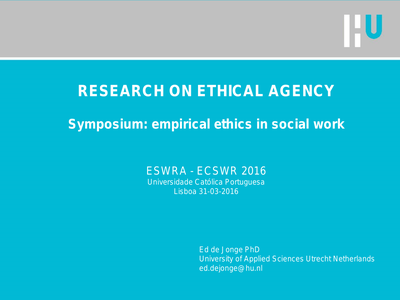
Symposium ESWRA - ECSWR 2016: empirical ethics in social work. Objective: ethical aspects of social work (esp. at home) Structure: cooperation of the research group of UAS Utrecht Netherlands with six regional welfare organizations Method: practice based ethics research Focus on professional practice: learning from moral experiences in frontline practice (cf. Van Doorn, 2008) Hybrid approach: combining theoretical resources and professional practice (cf. Banks & Gallagher, 2009) Mixed methods: desk research, interviews, best practice units (BPU), development of ethical tools
DOCUMENT
DOCUMENT
This article discusses the viability of a feminist constructivist approach of knowledge through the careful reading of the work of the feminist scholar and historian of science and technology, Donna Haraway. Haraway proposes an interpretation of objectivity in terms of "situated knowledges". Both the subject and the object of knowledge are endowed with the status of material-semiotic actors. By blurring the epistemological boundary between subject and object, Haraway's narratives about scientific discourse become populated with hybrid subjects/objects. The author argues that the ethics of these hybrid subjects consists of an uneasy mixture of a Nietzschean and a socialist-Christian ethic. The article concludes by setting out why Haraway's project constitutes an interesting effort to fuse postmodern insights and feminist commitments.
DOCUMENT

Social workers nowadays are confronted with recurrent issues about religion and spirituality when in contact with diverse client groups. This was also the case in the beginning of the profession around 1900, in Europe as well as in the US. This study analyses the work of a Dutch pioneer in social work, Marie Muller-Lulofs (1854–1954) and presents the religious and worldview aspects of her reflections on social work. Her standard work Van mensch tot mensch (From person to person) of 1916 forms the basic text for theory-driven content analysis by applying the seven-dimension model of worldview of Ninian Smart: doctrine/philosophy, organisations, ethics, stories, experiences, rituals and materials. Results show that Muller-Lulofs makes a strong plea for a secular profession. Social-economic approaches are on the foreground. And yet, the methods, skills and professional attitudes she describes are substantially accounted for in religious and spiritual terms. This is mainly done by introducing narratives and metaphors derived from Christian and Buddhist traditions. It is concluded that Muller-Lulofs uses religion and spirituality in a non-dogmatic and non-prescriptive way, but as a source of inspiration to underpin the new profession. Her approach is relevant for current issues in social work in multicultural societies.
LINK
To understand under what conditions intercultural group work (IGW) leads to more intercultural interactions, a survey was conducted among local students (n = 80) and international students (n = 153) in Dutch universities. In this study, students were more inclined to engage in intercultural interactions when they perceived that working with culturally diverse others prepared them to work and live in a diverse setting. The positive association was strengthened when students perceived that diversity, in terms of nationality within their work group, was also beneficial for accomplishing their group task. The findings demonstrate the significance of students’ perceptions of IGW, including the perceived general value for personal development and intellectual benefits related to specific tasks. This implies that institutions and teachers could be made responsible for engaging with innovative educational methods to address and incorporate student diversity into curriculum.
MULTIFILE

During the first half of 2020, the outbreak of the COVID-19 virus had a huge global impact. The physical health of many was (often severely) threatened and affected, resulting in numerous deaths. Furthermore, all aspects of human coexistence came under pressure, such as economic activities and material living conditions, psychological well-being and social contacts, human rights and democratic decision-making, international political relations and global solidarity. As in other parts of the world, COVID-19 kept the Netherlands in its grip.In this article we would like to address the following questions:-What impact did pandemic and policy have on Dutch social work education and how was this experienced by students?-What was the impact of pandemic and policy on social work practices and what were its challenges for social professionals?-What does this all mean for the future of social work education, since it has to take the present concerns of students into account as well as prepare them for social work practice in the near future?
DOCUMENT

Generation Z (Gen Z) will account for a growing proportion of the global workforce in the coming years. Therefore, it is vitally important to understand this generation’s unique perspectives and preferences regarding work. This exploratory study examines the prioritisation and desirability of Gen Z work values according to respondents’ nationality. Data for this study was collected through a survey among 1188 undergraduate students enrolled in one university each in China, Germany, the Netherlands and Thailand. ANOVA test and Tukey post-hoc analysis were used to find out the difference between the groups based on nationality. Findings indicate nationality serves as a key differentiator in work value preferences. The findings challenge the concept of a global Generation Z as only two of the measured values, learning and visible results, were found to have universal appeal across the nationality groups. Despite increased levels of global interconnectedness and accompanying crossvergence of values, the results show significant statistical differences in work values based on the respondents’ nationality. Due to the scope and explorative design of the present study, it cannot be certain that the findings are exclusively from Gen Z characteristics or influenced by other, non-cultural, variables. This study suggests there is a need for study programmes at a tertiary level to embed experiential learning components and individual study pathways in their curricula to enable students to develop realistic expectations about the workplace and their place in it. In turn, these programmes will be able to develop a competitive advantage in HE landscape. The insights gained can be leveraged by internationally oriented study programmes, such as International Business (IB), to better address Gen Z needs and expectations.
MULTIFILE

Artificial intelligence-driven technology increasingly shapes work practices and, accordingly, employees’ opportunities for meaningful work (MW). In our paper, we identify five dimensions of MW: pursuing a purpose, social relationships, exercising skills and self-development, autonomy, self-esteem and recognition. Because MW is an important good, lacking opportunities for MW is a serious disadvantage. Therefore, we need to know to what extent employers have a duty to provide this good to their employees. We hold that employers have a duty of beneficence to design for opportunities for MW when implementing AI-technology in the workplace. We argue that this duty of beneficence is supported by the three major ethical theories, namely, Kantian ethics, consequentialism, and virtue ethics. We defend this duty against two objections, including the view that it is incompatible with the shareholder theory of the firm. We then employ the five dimensions of MW as our analytical lens to investigate how AI-based technological innovation in logistic warehouses has an impact, both positively and negatively, on MW, and illustrate that design for MW is feasible. We further support this practical feasibility with the help of insights from organizational psychology. We end by discussing how AI-based technology has an impact both on meaningful work (often seen as an aspirational goal) and decent work (generally seen as a matter of justice). Accordingly, ethical reflection on meaningful and decent work should become more integrated to do justice to how AI-technology inevitably shapes both simultaneously.
DOCUMENT