This study will examine whether voluntary work or an internship in a developing country contributes to the development of global citizenship among young people. For the purpose of this study, global citizenship will be defined as a combination of social awareness and possessing international competencies. For a period of four years, a group of 1000 participants between 14 and 25 years old was followed using online self-administered surveys, surveys conducted within the social environment and a smaller number of in-depth interviews. Data collection took place prior to an internship or voluntary work in a developing country, following their return, and six months after their return. Almost all of the international competencies that according to prior research are required to be able to function effectively when communicating with people from a different cultural background were found to have increased during their their stay abroad. Only reading and writing skills in the local language of the area were shown not to have improved. The greatest amount of improvement occurred in the area of intercultural competencies, namely attitude, knowledge, behaviour and skills. Following their stay abroad, the personal and social competencies of participants were also shown to have increased. Relatively speaking, their international professional and academic skills improved the least. Despite this, following the return from voluntary work or an internship in a developing country, a larger number of participants were shown to be exhibiting a socially responsible attitude with an understanding of interdependence, equality of all people and a shared responsibility for solving global issues, and expressed this more frequently in their behaviour. In addition, an increase in flexibility, cultural empathy, social initiative and emotional stability among participants was observed. What essentially characterises the participants according to the in-depth interviews is the ability they have developed to look through someone else’s eyes at their own culture and living conditions in the Netherlands and to use their improved self-confidence to live a more socially aware life and/or engage in international activities after their return from abroad.
DOCUMENT

Higher education is tasked with preparing students for a culturally diverse and globalizing world. Additionally, western nations have an increasingly diverse student population and know the success of their students will depend in part on being able to navigate diversity. There is therefore good reason for institutions of higher learning to promote and facilitate the development of ‘global citizens’ – people who can work and relate across borders and boundaries, both real and perceived. However, teachers are not necessarily equipped to foster this learning. Many teachers are used to a reproductive way of teaching while the learning that is needed here is identity learning, directed at dialogue, internally as well as externally. This chapter proposes the potential of creative, expressive and reflective writing as a way in which personal development – a form of a reflexive internal dialogue – can be fostered to promote cultural healing and global citizenship. The writing method will be described and a case study on cultural healing in the context of Canada’s reconciliation efforts with Aboriginal people will be used to illustrate the learning process involved. The processes of writing the self and re-narrating identity has several promising benefits for both students and teachers in higher education. First it allows us to learn more about ourselves and what blocks our learning (i.e. promotes self-reflection). Second, it allows us to change our story and our identifications and therefore choose differently (i.e. self-direction). Third, it is a companion on the road of life where we literally learn to talk and listen to ourselves and articulate the tacit knowledge that can be unearthed through narrative, journal, and poetic writing. Fourth, the method is playful and creative and although tears are frequently shed in the process, students report a great enjoyment in writing and sharing their stories with others. It is a meaningful dialogue about experience and also has the potential of promoting cultural (Lengelle, Jardine, & Bonnar, 2018) healing in the context of a very diverse student body (Banks, 2015). It also has the potential for creating new bonds in the classroom and allows teachers in higher education to engage in the difficult work of facilitating global citizenship learning. The internal dialogue described here also allows us to ‘clean up’ judgements and become aware of the need to reach out to others. Not only the actual sharing of vulnerable writing in a class or online setting shows us we are not alone, but ‘writing the self’ focuses deliberately on where we have become fearful about our own and others’ identities and allows us a learning process to unearth those things, heal them in order to reach out to others.
DOCUMENT

The internationalization of higher education has been driven by an increasingly globalized and interconnected world. One concept that embodies this internationalization process is global citizenship, which can be promoted through student mobility, internationalization-at-home, or other forms of intercultural learning. While global citizenship remains a broad and highly contested term, the increased interest of its role in higher education has inspired research in different fields. The aim of this paper is to provide a review of existing research approaches to studying global citizenship, and to formulate future research directions that may integrate these approaches into a holistic framework. By reviewing literature from different fields in the social sciences, we have identified three main research approaches: intercultural competence, social identification with a global community, and civic engagement. While each approach reflects an important dimension of global citizenship, they remain separate in the literature, complicating the understanding and application of global citizenship in higher education. Therefore, for each approach we present a general conceptualization and a brief overview of prior findings. We discuss how integrating these approaches can lead to a more holistic understanding of global citizenship and guide future avenues for research and practice in higher education.
DOCUMENT

This article reflects on the workshop Bridging the KAP-gap in global education, which was part of the DEEEP-conference Global Justice through Global Citizenship. The objective of the workshop was, to learn about strategies to bridge the KAP (Knowledge, Attitude, Practice) -gap and to gain ideas how to apply these strategies to participants’ own practices. The workshop turned into a slightly different direction and raised some fundamental questions: What could one expect of global education? Which others factors influence learners’ behaviour? To which manner does global education aim to change behaviour? Should global education aim to change behaviour? This article summarizes the outcomes of an evaluation which was done amongst alumni-students of the minor programme Global Development Issues of Fontys University of Applied Sciences and the main issues that were discussed during the workshop, also based on the integrated model of behavioural prediction. The article ends with some lessons learned, especially for the curriculumowners of the minor programme, who organised this workshop.
MULTIFILE

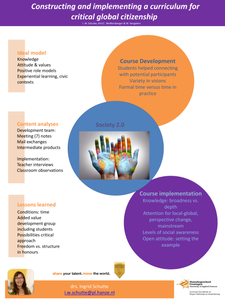
Poster presentation at Hanze Research Day 26 January 2016The poster presents a case study on the development and implementation of an undergraduate honours course for critical global citizenship, Society 2.0, in the Netherlands. Two teachers, two students and a researcher developed this course using a theory-based model as guideline. The course was delivered in 2014 and 2015. The aim of the research is to provide insights in the building and implementing of a critical global citizenship course.
DOCUMENT
This paper aims to explain the influence of facility design on urban quality of life from an educational perspective. The outcome of this paper is to determine the influence of facility management (FM) on the quality of life of citizens in the city of The Hague by actively using a facility design to positively influence the livability.
DOCUMENT
Abstract: In this article I will reconstruct the Dutch debate on citizenship against the developing thinking about social citizenship in the context of globalization. I will show that the confusion around citizenship in the Netherlands can be seen as a result from a split between an unanimous negative valuation of Dutch citizen participation and the practice in which the participation of Dutch population is high. Recent theory on citizenship and participation localizes citizen participation, through membership, in the heart of citizenship practices (B.S. Turner). This can be understood as that all kinds of practices and activities can be viewed as citizenship practices and citizenship activities. From this perspective it becomes clear that in the Netherlands, due to the nation-state conceptualisation of citizenship social participation is not acknowledged as part of citizenship. In reverse, the case study learns about the theory of citizenship in practices that that theory functions as a framework that visualises different - sometimes conflicting - notions and practices of citizenship and thereby recognises all these as part of citizenship.
DOCUMENT
Using a mixed method approach, this case study investigates effects on the participating students () of an undergraduate honors course in the Netherlands, aimed at global justice citizenship. Knowledge about effects of global citizenship courses is still limited. The Ethical Sensitivity Scale Questionnaire and the Global Citizenship Scale were used in a pre- and posttest design to measure possible development in the moral and civic domain among the participants of the course. In the qualitative part, deductive content analyses of students’ work and students’ written reflection on the course, utilizing the theory-based curriculum guidelines Global Justice Citizenship Education, were performed. In addition, a follow-up blog and interview were analyzed to learn students’ perception on the effects of the course after half a year. Quantitative results show increased ethical sensitivity as well as global civic engagement and global competence among the participants. Qualitative results point in the same direction and provide deeper insights in the content of students’ learning and the perceived impact of the course on their attitudes and behavior. Results are discussed in relation to theory on justice-oriented global citizenship and honors pedagogies.
LINK
In this chapter, we propose that the democracy we wish to see out in the world is influenced by the quality of our own “inner democracies”—that is: the quality of the democracies among and between the selves or voices in the landscape of the self. We must find ways out of the I-prisons we experience and perpetuate. With this in mind, we propose that ”writing the self,” a method whereby creative, expressive, and reflective writing is used to cultivate an internal dialogue and construct a new identity narrative (Lengelle, 2014), can assist in reshaping our stories about ”the Other and ourselves” and can contribute to personal and cultural healing and reconciliation. The inner dialogue reconciled is foundational for the external dialogue at the heart of global citizenship within education. Indeed, as Schellhammer argues, we must cultivate the self in order to become inter-culturally competent, and this includes facing shadow aspects through truthful dialogues with the self and caring for the self. https://doi.org/10.1007/978-3-319-62861-5_6 LinkedIn: https://www.linkedin.com/in/reinekke-lengelle-phd-767a4322/
MULTIFILE

How can undergraduate students be prepared for global citizenship? This question was investigated in a mixed-methods case study of an international, blended one-semester course. Undergraduate honors students (N = 22) from the USA and the Netherlands collaborated to explore what it means to be a member of the global community. Curriculum guidelines from the social justice oriented education for global citizenship were used to analyze the course’s program and focus the case study. The research questions were as follows: 1. How did the course relate to the curriculum guidelines? 2. What and how did students learn from the course? Analyses of the program showed that the course partly reflects the social justice oriented global citizenship education, in particular by addressing intercultural sensitivity and experiential learning. Quantitative measures in a pre-post design with control groups (N = 40) showed some growth in ethical sensitivity and social awareness. Qualitative measures indicated that participants developed a broader view on society and demonstrated a more open and active attitude towards others after the course. Experiential learning was considered a powerful aspect of the pedagogical approach. The results are discussed in relation to a developmental process whereby students gain awareness of global justice issues. © 2018 by the authors. Licensee MDPI, Basel, Switzerland.
MULTIFILE




